Get your free personalized podcast brief
We scan new podcasts and send you the top 5 insights daily.
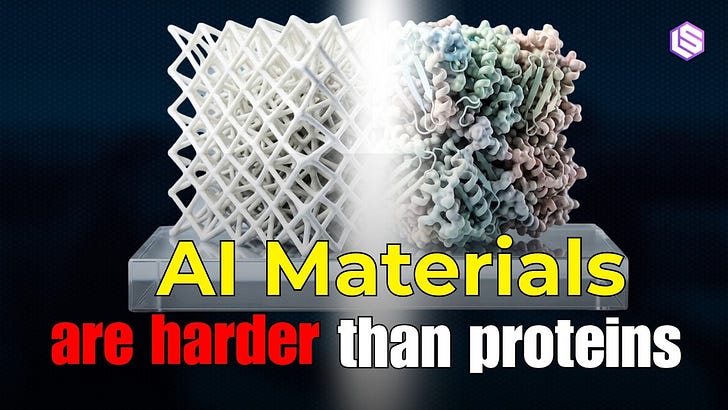
Unlike biology's SMILES strings, materials science variables like microstructure, processing methods, and supply chain cannot be captured in a simple text format. This makes universal, one-shot AI models impractical for materials discovery.
Related Insights
Unlike language models trained on the internet, AI for materials science overcomes data scarcity and unreliability (e.g., conflicting literature) with a closed loop. The system actively directs experiments, analyzes grounded results for patterns, and uses that new data to drive the next cycle.

The traditional scientific method in materials science—hypothesize, experiment, learn—is being replaced. AI enables a new paradigm: treating the vast space of all possible molecules as a searchable database. Scientists can now query for materials with desired properties, radically accelerating discovery.

Google DeepMind's AI has expanded the catalog of known stable crystals from 40,000 to over 400,000. These AI-predicted materials are now being lab-tested and could lead to breakthroughs in physics-limited industries by enabling technologies like better electric vehicle batteries and superconductors.

Unlike protein folding, which benefited from the CASP competition's experimental ground truth data, materials science lacks large-scale, high-quality experimental datasets. Existing data often comes from low-fidelity simulations, meaning even the best AI models are trained on imperfect information, hindering a major breakthrough.
Early AI models advanced by scraping web text and code. The next revolution, especially in "AI for science," requires overcoming a major hurdle: consolidating and formatting the world's vast but fragmented scientific data across disciplines like chemistry and materials science for model training.

Unlike many AI fields obsessed with compute, the primary bottleneck in materials discovery is the speed and cost of running physical experiments. Progress depends on experimental throughput, not just bigger models or more GPUs.
Despite significant hype, new "foundation models" for materials science may not be ready to replace traditional physics-based methods. In practice, one prominent model was only five times faster than existing GPU-accelerated calculations and proved unreliable, with molecules nonsensically falling apart, highlighting the need for more rigorous evaluation.
The internet is an insufficient training ground for scientific AI because most crucial information—including failed experiments, negative data, and nuanced procedural details—is never published. This undocumented knowledge, what scientists call "good hands," represents a major data bottleneck for building truly intelligent scientific models.

While LLMs possess vast 'Wikipedia-level' chemical knowledge, they struggle with specific, constrained tasks that expert chemists find trivial, such as designing a molecule with an exact number of atoms. This highlights a critical gap between general knowledge and applied, creative design in AI.
AI models can screen vast material spaces to identify novel solutions that defy conventional chemical intuition. Heather Kulik's group used AI to discover a quantum mechanical phenomenon that made a polymer four times tougher, a design experimentalists admitted they would never have conceived on their own.