Get your free personalized podcast brief
We scan new podcasts and send you the top 5 insights daily.
Unlike language models trained on the internet, AI for materials science overcomes data scarcity and unreliability (e.g., conflicting literature) with a closed loop. The system actively directs experiments, analyzes grounded results for patterns, and uses that new data to drive the next cycle.

Related Insights
The traditional scientific method in materials science—hypothesize, experiment, learn—is being replaced. AI enables a new paradigm: treating the vast space of all possible molecules as a searchable database. Scientists can now query for materials with desired properties, radically accelerating discovery.

Foundation models can't be trained for physics using existing literature because the data is too noisy and lacks published negative results. A physical lab is needed to generate clean data and capture the learning signal from failed experiments, which is a core thesis for Periodic Labs.

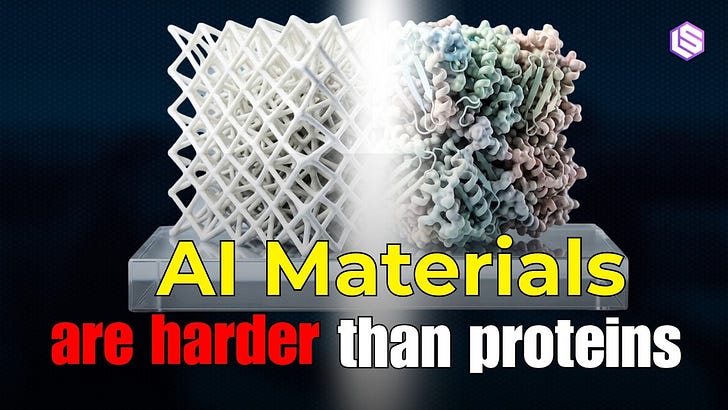
Unlike protein folding, which benefited from the CASP competition's experimental ground truth data, materials science lacks large-scale, high-quality experimental datasets. Existing data often comes from low-fidelity simulations, meaning even the best AI models are trained on imperfect information, hindering a major breakthrough.
To make genuine scientific breakthroughs, an AI needs to learn the abstract reasoning strategies and mental models of expert scientists. This involves teaching it higher-level concepts, such as thinking in terms of symmetries, a core principle in physics that current models lack.
AI models are trained on large lab-generated datasets. The models then simulate biology and make predictions, which are validated back in the lab. This feedback loop accelerates discovery by replacing random experimental "walks" with a more direct computational route, making research faster and more efficient.

To ensure scientific validity and mitigate the risk of AI hallucinations, a hybrid approach is most effective. By combining AI's pattern-matching capabilities with traditional physics-based simulation methods, researchers can create a feedback loop where one system validates the other, increasing confidence in the final results.

The ultimate goal isn't just modeling specific systems (like protein folding), but automating the entire scientific method. This involves AI generating hypotheses, choosing experiments, analyzing results, and updating a 'world model' of a domain, creating a continuous loop of discovery.

Experiments are not just for validation; they are a form of computation. By treating nature as a 'Physics Processing Unit' (PPU) working alongside digital GPUs, we can integrate physical experimentation directly into the computational loop, creating a powerful hybrid system for materials discovery.
Instead of relying on digital proxies like code graders, Periodic Labs uses real-world lab experiments as the ultimate reward function. Nature itself becomes the reinforcement learning environment, ensuring the AI is optimized against physical reality, not flawed simulations.
Current LLMs fail at science because they lack the ability to iterate. True scientific inquiry is a loop: form a hypothesis, conduct an experiment, analyze the result (even if incorrect), and refine. AI needs this same iterative capability with the real world to make genuine discoveries.