Get your free personalized podcast brief
We scan new podcasts and send you the top 5 insights daily.
AI models can screen vast material spaces to identify novel solutions that defy conventional chemical intuition. Heather Kulik's group used AI to discover a quantum mechanical phenomenon that made a polymer four times tougher, a design experimentalists admitted they would never have conceived on their own.
Related Insights
The traditional scientific method in materials science—hypothesize, experiment, learn—is being replaced. AI enables a new paradigm: treating the vast space of all possible molecules as a searchable database. Scientists can now query for materials with desired properties, radically accelerating discovery.

Google DeepMind's AI has expanded the catalog of known stable crystals from 40,000 to over 400,000. These AI-predicted materials are now being lab-tested and could lead to breakthroughs in physics-limited industries by enabling technologies like better electric vehicle batteries and superconductors.

AI's true power in science isn't autonomous discovery, but process compression. It acts as an expert guide, allowing motivated individuals to navigate complex fields like drug discovery and assemble workflows that once required multiple specialized teams, blurring the line between professional research and individual effort.

In a direct comparison, a medicinal chemist was better than an AI model at evaluating the synthesizability of 30,000 compounds. The chemist's intuitive, "liability-spotting" approach highlights the continued value of expert human judgment and the need for human-in-the-loop AI systems.

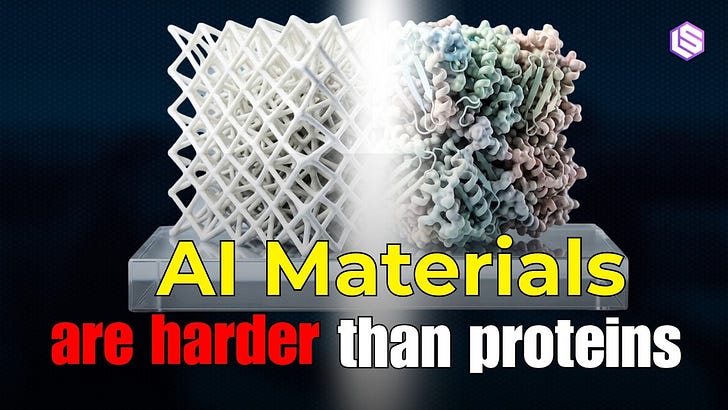
Unlike protein folding, which benefited from the CASP competition's experimental ground truth data, materials science lacks large-scale, high-quality experimental datasets. Existing data often comes from low-fidelity simulations, meaning even the best AI models are trained on imperfect information, hindering a major breakthrough.
AlphaFold's success in identifying a key protein for human fertilization (out of 2,000 possibilities) showcases AI's power. It acts as a hypothesis generator, dramatically reducing the search space for expensive and time-consuming real-world experiments.

An AI model analyzing drug delivery peptides discovered that adding a flexible amino acid before the active end group significantly improved cell entry. This was not a commonplace understanding in the field. Initially questioned by chemists, the insight was experimentally validated, showing how AI can augment human expertise by revealing novel scientific mechanisms.

Rather than just replacing physics-based models, AI can be used to select the *correct* physics model. Heather Kulik's team uses the quantum wave function itself as an input to a neural network to predict which quantum mechanical approximation will be most accurate for a specific material, a complex task that defies simple heuristics.
Experiments are not just for validation; they are a form of computation. By treating nature as a 'Physics Processing Unit' (PPU) working alongside digital GPUs, we can integrate physical experimentation directly into the computational loop, creating a powerful hybrid system for materials discovery.
The primary impact of quantum computing won't just be faster calculations. It will be its ability to generate entirely new insights into complex systems like molecules—knowledge that is currently out of reach. This new data can then be fed into AI models, creating a powerful synergistic loop of discovery.
