Get your free personalized podcast brief
We scan new podcasts and send you the top 5 insights daily.
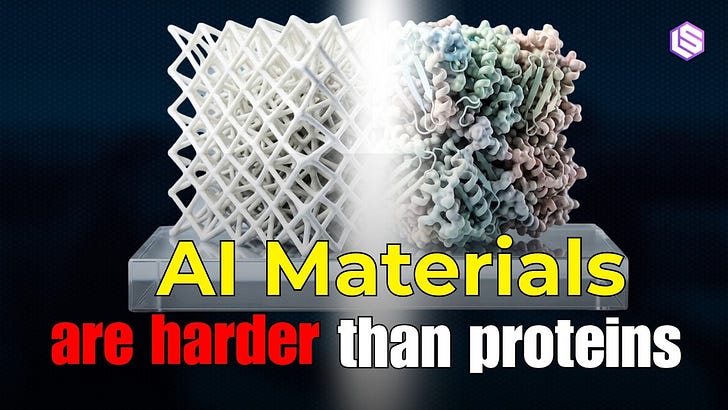
Rather than just replacing physics-based models, AI can be used to select the *correct* physics model. Heather Kulik's team uses the quantum wave function itself as an input to a neural network to predict which quantum mechanical approximation will be most accurate for a specific material, a complex task that defies simple heuristics.
Related Insights
The traditional scientific method in materials science—hypothesize, experiment, learn—is being replaced. AI enables a new paradigm: treating the vast space of all possible molecules as a searchable database. Scientists can now query for materials with desired properties, radically accelerating discovery.

Startups and major labs are focusing on "world models," which simulate physical reality, cause, and effect. This is seen as the necessary step beyond text-based LLMs to create agents that can truly understand and interact with the physical world, a key step towards AGI.
Google DeepMind's AI has expanded the catalog of known stable crystals from 40,000 to over 400,000. These AI-predicted materials are now being lab-tested and could lead to breakthroughs in physics-limited industries by enabling technologies like better electric vehicle batteries and superconductors.

To make genuine scientific breakthroughs, an AI needs to learn the abstract reasoning strategies and mental models of expert scientists. This involves teaching it higher-level concepts, such as thinking in terms of symmetries, a core principle in physics that current models lack.

A deep, non-obvious connection exists between generative AI (diffusion models, RL) and the physics of non-equilibrium systems. Prof. Max Welling notes their mathematical foundations are the same. This allows AI researchers to borrow theorems from physics and physicists to use AI models, fueling cross-disciplinary innovation.
AI is developing spatial reasoning that approaches human levels. This will enable it to solve novel physics problems, leading to breakthroughs that create entirely new classes of technology, much like discoveries in the 1940s led to GPS and cell phones.

Contrary to the idea that AI will make physical experiments obsolete, its real power is predictive. AI can virtually iterate through many potential experiments to identify which ones are most likely to succeed, thus optimizing resource allocation and drastically reducing failure rates in the lab.

A symbiotic relationship exists between AI and quantum computing, where AI is used to significantly speed up the optimization and calibration of quantum machines. By automating solutions to the critical 'noise' and error-rate problems, AI is shortening the development timeline for achieving stable, powerful quantum computers.

The primary impact of quantum computing won't just be faster calculations. It will be its ability to generate entirely new insights into complex systems like molecules—knowledge that is currently out of reach. This new data can then be fed into AI models, creating a powerful synergistic loop of discovery.

AI models can screen vast material spaces to identify novel solutions that defy conventional chemical intuition. Heather Kulik's group used AI to discover a quantum mechanical phenomenon that made a polymer four times tougher, a design experimentalists admitted they would never have conceived on their own.