Get your free personalized podcast brief
We scan new podcasts and send you the top 5 insights daily.
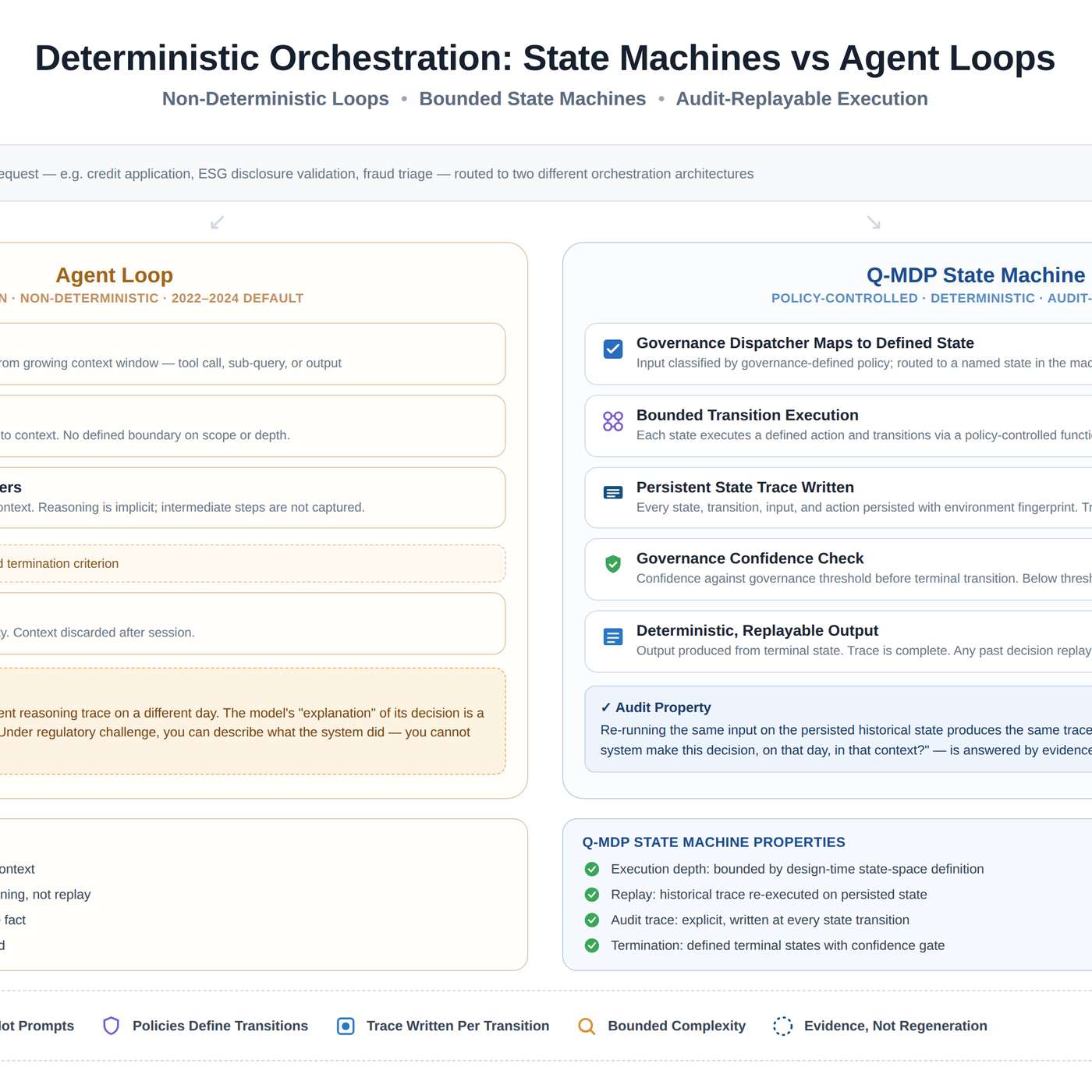
Shift from letting an LLM manage its own execution loop to a design where a deterministic orchestrator controls the flow. The LLM's role becomes a stateless node that simply processes input or selects from a predefined list of valid next steps.

Related Insights
Fully autonomous agents are not yet reliable for complex production use cases because accuracy collapses when chaining multiple probabilistic steps. Zapier's CEO recommends a hybrid "agentic workflow" approach: embed a single, decisive agent within an otherwise deterministic, structured workflow to ensure reliability while still leveraging LLM intelligence.

Don't give LLMs full control. Use deterministic code for core logic, validation, and enforcing rules. Delegate only tasks requiring flexibility or understanding of unstructured input to the LLM, treating it as a specialized component, not the entire system.
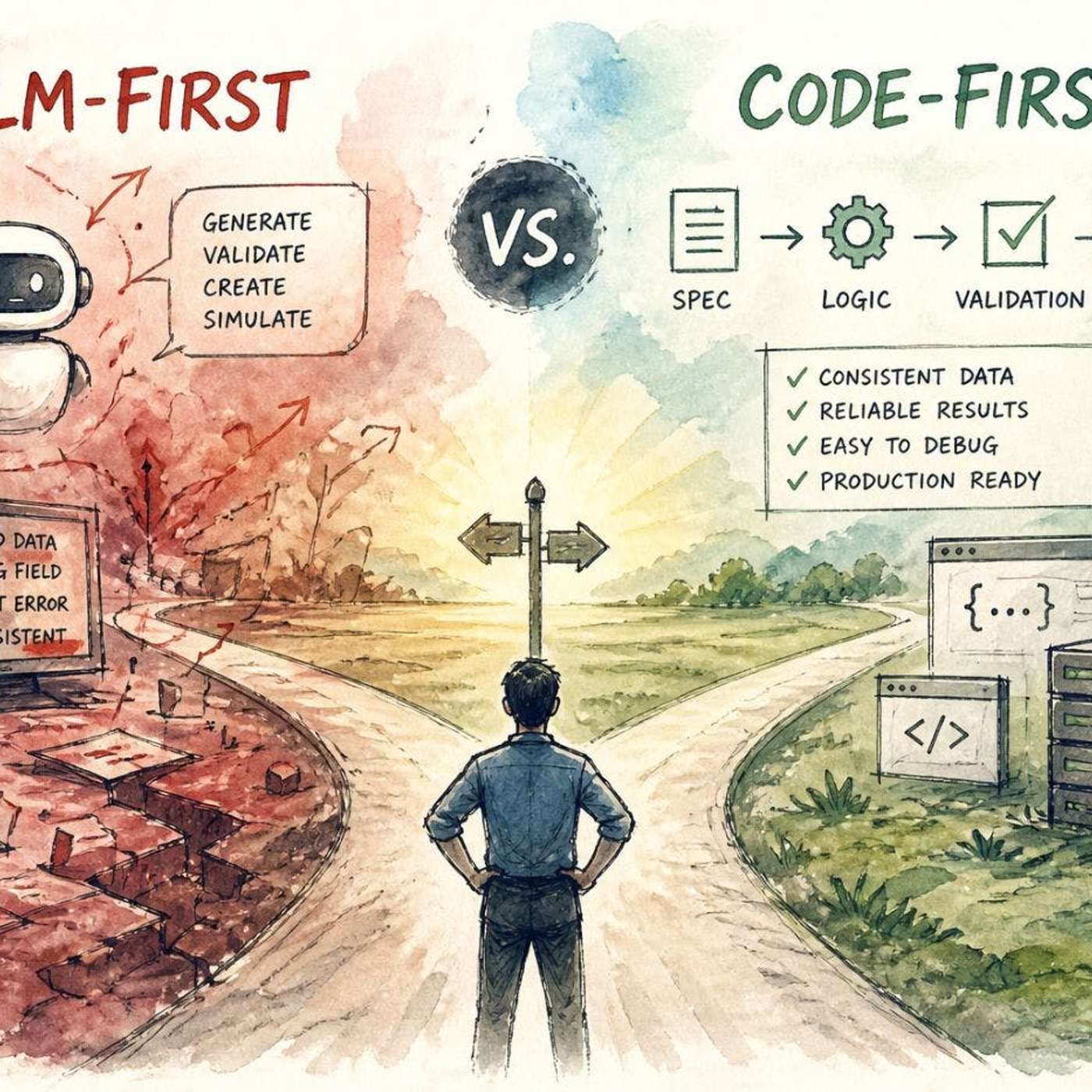
A new academic framework, ArbiterK, challenges the standard model of an LLM acting as the central controller. It inverts the paradigm by embedding the LLM within a deterministic execution system, demoting it to a suggestion engine. This ensures the system, not the probabilistic LLM, retains final control and enforces rules.

The true building block of an AI feature is the "agent"—a combination of the model, system prompts, tool descriptions, and feedback loops. Swapping an LLM is not a simple drop-in replacement; it breaks the agent's behavior and requires re-engineering the entire system around it.

Tools like LangGraph support state machine patterns, but don't guarantee them. The critical shift is an engineering discipline where orchestration logic is explicitly designed and bounded by developers, rather than being improvised by the LLM at runtime.
General-purpose AI assistants produce inconsistent output. Instead, define AI agents with specific roles, boundaries, and quality gates, much like onboarding a new engineer with a clear job description. This disciplined approach leverages how LLMs are trained, leading to more reliable and predictable results within the SDLC.
The LAM is not a model in the traditional sense, but an agent system. It uses the best available LLMs for language understanding and connects them to Rabbit's proprietary tech for controlling actions, allowing for modular upgrades of the underlying AI.

Jerry Murdock predicts agents will use an orchestration layer to triage tasks, selecting the best LLM for each job—like expensive Claude for reasoning and cheap open-source models for simple tasks. This shifts value from the models themselves to the agent's intelligent orchestration capabilities.

Purely probabilistic LLMs are unreliable for critical business processes. GetVocal's architecture uses a deterministic "context graph" based on user intentions as the core decision-making engine. This provides traceability and reliability, while selectively calling generative models for conversational nuance.

As AI models execute tasks via function calling, their internal state is insufficient for reliable, repeatable business outcomes. They must integrate with external systems (like BPMS) to become predictable "runtimes," ensuring consistent results despite prompt failures or hallucinations.