Get your free personalized podcast brief
We scan new podcasts and send you the top 5 insights daily.
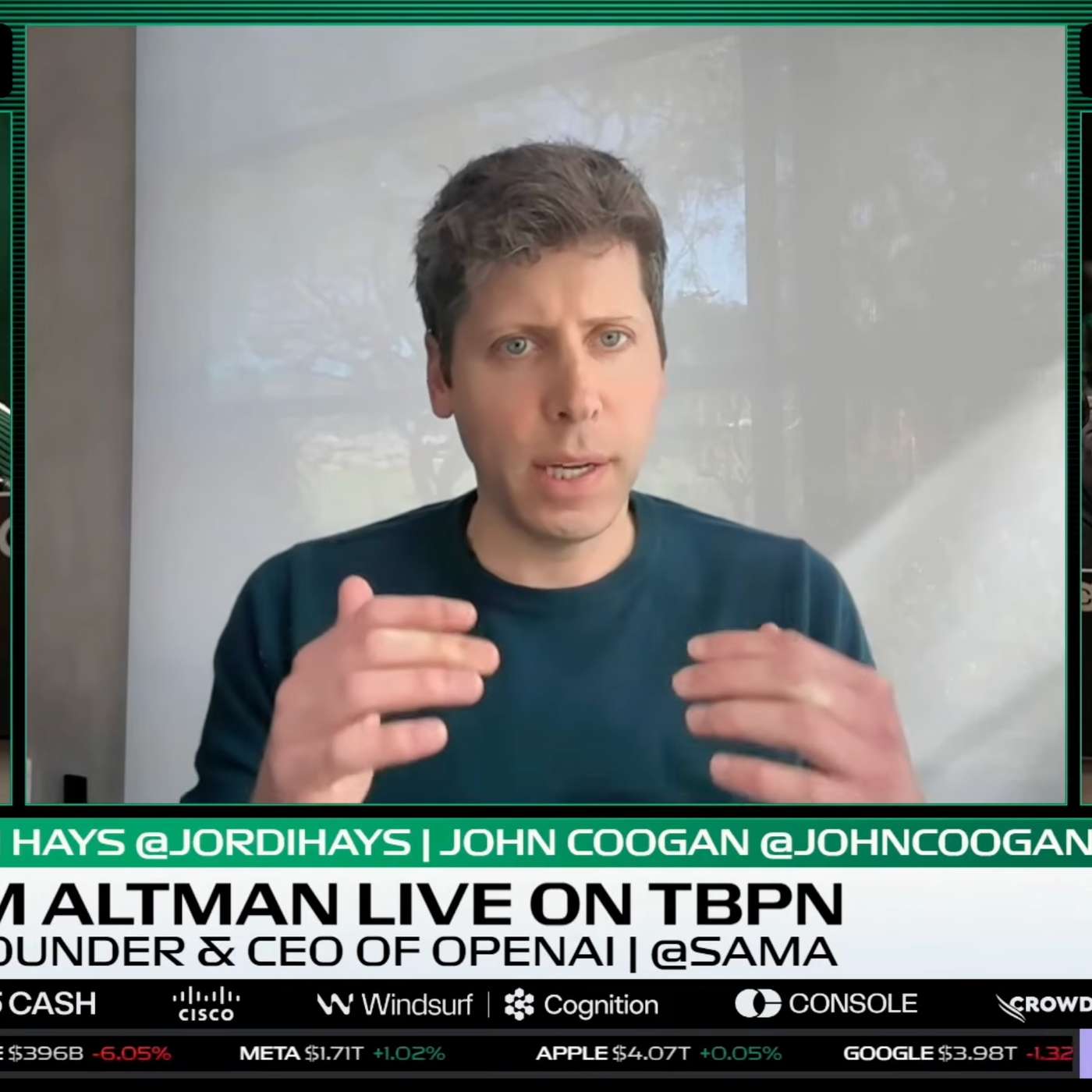
Sam Altman highlights that allowing users to correct an AI model while it's working on a long task is a crucial new capability. This is analogous to correcting a coworker in real-time, preventing wasted effort and enabling more sophisticated outcomes than 'one-shot' generation.
Related Insights
Users who treat AI as a collaborator—debating with it, challenging its outputs, and engaging in back-and-forth dialogue—see superior outcomes. This mindset shift produces not just efficiency gains, but also higher quality, more innovative results compared to simply delegating discrete tasks to the AI.
Instead of waiting for AI models to be perfect, design your application from the start to allow for human correction. This pragmatic approach acknowledges AI's inherent uncertainty and allows you to deliver value sooner by leveraging human oversight to handle edge cases.

The core of an effective AI data flywheel is a process that captures human corrections not as simple fixes, but as perfectly formatted training examples. This structured data, containing the original input, the AI's error, and the human's ground truth, becomes a portable, fine-tuning-ready asset that directly improves the next model iteration.
To avoid confusing agents with contradictory goals, Tasklet plans to shift from pre-generated, static instructions to dynamically generating them just-in-time for each task run. This ensures the agent always operates on the most current user feedback, preventing errors from conflicting historical directives.

Unlike previous models that frequently failed, Opus 4.5 allows for a fluid, uninterrupted coding process. The AI can build complex applications from a simple prompt and autonomously fix its own errors, representing a significant leap in capability and reliability for developers.

Sam Altman argues there is a massive "capability overhang" where models are far more powerful than current tools allow users to leverage. He believes the biggest gains will come from improving user interfaces and workflows, not just from increasing raw AI intelligence.
While correcting AI outputs in batches is a powerful start, the next frontier is creating interactive AI pipelines. These advanced systems can recognize when they lack confidence, intelligently pause, and request human input in real-time. This transforms the human's role from a post-process reviewer to an active, on-demand collaborator.
Sam Altman describes his ideal product: a to-do list where adding a task triggers an AI agent to attempt completion. This model—where the AI proactively works, asks for clarification, and integrates with manual effort—represents a profound shift in productivity software.
AI development has evolved to where models can be directed using human-like language. Instead of complex prompt engineering or fine-tuning, developers can provide instructions, documentation, and context in plain English to guide the AI's behavior, democratizing access to sophisticated outcomes.

Advanced models are moving beyond simple prompt-response cycles. New interfaces, like in OpenAI's shopping model, allow users to interrupt the model's reasoning process (its "chain of thought") to provide real-time corrections, representing a powerful new way for humans to collaborate with AI agents.
![[State of Post-Training] From GPT-4.1 to 5.1: RLVR, Agent & Token Efficiency — Josh McGrath, OpenAI thumbnail](https://assets.flightcast.com/V2Uploads/nvaja2542wefzb8rjg5f519m/01K4D8FB4MNA071BM5ZDSMH34N/square.jpg)