Get your free personalized podcast brief
We scan new podcasts and send you the top 5 insights daily.
To avoid confusing agents with contradictory goals, Tasklet plans to shift from pre-generated, static instructions to dynamically generating them just-in-time for each task run. This ensures the agent always operates on the most current user feedback, preventing errors from conflicting historical directives.

Related Insights
Before delegating a complex task, use a simple prompt to have a context-aware system generate a more detailed and effective prompt. This "prompt-for-a-prompt" workflow adds necessary detail and structure, significantly improving the agent's success rate and saving rework.

Treating AI evaluation like a final exam is a mistake. For critical enterprise systems, evaluations should be embedded at every step of an agent's workflow (e.g., after planning, before action). This is akin to unit testing in classic software development and is essential for building trustworthy, production-ready agents.
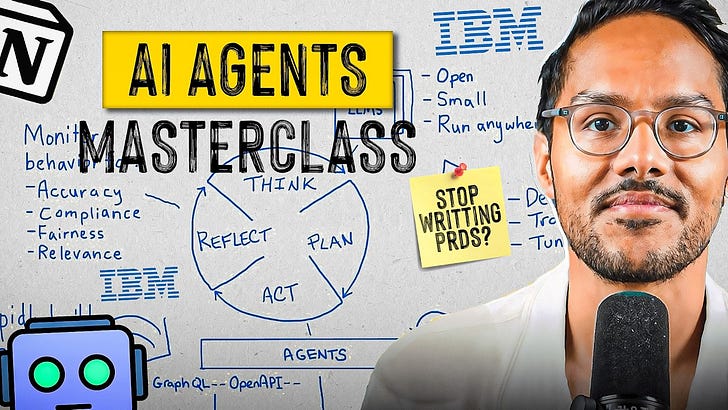
Frame AI agent development like training an intern. Initially, they need clear instructions, access to tools, and your specific systems. They won't be perfect at first, but with iterative feedback and training ('progress over perfection'), they can evolve to handle complex tasks autonomously.

When building Spiral, a single large language model trying to both interview the user and write content failed due to "context rot." The solution was a multi-agent system where an "interviewer" agent hands off the full context to a separate "writer" agent, improving performance and reliability.

Humans mistakenly believe they are giving AIs goals. In reality, they are providing a 'description of a goal' (e.g., a text prompt). The AI must then infer the actual goal from this lossy, ambiguous description. Many alignment failures are not malicious disobedience but simple incompetence at this critical inference step.

Tasklet's CEO argues that while traditional workflow automation seems safer, agentic systems that let the model plan and execute will ultimately prove more robust. They can handle unexpected errors and nuance that break rigid, pre-defined workflows, a bet on future model improvements.
Long, continuous AI chat threads degrade output quality as the context window fills up, making it harder for the model to recall early details. To maintain high-quality results, treat each discrete feature or task as a new chat, ensuring the agent has a clean, focused context for each job.

Contrary to the trend toward multi-agent systems, Tasklet finds that one powerful agent with access to all context and tools is superior for a single user's goals. Splitting tasks among specialized agents is less effective than giving one generalist agent all information, as foundation models are already experts at everything.
Borrowing from classic management theory, the most effective way to use AI agents is to fix problems at the earliest 'lowest value stage'. This means rigorously reviewing the agent's proposed plan *before* it writes any code, preventing costly rework later on.
To make agents useful over long periods, Tasklet engineers an "illusion" of infinite memory. Instead of feeding a long chat history, they use advanced context engineering: LLM-based compaction, scoping context for sub-agents, and having the LLM manage its own state in a SQL database to recall relevant information efficiently.