Get your free personalized podcast brief
We scan new podcasts and send you the top 5 insights daily.
Unlike previous models that frequently failed, Opus 4.5 allows for a fluid, uninterrupted coding process. The AI can build complex applications from a simple prompt and autonomously fix its own errors, representing a significant leap in capability and reliability for developers.

Related Insights
AI's impact on coding is unfolding in stages. Phase 1 was autocomplete (Copilot). We're now in Phase 2, defined by interactive agents where developers orchestrate tasks with prompts. Phase 3 will be true automation, where agents independently handle complete, albeit simpler, development workflows without direct human guidance.
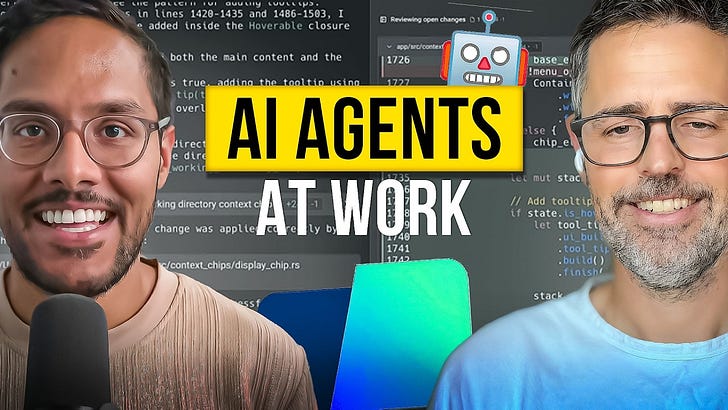
AI code editors can be tasked with high-level goals like "fix lint errors." The agent will then independently run necessary commands, interpret the output, apply code changes, and re-run the commands to verify the fix, all without direct human intervention or step-by-step instructions.

AI labs like Anthropic find that mid-tier models can be trained with reinforcement learning to outperform their largest, most expensive models in just a few months, accelerating the pace of capability improvements.
Many AI projects fail to reach production because of reliability issues. The vision for continual learning is to deploy agents that are 'good enough,' then use RL to correct behavior based on real-world errors, much like training a human. This solves the final-mile reliability problem and could unlock a vast market.

Earlier AI models would praise any writing given to them. A breakthrough occurred when the Spiral team found Claude 4 Opus could reliably judge writing quality, even its own. This capability enables building AI products with built-in feedback loops for self-improvement and developing taste.
To maximize an AI agent's effectiveness, establish foundational software engineering practices like typed languages, linters, and tests. These tools provide the necessary context and feedback loops for the AI to identify, understand, and correct its own mistakes, making it more resilient.
A key strategy for labs like Anthropic is automating AI research itself. By building models that can perform the tasks of AI researchers, they aim to create a feedback loop that dramatically accelerates the pace of innovation.
The recent leap in AI coding isn't solely from a more powerful base model. The true innovation is a product layer that enables agent-like behavior: the system constantly evaluates and refines its own output, leading to far more complex and complete results than the LLM could achieve alone.
The primary obstacle to creating a fully autonomous AI software engineer isn't just model intelligence but "controlling entropy." This refers to the challenge of preventing the compounding accumulation of small, 1% errors that eventually derail a complex, multi-step task and get the agent irretrievably off track.
The new Spiral app, with its complex UI and multiple features, was built almost entirely by one person. This was made possible by leveraging AI coding agents like Droid and Claude, which dramatically accelerates the development process from idea to a beautiful, functional product.