Get your free personalized podcast brief
We scan new podcasts and send you the top 5 insights daily.
Google's rumored "Gemini 3.2 Flash" model suggests a strategy focused on cost-efficiency rather than chasing state-of-the-art benchmarks. By offering near-frontier performance at a 15-20x lower inference cost, Google can capture a huge segment of the enterprise market focused on practical, scalable implementation.

Related Insights
The primary threat from competitors like Google may not be a superior model, but a more cost-efficient one. Google's Gemini 3 Flash offers "frontier-level intelligence" at a fraction of the cost. This shifts the competitive battleground from pure performance to price-performance, potentially undermining business models built on expensive, large-scale compute.

While competitors pay Nvidia's ~80% gross margins for GPUs, Google's custom TPUs have an estimated ~50% margin. In the AI era, where the cost to generate tokens is a primary business driver, this structural cost advantage could make Google the low-cost provider and ultimate winner in the long run.
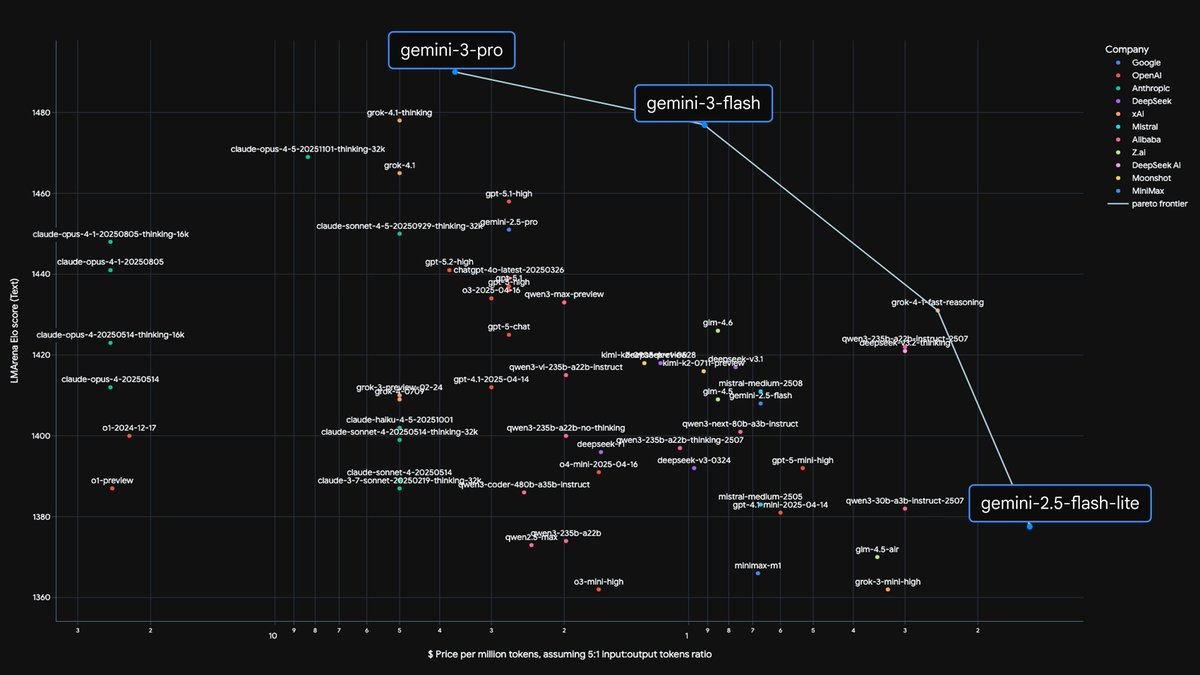
Models like Gemini 3 Flash show a key trend: making frontier intelligence faster, cheaper, and more efficient. The trajectory is for today's state-of-the-art models to become 10x cheaper within a year, enabling widespread, low-latency, and on-device deployment.

Google's strategy involves creating both cutting-edge models (Pro/Ultra) and efficient ones (Flash). The key is using distillation to transfer capabilities from large models to smaller, faster versions, allowing them to serve a wide range of use cases from complex reasoning to everyday applications.
As AI model performance commoditizes, the strategic battleground is shifting from models to platforms. Tech giants like Google are positioning their offerings not as features, but as the fundamental 'operating system' for the agentic enterprise. The new competitive moat is the control plane that orchestrates agents.
When multiple models can solve a task reliably ('benchmark saturation'), the strategic goal is no longer to find the most intelligent model. Instead, it becomes an optimization problem: select the smallest, cheapest, and fastest model that still meets the performance bar, creating a major competitive advantage in inference.

Google's Nano Banana 2 illustrates a market shift where enterprise adoption is driven by cost and speed, not just creating the highest quality output. The focus is on deploying 'good enough' AI cheaply and quickly at scale, turning AI into a production-ready infrastructure component rather than a creative novelty.
The narrative of endless demand for NVIDIA's high-end GPUs is flawed. It will be cracked by two forces: the shift of AI inference to on-device flash memory, reducing cloud reliance, and Google's ability to give away its increasingly powerful Gemini AI for free, undercutting the revenue models that fuel GPU demand.

While competitors like OpenAI must buy GPUs from NVIDIA, Google trains its frontier AI models (like Gemini) on its own custom Tensor Processing Units (TPUs). This vertical integration gives Google a significant, often overlooked, strategic advantage in cost, efficiency, and long-term innovation in the AI race.

The release of Gemini 3.1 Pro highlights a market shift where raw capability is becoming table stakes. Google achieved a massive intelligence jump with zero incremental cost, demonstrating that the new competitive frontier for AI models is commoditizing intelligence and winning on distribution and price efficiency, rather than just holding the top spot on a benchmark for a few weeks.