Get your free personalized podcast brief
We scan new podcasts and send you the top 5 insights daily.
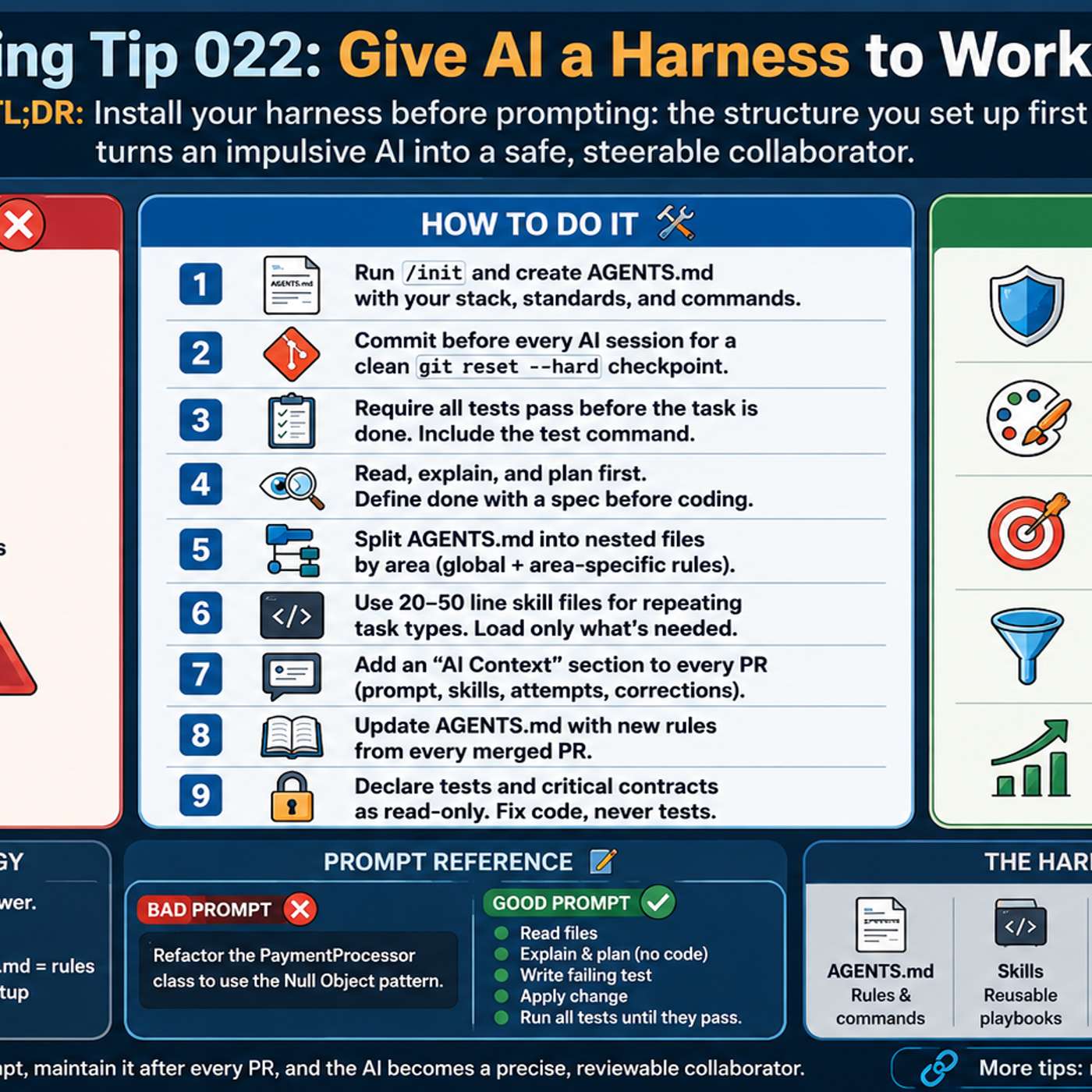
Treat your AI skills and loops like code by managing them in Git. This provides a crucial safety net, allowing you to instantly roll back to a previously effective version if a new LLM update causes performance to decline.

Related Insights
Relying on the context of a chat session is a mistake, as it disappears or gets compacted over time. To ensure consistent AI behavior and create a traceable record, rules and project context must be externalized into version-controlled 'skill files' or configurations that the AI reads at the start of every session.
When a new AI model degrades a skill, avoid a full rollback. Instead, 'revert forward' by modifying the current version to reintroduce the specific lost behaviors. This preserves any new benefits from the model update while fixing the regression.
To maximize AI's impact, treat LLM skills and prompts like a centralized codebase. When one person discovers a better technique, it should be integrated into a shared, version-controlled repository, ensuring the entire team benefits from individual learnings.

When an AI coding assistant goes off track, it can be hard to undo the damage. Developer Terry Lynn mitigates this risk by programming his AI workflow to make a Git commit before and after each small phase of a task. This creates a trail of "breadcrumbs," allowing him to easily revert to a stable state if the AI makes a mistake.

Relying on a local file system for your AI's context creates a single point of failure. By migrating context files to a cloud repository like GitHub, your 'AI brain' becomes portable, collaborative, and platform-agnostic, allowing you to plug it into any tool (Claude, Codex, etc.) or device.

To give an AI assistant persistent knowledge, create a dedicated Git repo. Prompt the AI (e.g., Claude Code) to save important artifacts like customer quotes or useful SQL queries into this repo as markdown files. This creates a curated, searchable 'cache' that bypasses the need to re-query external systems.

Add a final step to your skill's instructions that prompts the AI to review its own performance after each run. It should check for failures, user corrections, or new discoveries, and then propose updates to its own code. This creates a powerful self-improvement loop for your automations.

Long-running AI agent conversations degrade in quality as the context window fills. The best engineers combat this with "intentional compaction": they direct the agent to summarize its progress into a clean markdown file, then start a fresh session using that summary as the new, clean input. This is like rebooting the agent's short-term memory.

LLMs tend to amend instructions rather than replace them, leading to confusing and contradictory prompts over time. To maintain agent performance, periodically "purge" your markdown instruction files by rewriting them from scratch, ensuring they remain concise and accurate.

Chats in LLMs are temporary. To give your AI a permanent memory, store key instructions, playbooks, and processes as markdown documents within the AI's project files. This creates a stable intelligence layer that the AI always references, and the format is portable enough to be moved to other LLMs.
