Get your free personalized podcast brief
We scan new podcasts and send you the top 5 insights daily.
Relying on a local file system for your AI's context creates a single point of failure. By migrating context files to a cloud repository like GitHub, your 'AI brain' becomes portable, collaborative, and platform-agnostic, allowing you to plug it into any tool (Claude, Codex, etc.) or device.

Related Insights
Use an AI assistant like Claude Code to create a persistent corporate memory. Instruct it to save valuable artifacts like customer quotes, analyses, and complex SQL queries into a dedicated Git repository. This makes critical, unstructured information easily searchable and reusable for future AI-driven tasks.

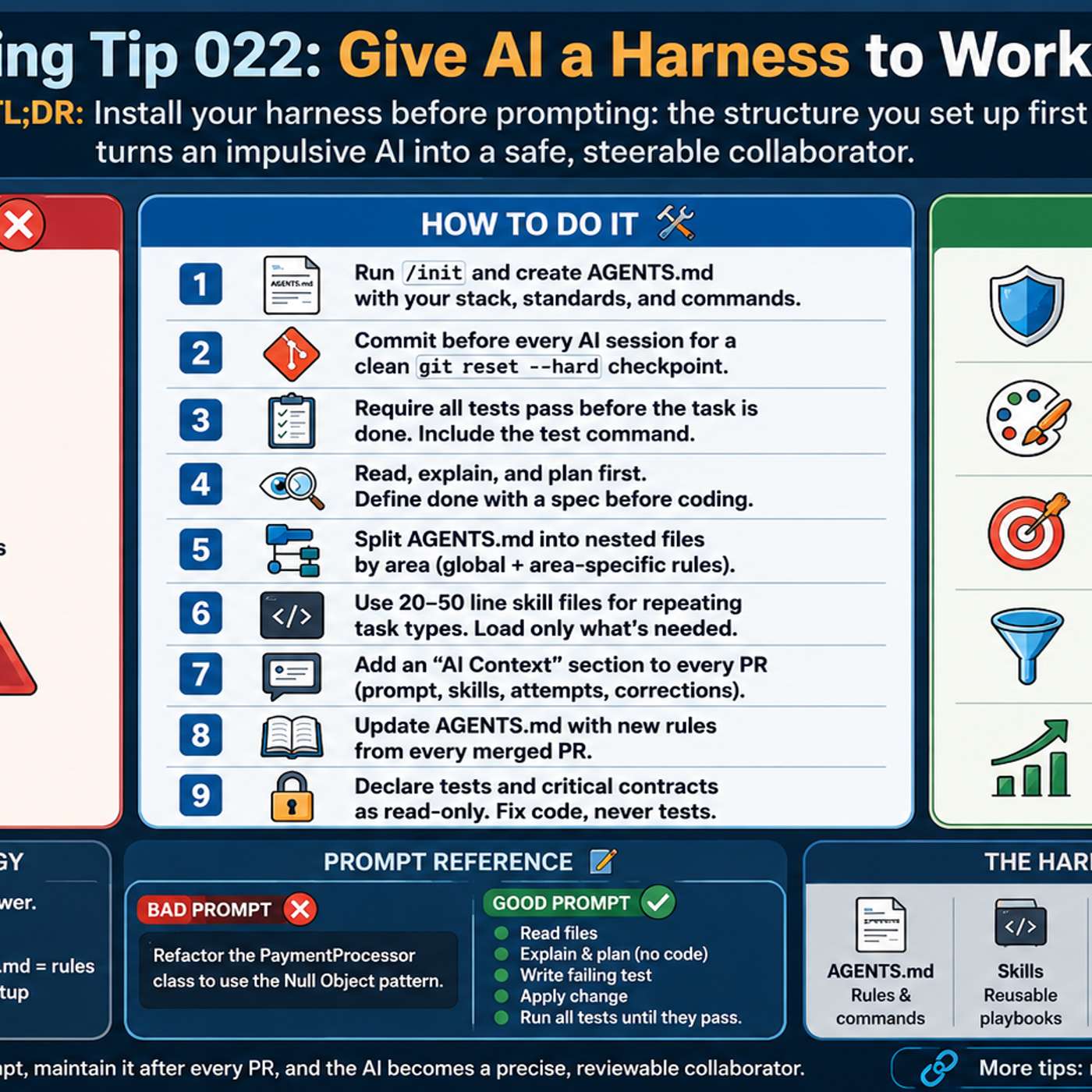
Relying on the context of a chat session is a mistake, as it disappears or gets compacted over time. To ensure consistent AI behavior and create a traceable record, rules and project context must be externalized into version-controlled 'skill files' or configurations that the AI reads at the start of every session.
Instead of using siloed note-taking apps, structure all your knowledge—code, writing, proposals, notes—into a single GitHub monorepo. This creates a unified, context-rich environment that any AI coding assistant can access. This approach avoids vendor lock-in and provides the AI with a comprehensive "second brain" to work from.

OpenAI structures its repositories to be a complete, self-contained knowledge base for AI agents. All project artifacts—design docs, historical implementation plans, and even text versions of external library documentation—are checked in, allowing the agent to find any needed context via simple search.

To combat reliance on a single AI provider, users can build a personal context layer—a collection of documents, data connections, and skill playbooks. This system acts as personal "alpha," allowing any capable AI model to quickly understand a user's context and perform tasks effectively, ensuring portability and reducing vendor lock-in.

Relying on chat history for an AI's memory is fragile. A more robust method is to have the AI serialize key learnings into an external, structured file system (like an Obsidian vault). This creates inspectable, editable, and reusable artifacts that can outlive any single conversation thread.

To give an AI assistant persistent knowledge, create a dedicated Git repo. Prompt the AI (e.g., Claude Code) to save important artifacts like customer quotes or useful SQL queries into this repo as markdown files. This creates a curated, searchable 'cache' that bypasses the need to re-query external systems.

Notion's team uses a `claude.md` file in their repo root to provide global instructions (e.g., tech stack) to their AI assistant. A git-ignored `claude.local.md` file is then used by each developer to provide personal context, like their username, which prevents the AI from modifying others' work.

Build a repository of small, functional tools and research projects. This 'hoard' serves as a powerful, personalized context for AI agents. You can direct them to consult and combine these past solutions to tackle new, complex problems, effectively weaponizing your accumulated experience.

Instead of relying on platform-specific, cloud-based memory, the most robust approach is to structure an agent's knowledge in local markdown files. This creates a portable and compounding 'AI Operating System' that ensures your custom context and skills are never locked into a single vendor.
