Get your free personalized podcast brief
We scan new podcasts and send you the top 5 insights daily.
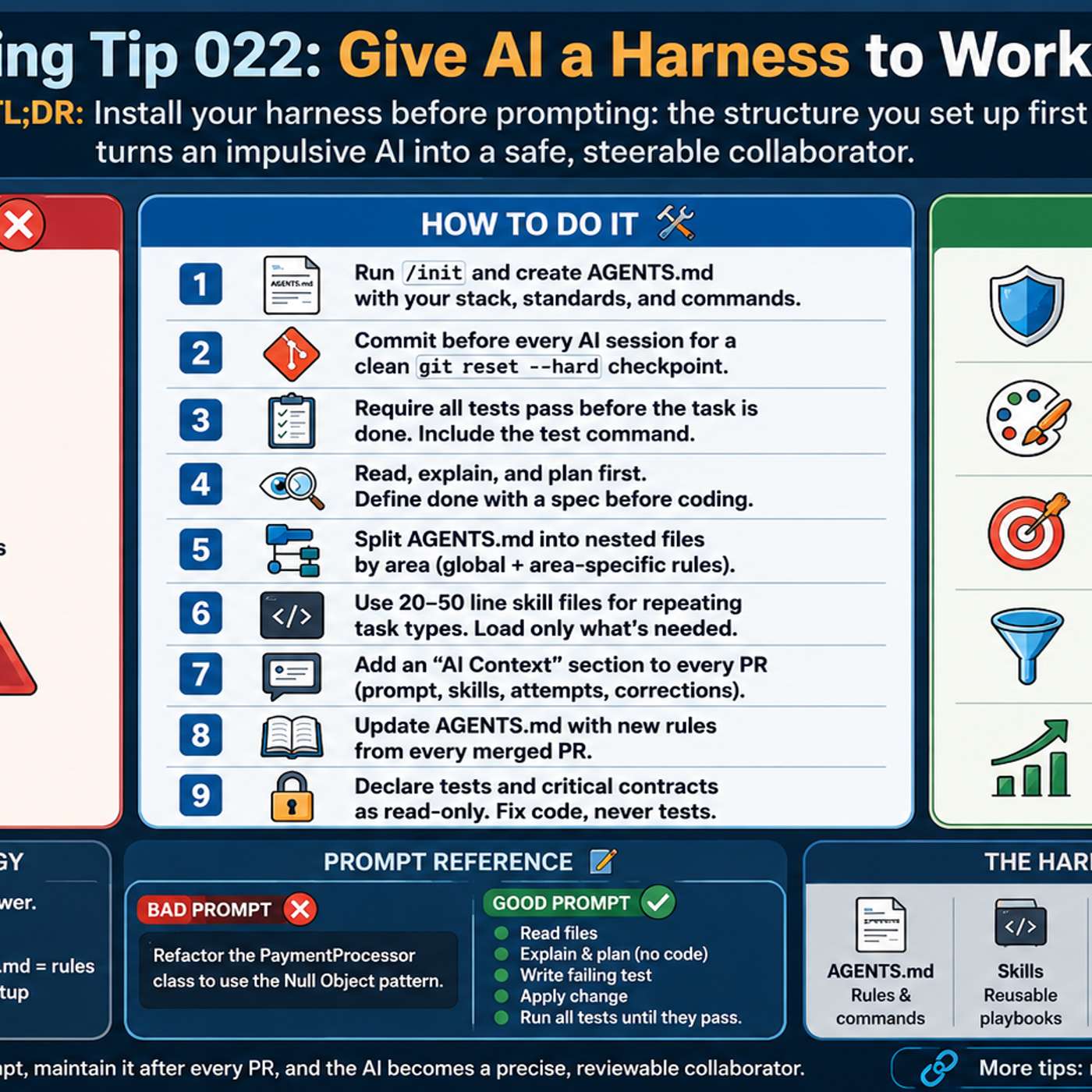
Relying on the context of a chat session is a mistake, as it disappears or gets compacted over time. To ensure consistent AI behavior and create a traceable record, rules and project context must be externalized into version-controlled 'skill files' or configurations that the AI reads at the start of every session.
Related Insights
The all-caps `clod` file, created via the `init` command, stores project structure and user-defined rules. Unlike temporary in-chat instructions that get lost or degraded as the conversation continues, this file is referenced in every session, ensuring consistent behavior and enforcing project-wide guardrails.

To prevent an AI agent from repeating mistakes across coding sessions, create 'agents.md' files in your codebase. These act as a persistent memory, providing context and instructions specific to a folder or the entire repo. The agent reads these files before working, allowing it to learn from past iterations and improve over time.

Build a system where new data from meetings or intel is automatically appended to existing project or person-specific files. This creates "living files" that compound in value, giving the AI richer, ever-improving context over time, unlike stateless chatbots.

Structure AI context into three layers: a short global file for universal preferences, project-specific files for domain rules, and an indexed library of modular context files (e.g., business details) that the AI only loads when relevant, preventing context window bloat.

To manage complex projects across multiple sessions, mandate that your AI assistant saves every plan and decision into external markdown files. This creates a persistent project history that overcomes the AI's limited context window and also serves as a personal memory aid for part-time builders.

Instead of starting new chats for every task, use single, long-running 'monothreads' for each major workstream. Advanced context compaction in tools like Codex allows these threads to persist memory over time, turning the AI from a simple Q&A bot into an ongoing project collaborator with deep context.

The 'Claudie' AI project manager reads a core markdown file every time it runs, which acts as a permanent job description. This file defines its role, key principles, and context. This provides the agent with a stable identity, similar to a human employee, ensuring consistent and reliable work.

Relying on chat history for an AI's memory is fragile. A more robust method is to have the AI serialize key learnings into an external, structured file system (like an Obsidian vault). This creates inspectable, editable, and reusable artifacts that can outlive any single conversation thread.
AI agents have limited context windows and "forget" earlier instructions. To solve this, generate PRDs (e.g., master plan, design guidelines) and a task list. Then, instruct the agent to reference these documents before every action, effectively creating a persistent, dynamic source of truth for the project.

Instead of relying on platform-specific, cloud-based memory, the most robust approach is to structure an agent's knowledge in local markdown files. This creates a portable and compounding 'AI Operating System' that ensures your custom context and skills are never locked into a single vendor.