Get your free personalized podcast brief
We scan new podcasts and send you the top 5 insights daily.
Companies struggle to realize meaningful returns on their generative AI investments because they deploy coding and drafting tools for isolated, individual tasks. True enterprise productivity gains require integrating agents across the entire software development lifecycle—incorporating planning 'left of code' and testing/governance 'right of code'—using organizational context graphs rather than relying solely on individual, one-on-one agent interactions.

Related Insights
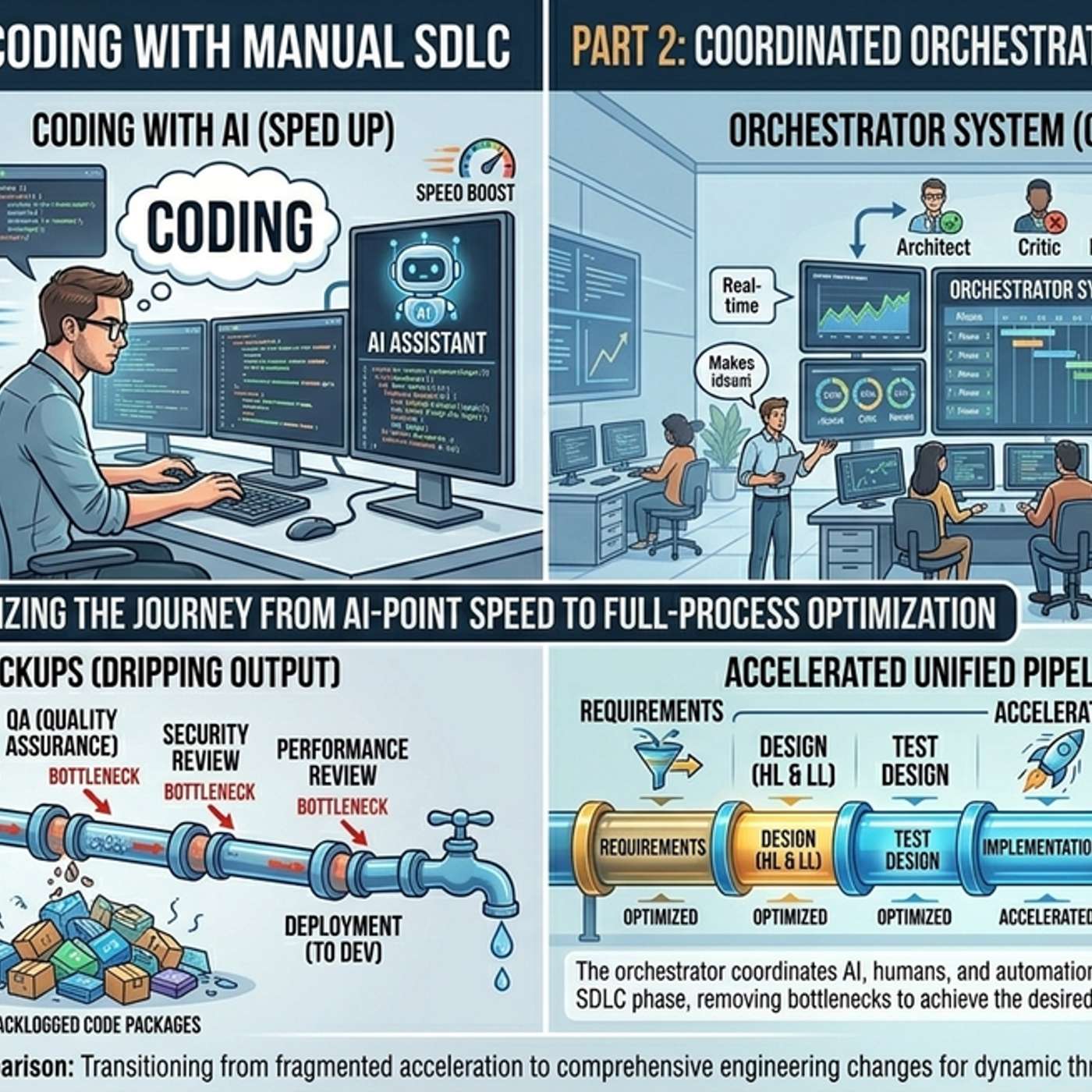
Speeding up just the coding phase with AI doesn't increase overall project delivery speed. It merely shifts the bottleneck to other parts of the Software Development Life Cycle (SDLC) like design, review, or deployment. To achieve real throughput gains, the entire end-to-end workflow must be optimized.
Asana's CPO explains that despite massive AI spend, enterprise productivity gains are nil. This is because employees use AI in isolation, and their corrections don't feed back into a shared system. True ROI comes from a compounding loop where human feedback automatically improves the shared AI context.

By fully automating the "inner loop" of coding, AI agents allow developers to bypass traditional upstream planning tools like Jira and overwhelm downstream processes like code review and CI/CD. This breaks the established software development lifecycle, creating new organizational bottlenecks that need to be addressed.

The most significant productivity gains come from applying AI to every stage of development, including research, planning, product marketing, and status updates. Limiting AI to just code generation misses the larger opportunity to automate the entire engineering process.
According to MIT research, the vast majority of corporate AI pilots fail. This is not due to the technology itself, but a disconnect where executives perceive success while employees report zero actual use. The core reason is a failure to integrate the tools into existing, meaningful workflows.

Initial failure is normal for enterprise AI agents because they are not just plug-and-play models. ROI is achieved by treating AI as an entire system that requires iteration across models, data, workflows, and user experience. Expecting an out-of-the-box solution to work perfectly is a recipe for disappointment.
Many engineering teams stall at "AI adoption"—simply providing tool licenses. The key to unlocking compounding value is "AI management"—designing a controlled, observable system where agents operate within the SDLC. Teams that get chaotic results often blame the model when the real failure is the process architecture around it.
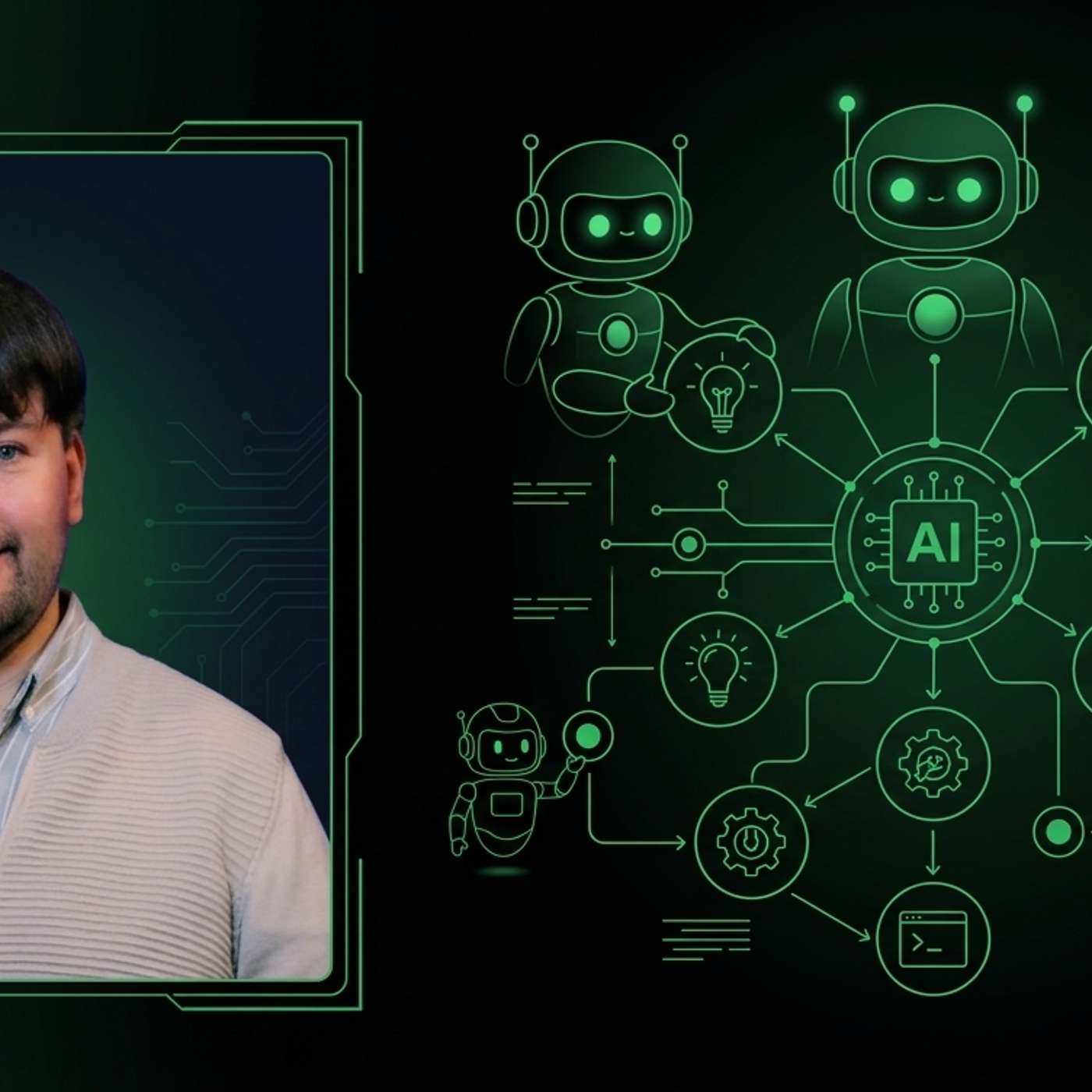
Deploying AI agents in isolated business functions is a missed opportunity. True enterprise value is unlocked when agents share context (e.g., between sales and maintenance), enabling optimization across the entire organization, not just within a silo.

An engineering org was effective at using AI for delegating and assessing code, but failed to tackle large problems. The missing piece was a dedicated 'planning phase' to scaffold significant work before execution. Without it, their AI-driven compounding of learnings was limited to small, incremental gains.
Most enterprises don't need smarter AI to see huge productivity gains. The real barrier is that models lack deep organizational context—unwritten rules, project histories, and key personnel knowledge. Successfully feeding this "ontology" into existing AI is the key to unlocking its value.