Get your free personalized podcast brief
We scan new podcasts and send you the top 5 insights daily.
By fully automating the "inner loop" of coding, AI agents allow developers to bypass traditional upstream planning tools like Jira and overwhelm downstream processes like code review and CI/CD. This breaks the established software development lifecycle, creating new organizational bottlenecks that need to be addressed.

Related Insights
The conventional, sequential stages of software development (design, code, test, review) are becoming obsolete. AI agents merge these steps into a single, iterative loop driven by user intent. This isn't a 10x improvement on the existing workflow; it's a fundamental paradigm shift that makes the entire traditional process a relic.

As AI agents and copilots accelerate code creation from numerous sources, the primary challenge for engineering teams becomes validating this massive influx of pull requests. This makes the code review process the new critical choke point in the software development lifecycle.
As AI coding agents generate vast amounts of code, the most tedious part of a developer's job shifts from writing code to reviewing it. This creates a new product opportunity: building tools that help developers validate and build confidence in AI-written code, making the review process less of a chore.

The ease of creating PRs with AI agents shifts the developer bottleneck from code generation to code validation. The new challenge is not writing the code, but gaining the confidence to merge it, elevating the importance of review, testing, and CI/CD pipelines.
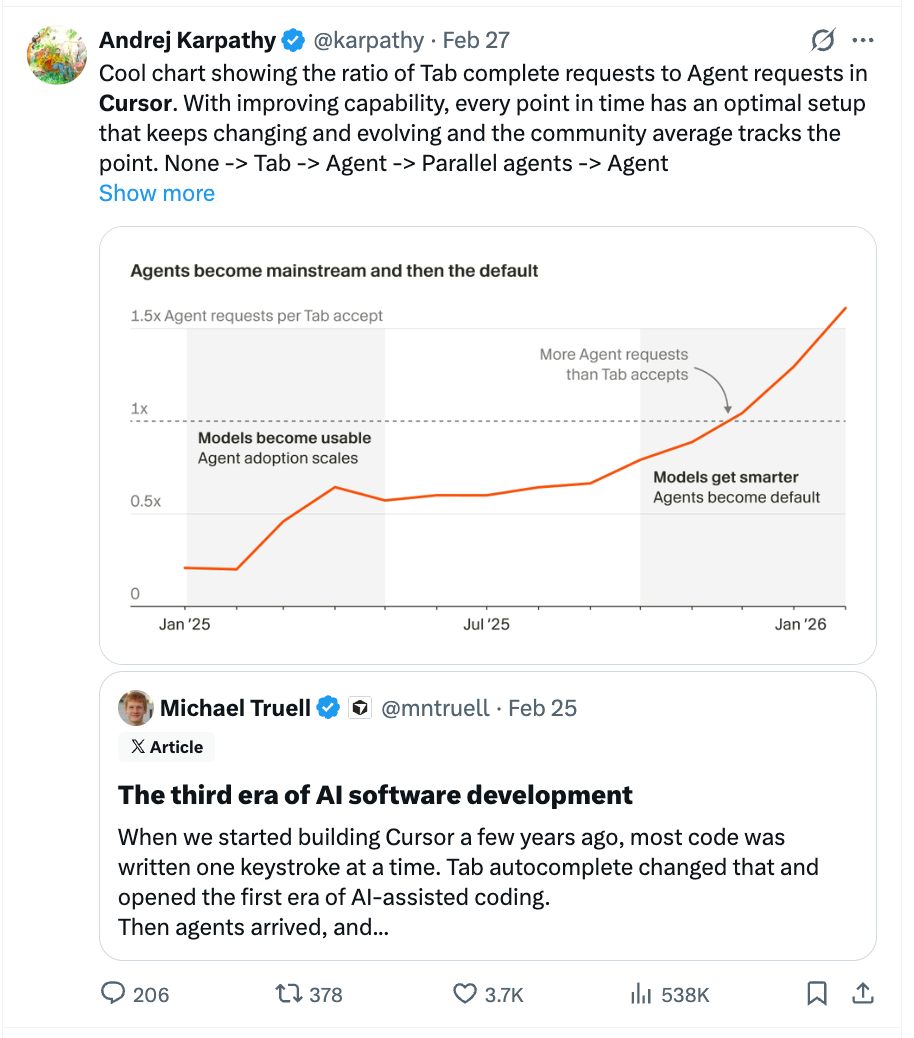
With AI making code generation cheap, the limiting factors for development velocity are now defining what to build (product) and ensuring its quality (review). Engineers will increasingly focus on high-level systems architecture rather than typing code.

With AI agents capable of generating code and designs at an unprecedented rate, the new chokepoint in workflows is human review. The primary challenge is no longer production but scaling the evaluation process to ensure AI-generated output aligns with quality standards and company values.

Inspired by fully automated manufacturing, this approach mandates that no human ever writes or reviews code. AI agents handle the entire development lifecycle from spec to deployment, driven by the declining cost of tokens and increasingly capable models.

Simply deploying AI to write code faster doesn't increase end-to-end velocity. It creates a new bottleneck where human engineers are overwhelmed with reviewing a flood of AI-generated code. To truly benefit, companies must also automate verification and validation processes.

With AI agents autonomously generating pull requests, the primary constraint in software development is no longer writing code but the human capacity to review it. Companies like Block are seeing PRs per engineer increase massively, creating a new challenge for engineering managers to solve.

The current software development lifecycle, from Git infrastructure to PR tools, was designed for a world where humans write every line of code. According to Cursor, this infrastructure is now 'crumbling under the pressure' of agentic coding, creating a massive opportunity to rebuild the entire toolchain from first principles for an AI-native era.
