Get your free personalized podcast brief
We scan new podcasts and send you the top 5 insights daily.
A new user behavior is emerging where developers physically whisper into specialized gooseneck microphones to interact with their AI coding agents. This verbal communication is significantly faster than typing, allowing them to 'brain dump' context, ramble, and explore side tangents in a more natural way to solve complex problems.

Related Insights
Instead of typing structured prompts, the most effective way to onboard an agent is to use "ramble mode." Simply record a long, stream-of-consciousness voice note explaining your needs, context, and goals. The AI can parse this high-bandwidth, unstructured data to build a comprehensive understanding of its role.

To feed AI models the rich context they require, advanced users are shifting from typing to speaking. They use high-fidelity, noise-canceling microphones to 'whisper' detailed prompts, dramatically increasing the amount of information provided per second and improving AI output quality.

The interface for AI agents is becoming nearly frictionless. By setting up a voice-to-voice loop via an app like Telegram, users can issue complex commands by simply holding down a button and speaking. This model removes the cognitive load of typing and makes interaction more natural and immediate.

To bypass the social awkwardness of dictating in open offices, a new behavior is emerging: entire teams are adopting cheap podium mics to quietly whisper to their computers. This creates a surreal but highly productive environment, transforming workplace culture around a new technology and normalizing voice input.

Instead of typing, dictating prompts for AI coding tools allows for faster and more detailed instructions. Speaking your thought process naturally includes more context and nuance, which leads to better results from the AI. Tools like Whisperflow are optimized with developer terminology for higher accuracy.

AI coding agents are fundamentally changing the developer workflow. Engineers are increasingly using voice commands with tools like foot pedals to direct AI, moving away from manual typing. This shift merges the traditionally separate functions of product management, design, and engineering into a single creative act.

Gabor dictates long, detailed prompts to his AI agents. This allows him to provide significantly more context, nuance, and specific constraints than would be practical to type. The AI can parse the verbose input, leading to a much better-specified final product.
The process of verbally explaining a complex problem to an AI assistant helps developers uncover solutions on their own. This mirrors the traditional "rubber ducking" debugging technique, where vocalizing a problem clarifies one's thinking and reveals the solution.
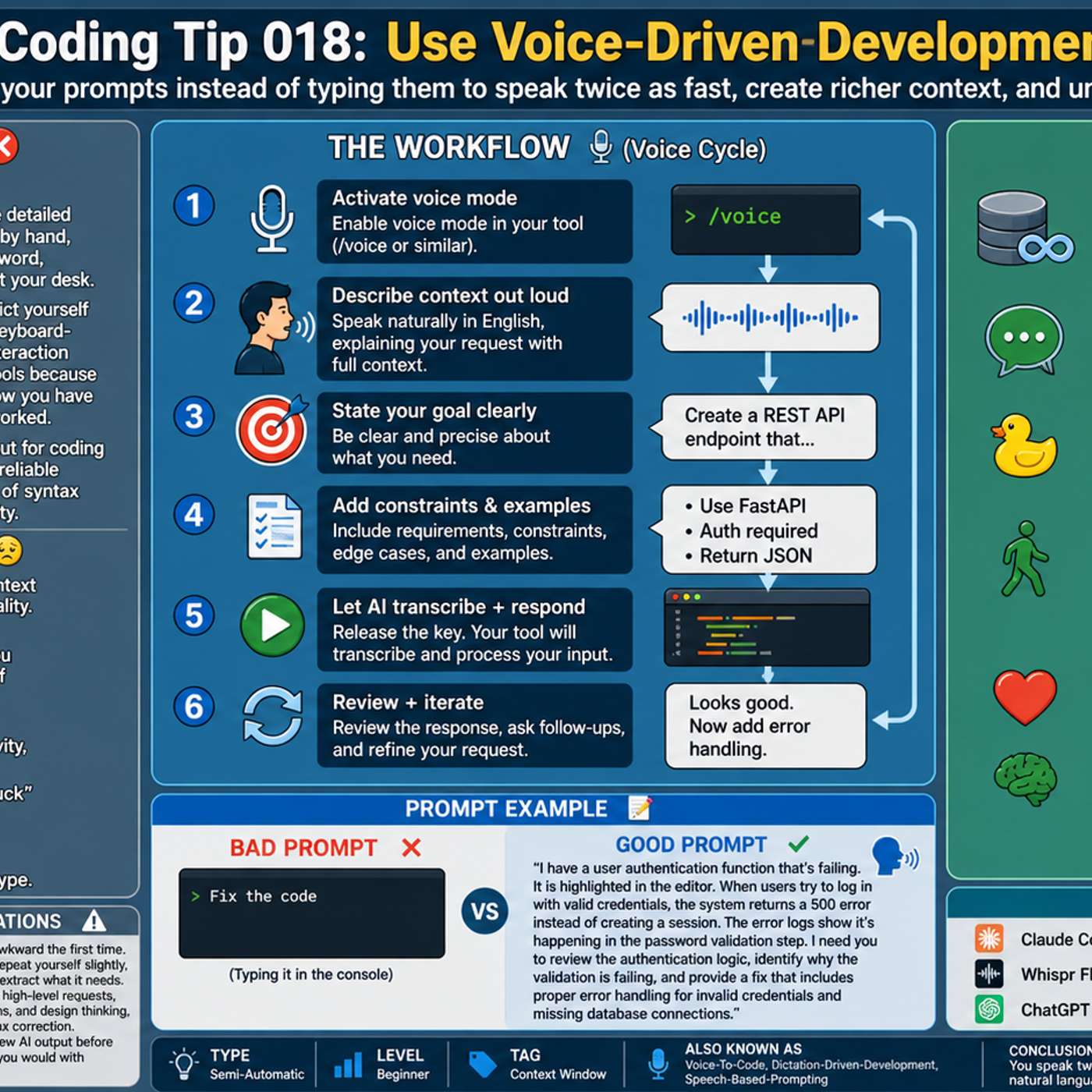
Using speech-to-text to talk to an AI is not just about speed. The 'art of the ramble' allows you to provide messy, uncertain, and richer context that you would filter out when typing. This gives the model access to your unpolished thought process, enabling it to help clarify your thinking and produce better results.

Google is heavily investing in audio interaction, as seen in its "Gemini mic" feature. The ability to "ramble" at a model to generate code or structured content is seen as a fast-growing and powerful paradigm. This moves beyond simple voice commands to using natural, unstructured speech as a primary input for creative and technical work.
