Get your free personalized podcast brief
We scan new podcasts and send you the top 5 insights daily.
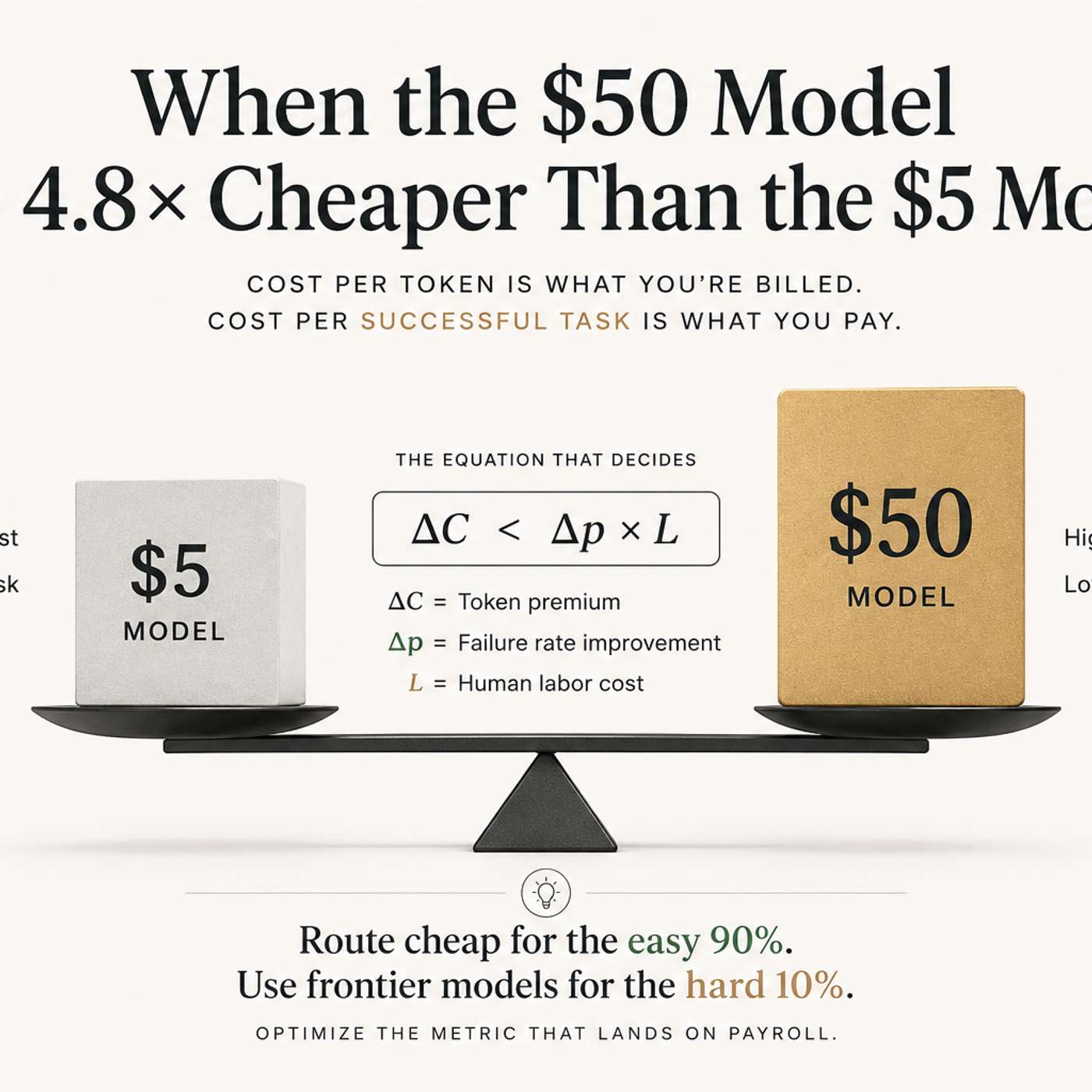
It's economically rational to use expensive, high-IQ frontier models for functions with unlimited upside, like sales or product development. For functions where the goal is precision rather than unbounded creativity (e.g., accurately closing financial books), cheaper, fine-tuned open-weight models are more efficient.

Related Insights
With frontier models costing over 100x more than competent alternatives ($56 vs. 50¢ per million tokens), companies are burning cash. An estimated 98% of tasks sent to top-tier models don't require that power, an inefficiency driven by engineers who are disconnected from cost implications.

The optimal strategy for enterprise AI is not to rely solely on expensive frontier models. Instead, companies use a powerful model like Claude or GPT-4 to plan tasks and then delegate the execution to cheaper, fine-tuned open-source models. This massively reduces cost while maintaining high performance.
![Gavin Baker - AI Market Jitters - [Invest Like the Best, EP.485] thumbnail](https://megaphone.imgix.net/podcasts/c8fca7de-8f77-11f1-ae96-ab857574605f/image/e34471e6c9b4af0375abbd710ff0fa11.jpg?ixlib=rails-4.3.1&max-w=3000&max-h=3000&fit=crop&auto=format,compress)
The choice between expensive frontier models and cheaper open-source ones depends on use case maturity. Enterprises should use powerful, general frontier models to discover new applications. Once a workflow is defined, they can migrate to a smaller, fine-tuned open model for efficiency.

Relying solely on expensive frontier models is unsustainable. Vertical AI companies must build a portfolio of smaller, specialized models that match frontier performance on specific tasks but cost 100x less, effectively allocating intelligence where it's needed most.

The smartest 'AI-pilled' companies adopt a two-tiered model strategy. They use expensive, frontier models for internal, high-leverage tasks like creating new knowledge and optimizing processes. However, they use cheaper, open-weight models in the 'bill of materials' for the customer-facing product to manage costs effectively.

An emerging rule from enterprise deployments is to use small, fine-tuned models for well-defined, domain-specific tasks where they excel. Large models should be reserved for generic, open-ended applications with unknown query types where their broad knowledge base is necessary. This hybrid approach optimizes performance and cost.

As AI costs rise, using one powerful frontier model for every task is no longer financially viable. The solution is to create a dedicated "Model Sommelier" role responsible for curating a portfolio of models, continuously testing and selecting the most cost-effective option for each specific business use case.

According to NVIDIA's VP, the modern approach to enterprise AI involves mixing models. Use expensive, powerful frontier models for complex, high-value tasks like agentic planning. For more trivial, high-volume tasks like document summarization, use cheaper, fine-tuned open-source models to optimize cost.

For repeatable, deterministic workflows, companies can achieve better performance and cost-efficiency by fine-tuning smaller, specialized models. Overusing expensive frontier models for routine tasks is a strategic error in managing "token capital" and AI spend.

An optimal AI architecture routes tasks to different models based on complexity and risk. Simple, low-stakes work like data extraction should go to the cheapest models. Ambiguous, high-stakes work like system design warrants expensive frontier models, where preventing one engineering mistake justifies the premium token cost.