Get your free personalized podcast brief
We scan new podcasts and send you the top 5 insights daily.
With frontier models costing over 100x more than competent alternatives ($56 vs. 50¢ per million tokens), companies are burning cash. An estimated 98% of tasks sent to top-tier models don't require that power, an inefficiency driven by engineers who are disconnected from cost implications.

Related Insights
AI labs profit from token generation, creating a "big token" economy that conflicts with enterprise budgets. The solution is to use a portfolio of models—large ones for complex tasks and smaller, cheaper ones for simple edits—to optimize the cost-performance ratio.

Current AI models are priced too cheaply, leading to inefficient consumption like using powerful models for simple tasks. As prices rise to reflect true costs, companies will need to optimize usage. This may create a new role, the 'Chief Token Officer,' responsible for allocating AI compute resources versus human capital.

A paradox exists where the cost for a fixed level of AI capability (e.g., GPT-4 level) has dropped 100-1000x. However, overall enterprise spend is increasing because applications now use frontier models with massive contexts and multi-step agentic workflows, creating huge multipliers on token usage that drive up total costs.

In response to budget blowouts from agentic AI, enterprises are moving beyond simple adoption to active cost management. A new "token efficiency" stack is emerging, featuring tactics like model routing to cheaper alternatives (e.g., DeepSeek) and custom post-trained models to reduce reliance on expensive foundation models.

As AI token consumption becomes a major budget item, companies are moving beyond using a single frontier model. Every organization will need a portfolio of models, including cheaper options for less complex tasks, to manage the "madness" of runaway costs.

Large customers are aggressively optimizing AI spend by abandoning a one-size-fits-all frontier model approach. One software provider is saving nearly $700,000 annually by switching to a much cheaper OpenAI model for a high-volume task, signaling a market-wide shift towards cost-efficiency and model routing.

The smartest 'AI-pilled' companies adopt a two-tiered model strategy. They use expensive, frontier models for internal, high-leverage tasks like creating new knowledge and optimizing processes. However, they use cheaper, open-weight models in the 'bill of materials' for the customer-facing product to manage costs effectively.

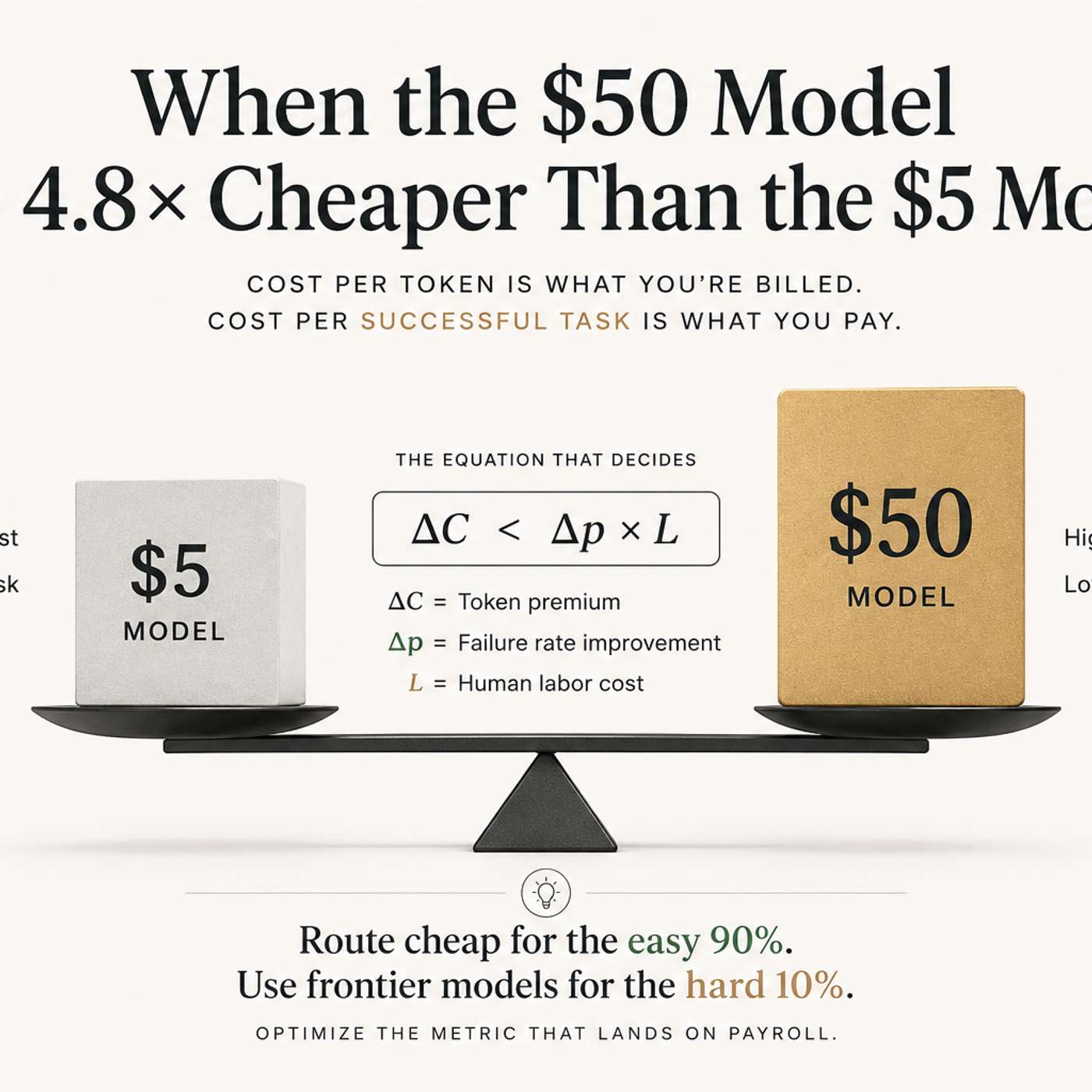
A model with a low per-token price can be more expensive if it's inefficient, verbose, or requires multiple attempts ('overthinking'). The actual invoice depends on the total tokens needed to complete a task, making token efficiency a hidden multiplier that savvy enterprises are now tracking to determine the true cost.
To control inference costs, companies are implementing model routing systems. They differentiate between expensive tokens from frontier models for complex reasoning and cheaper tokens from fine-tuned open-source models for simpler workflow tasks. This tiered approach optimizes both performance and budget, avoiding "token maxing."

An optimal AI architecture routes tasks to different models based on complexity and risk. Simple, low-stakes work like data extraction should go to the cheapest models. Ambiguous, high-stakes work like system design warrants expensive frontier models, where preventing one engineering mistake justifies the premium token cost.