Get your free personalized podcast brief
We scan new podcasts and send you the top 5 insights daily.
An audit of $34 million in AI spending found that 5% ($1.7 million) was incorrectly billed by providers. Errors include being charged for premium models while using cheaper ones or runaway agent loops. This highlights a critical need for independent verification of AI cloud spend.

Related Insights
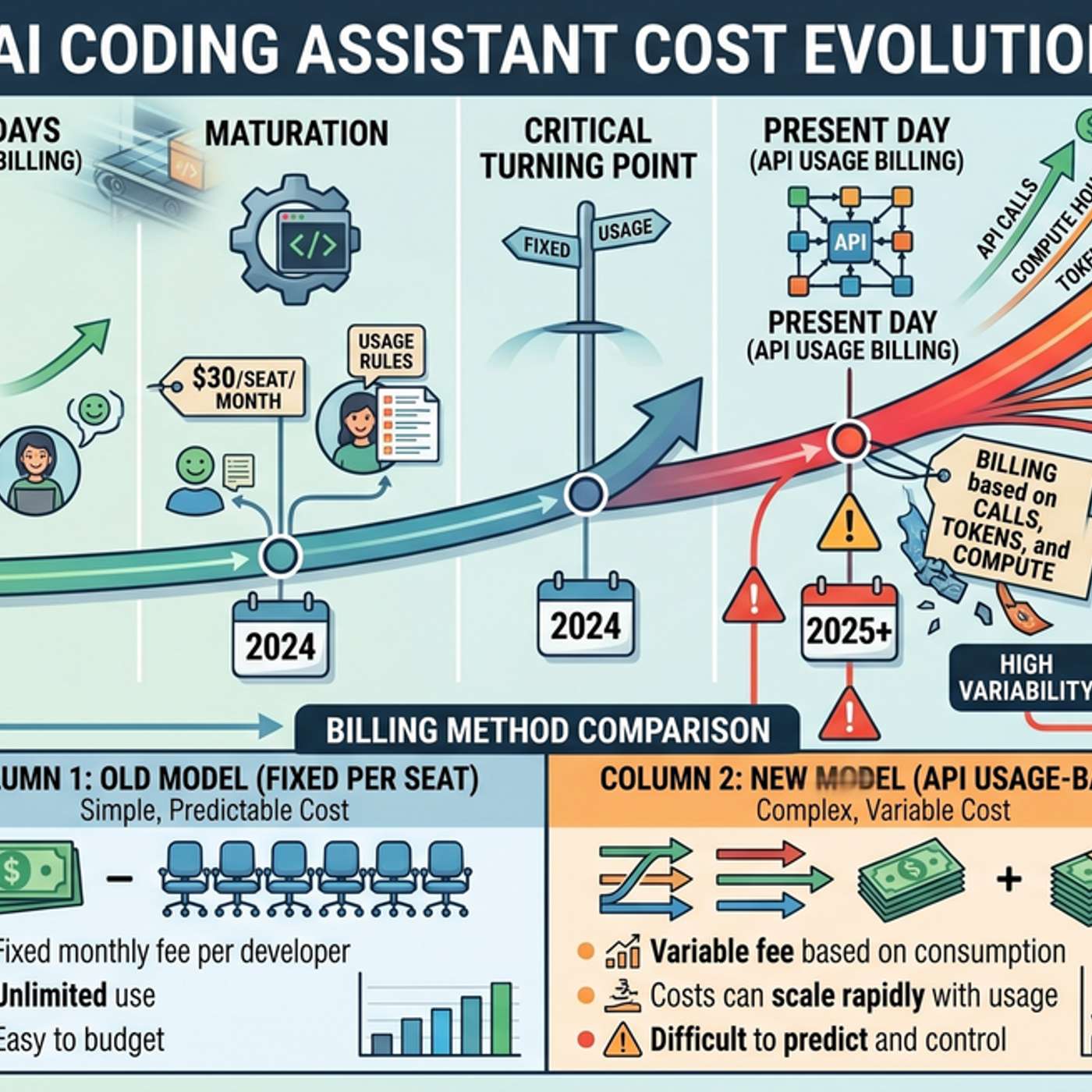
For years, flat-rate AI subscriptions heavily subsidized power users, masking the true cost of token consumption. As providers shift to usage-based billing, this subsidy is ending. Enterprises now face "sticker shock" and must justify AI spend with clear ROI, moving from rampant experimentation to cost-conscious implementation.
![The AI Token Shortage Begins [AI Monthly Recap] thumbnail](https://d3t3ozftmdmh3i.cloudfront.net/staging/podcast_uploaded_nologo/41472609/41472609-1752234663609-8665756a468e5.jpg)
Flat-rate AI plans are becoming economically unviable due to token-hungry agents. Companies like Google and Microsoft are pushing usage-based billing, forcing enterprises to confront the surprisingly high real cost of running models at scale, which was previously hidden by subsidized pricing experiments.
Unlike traditional compliance, AI agent audits will never yield a 100% pass rate. Due to their non-deterministic nature, all agents can be jailbroken or made to hallucinate under sufficient pressure. A realistic audit report acknowledges this, focusing on mitigating critical vulnerabilities and transparently reporting minor ones.
Traditional software budgeting fails for generative AI, where costs are variable and tied to tokens and usage. A CFO noted a team's daily per-person cost jumped 50% in one week. Companies must accept this volatility, run pilots to establish baseline costs, and then determine ROI, rather than trying to set a fixed budget upfront.

Microsoft's new autonomous AI agents, like Scout, operate continuously in the background, creating a major risk of uncontrolled token consumption and budget overruns for enterprise customers. While control tools exist, the fundamental model presents a new financial challenge for IT departments.
Startups face a "governance tax" where monitoring platforms charge significantly more than the underlying AI API usage. An example cited is a team nearly paying $36,000 annually for a tool to manage a $14,400 AI spend, representing a 250% markup just for monitoring.

Heavy users of AI development tools are skeptical of the astronomical token spending figures reported by some companies. This suggests many are either using the technology inefficiently or exaggerating their usage, raising questions about the true cost of AI development.

SaaStr's experience shows that while human user seats for Salesforce decreased dramatically, intensive data usage from 20 AI agents led to a significant net increase in their bill. This suggests a shift from per-seat to consumption-based pricing models driven by agentic AI.

The move away from seat-based licenses to consumption models for AI tools creates a new operational burden. Companies must now build governance models and teams to track usage at an individual employee level—like 'Bob in accounting'—to control unpredictable costs.
Just as uncontrolled cloud spending in the 2010s spawned the FinOps field, the shift to consumption-based AI pricing will necessitate a similar discipline. This involves attributing costs to specific workloads, setting granular budgets, and providing real-time visibility to prevent budget overruns and measure ROI accurately.