Get your free personalized podcast brief
We scan new podcasts and send you the top 5 insights daily.
To scale production, Saronic moves work from the final ship assembly line to pre-built sub-assemblies. This requires solving tough technical hurdles like getting automated aluminum welding (with partners like Path Robotics) to meet stringent maritime certifications.

Related Insights
To accelerate development, Saronic built the entire internal propulsion and electronics stack in a room eight months before the actual ship was constructed. This allowed extensive software testing and iteration, solving problems long before the vessel ever hit the water.
Founders are breaking down complex societal challenges like construction and energy into modular, repeatable parts. This "factory-first mindset" uses AI and autonomy to apply assembly line logic to industries far beyond traditional manufacturing, reframing the factory as a problem-solving methodology.

Instead of focusing on large platforms like destroyers, Saronic analyzes naval firepower through a startup lens: unit economics. By comparing the cost per Vertical Launch System (VLS) missile tube, they show how autonomous ships can deliver more firepower, faster, for less money.

Autonomy enables a first-principles redesign of vessels. By eliminating the need for human crews, ships can be built with fundamentally less steel and fewer labor hours, drastically reducing costs and build times compared to traditional naval platforms.
Instead of seeking a scarce, experienced workforce, Saronic designs ships for manufacturability. This counterintuitive approach allows them to train thousands of new workers, fundamentally solving the industry's talent bottleneck rather than just working around it and enabling a revitalization of the industrial base.
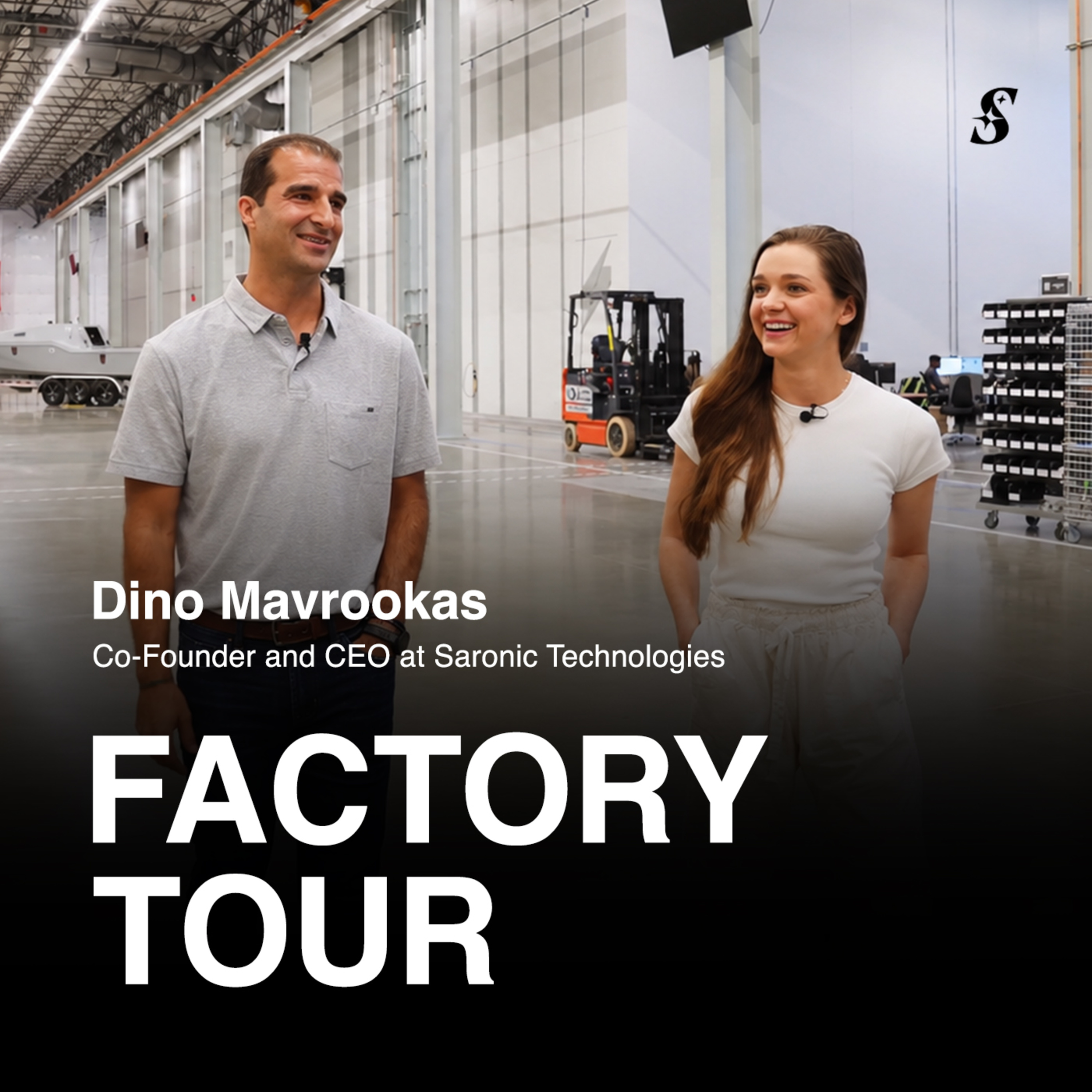
By vertically integrating, Saronic can optimize a ship's design for ease of manufacturing and simultaneously design the factory layout for that specific ship. This hardware-software co-design approach, common in chipmaking, is now being applied to heavy industry for massive efficiency gains.
Saronic initially focused on building small, cost-effective autonomous boats (Corsair) to meet an immediate defense need. The success and capital from this initial product gave them the credibility and resources to tackle their larger, more audacious ambition: building massive shipyards to restore U.S. naval capacity.
Saronic focuses on a simple, linear production flow that acts as a replicable blueprint. This 'system that builds the system' allows them to quickly establish new manufacturing facilities in standard warehouses, enabling rapid scaling not just in the U.S. but also for international allies.
By removing the human element, Saronic can design vessels to withstand extreme accelerations (over 20Gs), a physical impossibility for manned boats which are limited to ~0.6Gs. This allows for radically different performance capabilities.
The key benefit of autonomy in shipbuilding isn't just unmanned operation; it's simplified manufacturing. By removing the need for human crew and their support systems (quarters, life support), ship designs become simpler, enabling faster production, lower costs, and true industrial scale.