Get your free personalized podcast brief
We scan new podcasts and send you the top 5 insights daily.
While traditionally creating cultural friction, separate innovation teams are now more viable thanks to AI. The ability to go from idea to prototype extremely fast and leanly allows a small team to explore the "next frontier" without derailing the core product org, provided clear handoff rules exist.

Related Insights
To balance AI hype with reality, leaders should create two distinct teams. One focuses on generating measurable ROI this quarter using current AI capabilities. A separate "tiger team" incubates high-risk, experimental projects that operate at startup speed to prevent long-term disruption.
To innovate quickly without being bogged down by technical debt, portfolio companies should ring-fence new AI development. By outsourcing it and treating it as a separate "skunk works" project, the core tech team can focus on existing systems while the new initiative succeeds or fails on its own merits.

Small firms can outmaneuver large corporations in the AI era by embracing rapid, low-cost experimentation. While enterprises spend millions on specialized PhDs for single use cases, agile companies constantly test new models, learn from failures, and deploy what works to dominate their market.
In AI, low prototyping costs and customer uncertainty make the traditional research-first PM model obsolete. The new approach is to build a prototype quickly, show it to customers to discover possibilities, and then iterate based on their reactions, effectively building the solution before the problem is fully defined.

Afeyan advises against making breakthrough innovation everyone's responsibility, as it's unsustainable and disruptive to daily jobs. Instead, companies should create a separate group with different motivations, composition, and rewards, focused solely on discontinuous leaps.
AI tools reduce the communication overhead and lengthy handoffs that traditionally separated product and engineering. By streamlining the path from idea to code, AI makes the combined Chief Product and Technology Officer (CPTO) role more viable, enabling a single leader to manage both functions effectively.

To avoid choosing between deep research and product development, ElevenLabs organizes teams into problem-focused "labs." Each lab, a mix of researchers, engineers, and operators, tackles a specific problem (e.g., voice or agents), sequencing deep research first before building a product layer on top. This structure allows for both foundational breakthroughs and market-facing execution.

Historically, resource-intensive prototyping (requiring designers and tools like Figma) was reserved for major features. AI tools reduce prototype creation time to minutes, allowing PMs to de-risk even minor features with user testing and solution discovery, improving the entire product's success rate.
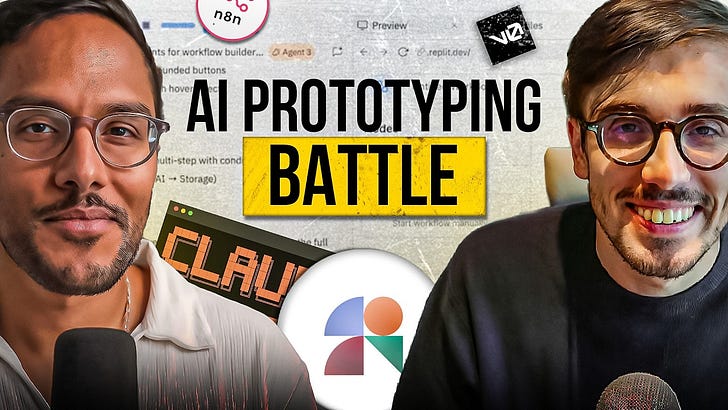
When an engineering team is hesitant about a new feature due to unfamiliarity (e.g., mobile development), a product leader can use AI tools to build a functional prototype. This proves feasibility and shifts the conversation from a deadlock to a collaborative discussion about productionizing the code.
Traditional agile development, despite its intent, still involves handoffs between research, design, and engineering which create opportunities for misinterpretation. AI tools collapse this sequential process, allowing a single person to move from idea to interactive prototype in minutes, keeping human judgment and creativity tightly coupled.
