Get your free personalized podcast brief
We scan new podcasts and send you the top 5 insights daily.
Just as Silicon Valley is the center for consumer tech, Kyiv and Ukraine are now the global hub for defense innovation. The rapid, real-world iteration on the battlefield provides unparalleled learning for military tech, strategy, and government organization that the West must integrate.
Related Insights
The Ukrainian conflict demonstrates the power of a fast, iterative cycle: deploy technology, see if it works, and adapt quickly. This agile approach, common in startups but alien to traditional defense, is essential for the U.S. to maintain its technological edge and avoid being outpaced.

The conflict in Ukraine exposed the vulnerability of expensive, "exquisite" military platforms (like tanks) to inexpensive technologies (like drones). This has shifted defense priorities toward cheap, mass-producible, "attritable" systems. This fundamental change in product and economics creates a massive opportunity for startups to innovate outside the traditional defense prime model.
While the U.S. and China pursue hyperwar as a national strategy, its most rapid development is happening organically on the battlefield. Outnumbered forces like Ukraine are forced to innovate with autonomous systems out of necessity, driving a bottom-up adoption of hyperwar tactics.

The war in Ukraine marks a historical inflection point in military technology. For the first time since the 19th century, the primary method of killing a soldier is no longer a bullet or artillery shell, but a drone. This fundamentally changes battlefield tactics and defense strategies.

European leaders have shifted from seeing Ukraine as a moral cause to a vital strategic asset. Ukraine's battle-tested army is viewed as Europe's "shield," and its innovations in drone warfare are seen as Europe's future "arsenal," especially amid doubts about US security guarantees.

The conflict in Ukraine demonstrates that modern warfare is rapidly changing due to AI, which enables fast, iterative development of low-cost drones. Investing in swarms of intelligent drones is now more strategically important than traditional, expensive military assets like aircraft carriers.

The pace of innovation is a critical factor in modern warfare. In one year, the Ukraine-Russia conflict advanced drone technology from a "2022" to a "2026" capability level. In that same period, Europe made zero progress, widening a dangerous technological gap.
The effectiveness of Ukrainian defense technology comes from its ability to dramatically lower the 'cost per shot' by orders of magnitude compared to legacy systems. This demonstrates that financial efficiency and adaptability, not just advanced features, are decisive on the modern battlefield.

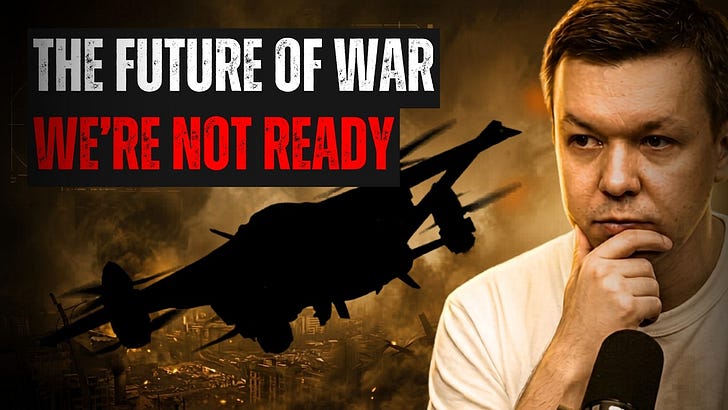
The war in Ukraine has evolved from a traditional territorial conflict into a "robot war," with drones dominating the front lines. This real-world battlefield is accelerating innovation at an "unbelievable" pace, driving new solutions for secure communications and autonomous targeting, providing critical lessons for US drone strategy.

Nations are now prioritizing partnerships with countries that have battle-tested expertise in modern warfare, like Ukraine's drone defense. This practical capability is becoming more valuable than traditional alliances with superpowers whose military technology may be outdated for current threats.