Get your free personalized podcast brief
We scan new podcasts and send you the top 5 insights daily.
To improve communication with engineering, PMs should use AI to analyze their company's actual codebase. Asking the AI for a high-level architecture diagram or to explain a component is a practical way to learn the system and develop a shared language with developers.

Related Insights
A powerful mindset for non-technical users is to treat the AI model not just as a tool, but as an infinitely patient expert programmer. This framing grants 'permission' to ask fundamental or 'silly' questions repeatedly until core engineering concepts are fully understood, without judgment.

Tools like Claude Code are democratizing software development. Product managers without a coding background can use these AI assistants to work in the terminal, manage databases, and deploy apps. This accelerates prototyping and deepens technical understanding, improving collaboration with engineers.

Product managers can use coding agents like Codex for self-service technical discovery. Instead of interrupting engineers with questions, they can ask the AI about the codebase, feature status, or implementation details, increasing their autonomy and team efficiency.

Create a reusable prompt (a "slash command") that explicitly asks your AI coding assistant to explain complex technical concepts. Frame the prompt with your current knowledge level (e.g., "explain this to a technical PM in the making using the 80/20 rule"). This transforms every coding session into a valuable learning opportunity.

To upskill a product team in AI, avoid creating a separate, intimidating new skill category. Instead, frame AI as a tool to augment existing competencies like execution (writing user stories), customer insight (synthesizing research), and strategy (brainstorming).

As AI tools lower the barrier to coding, the most effective PMs will evolve to contribute small code changes directly to the product. This blurs the lines between roles, unblocks small tasks, and deepens the PM's understanding of the product's construction.
In AI development, trace analysis is a point of tension. Product Managers should become fluent enough to ask intelligent questions and participate in debugging. However, they should avoid owning the process or tooling, respecting it as engineering's domain to maintain a healthy division of labor.

The key technical skill for an AI PM is not deep knowledge of model architecture but a higher-level understanding of how to orchestrate AI components. Knowing what AI can do and how systems connect is more valuable than knowing the specifics of fine-tuning or RAG implementation.
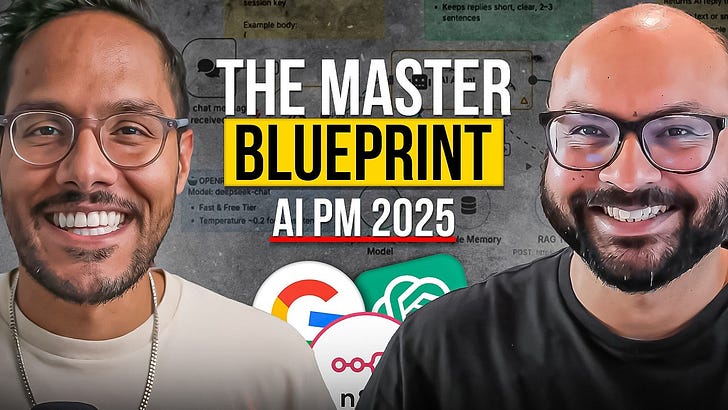
To effectively apply AI, product managers and designers must develop technical literacy, similar to how an architect understands plumbing. This knowledge of underlying principles, like how LLMs work or what an agent is, is crucial for conceiving innovative and practical solutions beyond superficial applications.
AI prototyping should be viewed as a fundamental skill for modern PMs, not an extra job responsibility. Just like using Figma to communicate design, AI prototyping tools allow PMs to make abstract AI concepts tangible for stakeholders and customers. This accelerates feedback loops and improves alignment on complex product behaviors.