Get your free personalized podcast brief
We scan new podcasts and send you the top 5 insights daily.
Building reliable AI agents requires a developer mindset shift. The most critical task is not writing the agent's code but creating robust evaluations ('evals') that define and verify the desired business outcome. This makes a test-driven development approach non-negotiable for enterprise AI.

Related Insights
While evals involve testing, their purpose isn't just to report bugs (information), like traditional QA. For an AI PM, evals are a core tool to actively shape and improve the product's behavior and performance (transformation) by iteratively refining prompts, models, and orchestration layers.

Before building an AI agent, product managers must first create an evaluation set and scorecard. This 'eval-driven development' approach is critical for measuring whether training is improving the model and aligning its progress with the product vision. Without it, you cannot objectively demonstrate progress.

Snowflake's CEO rejects a "YOLO AI" approach where model outputs are unpredictable. He insists enterprise AI products must be trustworthy, treating their development with the same discipline as software engineering. This includes mandatory evaluations (evals) for every model change to ensure reliability.
Exploratory AI coding, or 'vibe coding,' proved catastrophic for production environments. The most effective developers adapted by treating AI like a junior engineer, providing lightweight specifications, tests, and guardrails to ensure the output was viable and reliable.

The main obstacle to deploying enterprise AI isn't just technical; it's achieving organizational alignment on a quantifiable definition of success. Creating a comprehensive evaluation suite is crucial before building, as no single person typically knows all the right answers.
![Jesse Zhang - Building Decagon - [Invest Like the Best, EP.443] thumbnail](https://megaphone.imgix.net/podcasts/2cc4da2a-a266-11f0-ac41-9f5060c6f4ef/image/7df6dc347b875d4b90ae98f397bf1cb1.jpg?ixlib=rails-4.3.1&max-w=3000&max-h=3000&fit=crop&auto=format,compress)
Treating AI evaluation like a final exam is a mistake. For critical enterprise systems, evaluations should be embedded at every step of an agent's workflow (e.g., after planning, before action). This is akin to unit testing in classic software development and is essential for building trustworthy, production-ready agents.
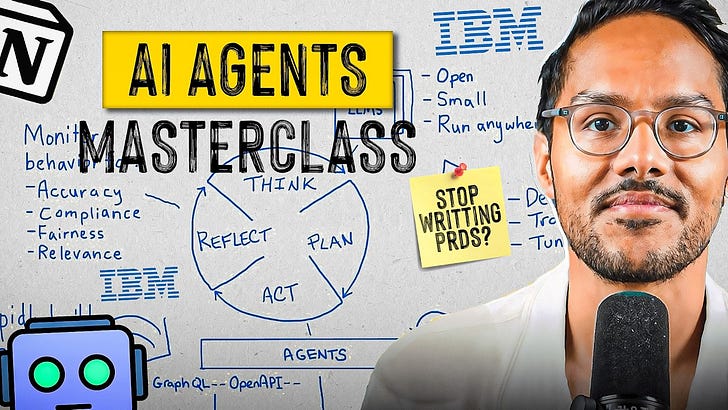
The primary bottleneck in improving AI is no longer data or compute, but the creation of 'evals'—tests that measure a model's capabilities. These evals act as product requirement documents (PRDs) for researchers, defining what success looks like and guiding the training process.

Building a functional AI agent is just the starting point. The real work lies in developing a set of evaluations ("evals") to test if the agent consistently behaves as expected. Without quantifying failures and successes against a standard, you're just guessing, not iteratively improving the agent's performance.

The prompts for your "LLM as a judge" evals function as a new form of PRD. They explicitly define the desired behavior, edge cases, and quality standards for your AI agent. Unlike static PRDs, these are living documents, derived from real user data and are constantly, automatically testing if the product meets its requirements.

As enterprises deploy agents for critical tasks like RFP generation or invoice processing, they will require dedicated evaluation frameworks and teams. This will create a massive new market for agent observability and eval tools, moving them beyond AI-native companies to the broader enterprise.