Get your free personalized podcast brief
We scan new podcasts and send you the top 5 insights daily.
Google's TurboQuant algorithm enables near-lossless context compression, drastically reducing memory usage and inference costs. This breakthrough could democratize powerful AI by making it far cheaper and faster to run, much like the fictional 'middle-out' compression from the show 'Silicon Valley' was a game-changer.

Related Insights
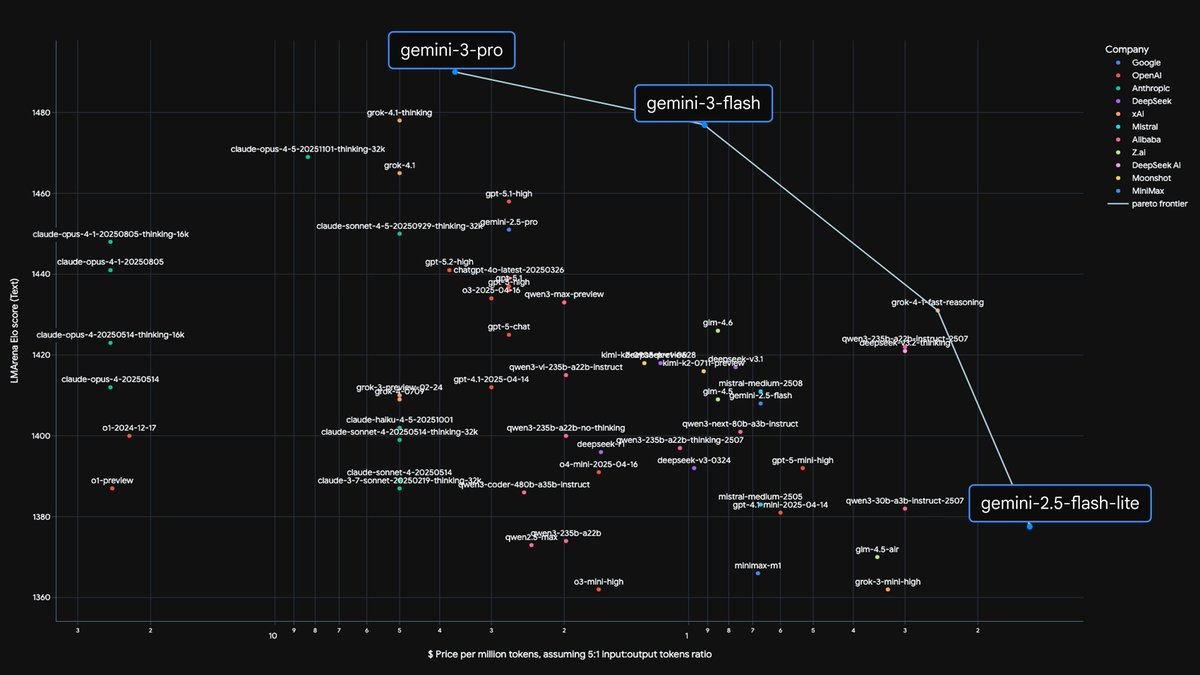
The primary threat from competitors like Google may not be a superior model, but a more cost-efficient one. Google's Gemini 3 Flash offers "frontier-level intelligence" at a fraction of the cost. This shifts the competitive battleground from pure performance to price-performance, potentially undermining business models built on expensive, large-scale compute.

Quantized Low-Rank Adaptation (QLORA) has democratized AI development by reducing memory for fine-tuning by up to 80%. This allows developers to customize powerful 7B models using a single consumer GPU (e.g., RTX 3060), work that previously required enterprise hardware costing over $50,000.

Score addresses the high cost of AI vision by using a decentralized network of miners to "distill" massive, general-purpose models (e.g., 3.4GB) into hyper-specialized, tiny models (e.g., 50MB). This allows complex vision tasks to run on local CPUs, unlocking use cases previously blocked by prohibitive GPU costs.

AI's hunger for context is making search a critical but expensive component. As illustrated by Turbo Puffer's origin, a single recommendation feature using vector embeddings can cost tens of thousands per month, forcing companies to find cheaper solutions to make AI features economically viable at scale.

Models like Gemini 3 Flash show a key trend: making frontier intelligence faster, cheaper, and more efficient. The trajectory is for today's state-of-the-art models to become 10x cheaper within a year, enabling widespread, low-latency, and on-device deployment.

Google's strategy involves creating both cutting-edge models (Pro/Ultra) and efficient ones (Flash). The key is using distillation to transfer capabilities from large models to smaller, faster versions, allowing them to serve a wide range of use cases from complex reasoning to everyday applications.
A fundamental constraint today is that the model architecture used for training must be the same as the one used for inference. Future breakthroughs could come from lifting this constraint. This would allow for specialized models: one optimized for compute-intensive training and another for memory-intensive serving.

Arvind Krishna forecasts a 1000x drop in AI compute costs over five years. This won't just come from better chips (a 10x gain). It will be compounded by new processor architectures (another 10x) and major software optimizations like model compression and quantization (a final 10x).

A key technique for creating powerful edge models is knowledge distillation. This involves using a large, powerful cloud-based model to generate training data that 'distills' its knowledge into a much smaller, more efficient model, making it suitable for specialized tasks on resource-constrained devices.

The release of Gemini 3.1 Pro highlights a market shift where raw capability is becoming table stakes. Google achieved a massive intelligence jump with zero incremental cost, demonstrating that the new competitive frontier for AI models is commoditizing intelligence and winning on distribution and price efficiency, rather than just holding the top spot on a benchmark for a few weeks.