Get your free personalized podcast brief
We scan new podcasts and send you the top 5 insights daily.
Properly funding AI isn't just about software licenses. A comprehensive budget should address four layers: 1) People to lead the strategy, 2) Platforms and their token usage, 3) Infrastructure like specialized hardware (e.g., GPUs), and 4) long-term investment in training proprietary models.

Related Insights
Companies mistakenly treat AI training as a project with a completion date. In reality, AI capability is a depreciating asset with a measurable rate of decay. Budgets must shift from funding one-off "ignition" events to funding continuous maintenance to prevent inevitable skill loss and wasted investment.

The core resource allocation question will evolve from budgeting for AI tools to choosing between hiring humans and buying compute tokens. Answering this requires a "software factory" with quantitative feedback loops to determine where each incremental dollar adds the most business value.

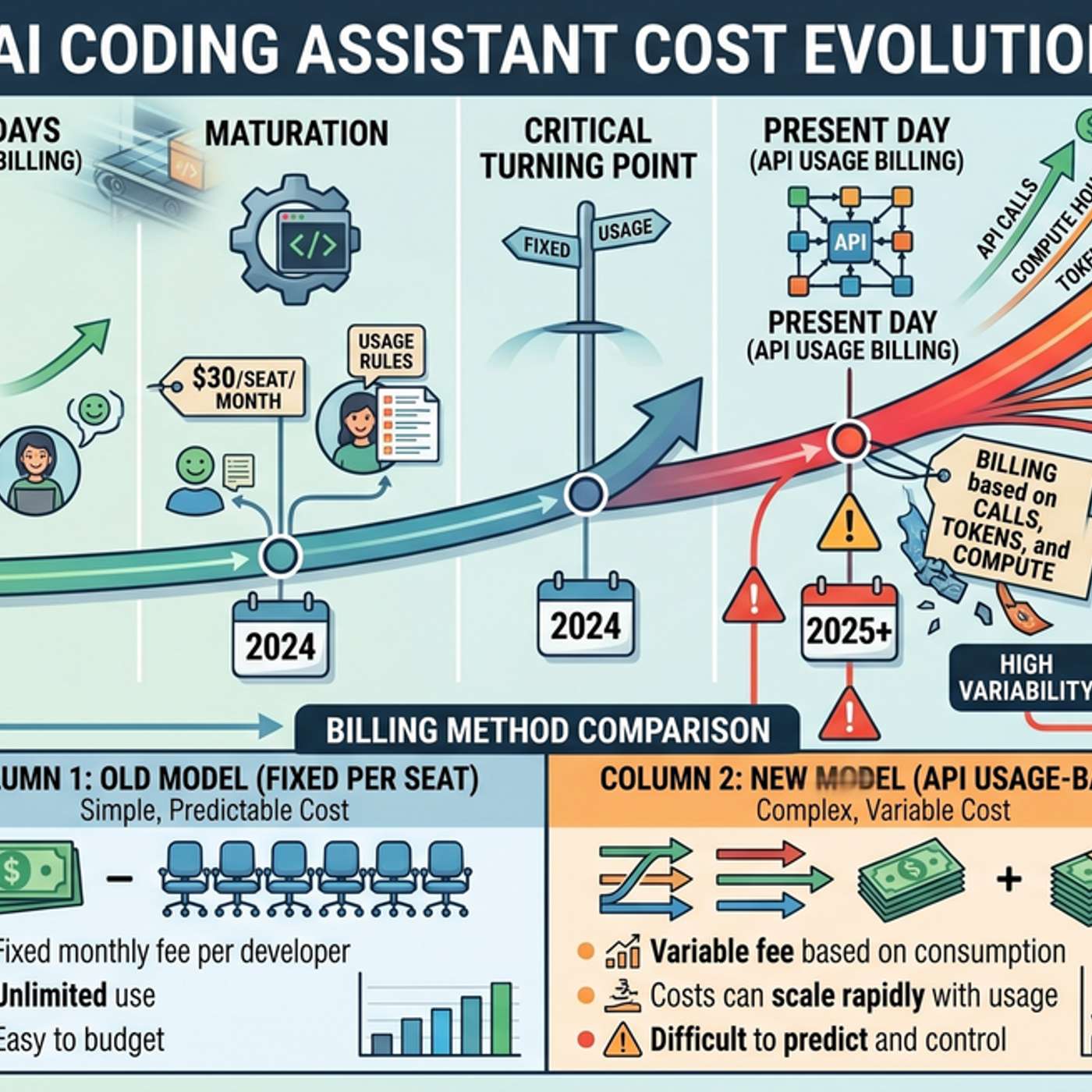
Unlike predictable seat-based SaaS, consumption-based AI is a fungible resource. Companies must treat 'intelligence' like capital, creating budgets and allocating it to the most productive people and projects. This requires a new financial discipline beyond simple software procurement.

Thinking about token budgets per person is a flawed, input-focused metric. The correct model is to allocate a budget (potentially seven figures) to a project or desired outcome, like beating a benchmark. This reframes AI spend as a capital allocation towards business goals, not an employee perk.
The shift to agentic AI means costs are no longer predictable per-seat subscriptions but variable expenses based on usage (tokens, compute). This requires managing AI like a capital allocation or a new form of labor, not just another software tool, a reality that early adopters are now grappling with.

Companies should reframe AI spending not as a traditional IT cost but as a direct investment in amplifying human capital. This model views AI agents as 'digital workers' that provide leverage to every employee, justifying spend based on the ROI of the augmented workforce.

Just as uncontrolled cloud spending in the 2010s spawned the FinOps field, the shift to consumption-based AI pricing will necessitate a similar discipline. This involves attributing costs to specific workloads, setting granular budgets, and providing real-time visibility to prevent budget overruns and measure ROI accurately.
To solve the challenge of budgeting for AI, Andrew MacDonald proposes a novel approach: merge the headcount and compute budgets into a single pool. This forces leaders to make direct trade-offs between hiring more engineers and spending on AI models, ensuring they allocate capital to the highest ROI activities.

AI's usage-based pricing doesn't fit traditional seat-based software budgets. Frame it like a marketing program (e.g., paid ads). If increased spending on AI tools generates high ROI, it justifies a larger, flexible budget, shifting the conversation with finance from fixed cost to performance investment.

Box CEO Aaron Levy notes a critical shift in corporate budgeting. AI spending is moving beyond the confines of the IT budget (typically 3-7% of revenue) to become a core operational expense (OPEX) for every department, from marketing to legal. This change will fundamentally alter how all business units allocate resources.
