Get your free personalized podcast brief
We scan new podcasts and send you the top 5 insights daily.
Rather than a complex observability stack like DataDog, Andon Labs has its AI agents communicate in a shared Slack channel. This provides a simple, real-time, and human-readable stream of their interactions, making it easy to monitor their behavior, debug issues, and spot interesting emergent properties.

Related Insights
Shopify built an AI agent named River that works exclusively in public Slack channels, never in DMs. This forces collaboration into the open, allowing 6,000 employees to watch and learn from each other's interactions with the AI, accelerating company-wide adoption and skill development.

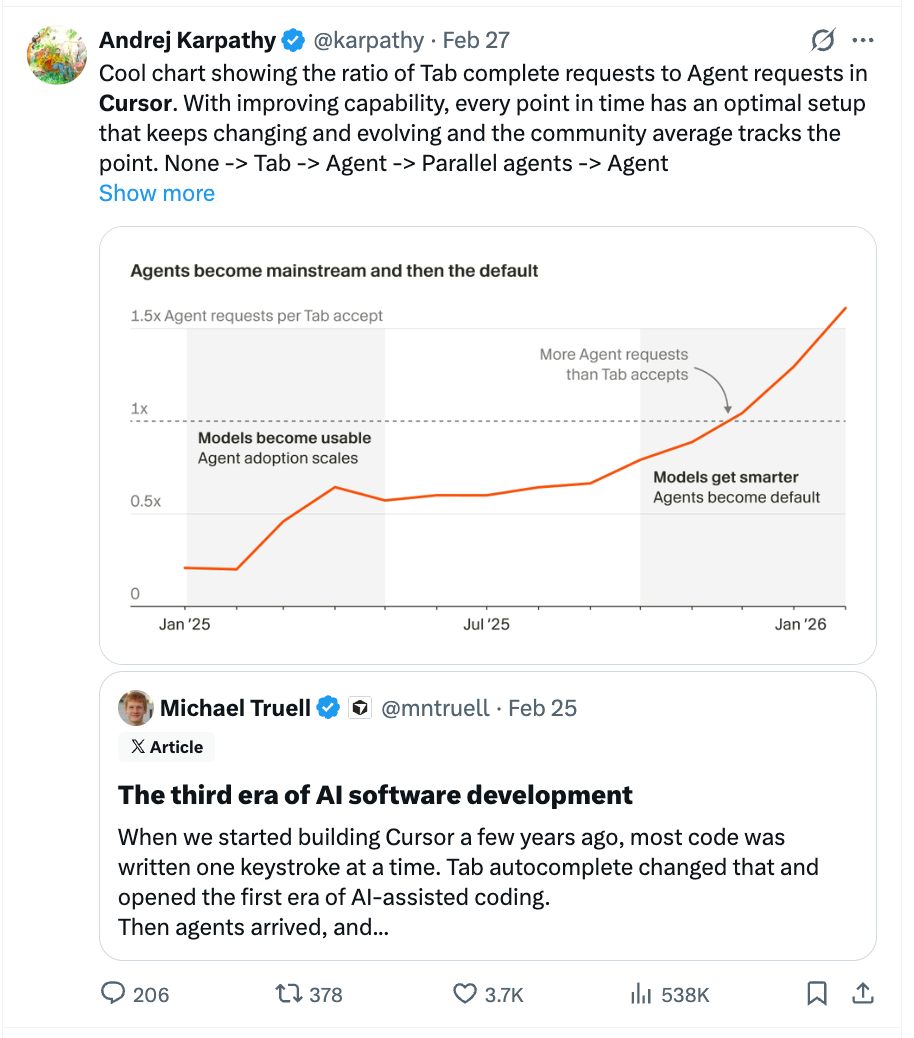
At Cursor, development is increasingly happening in Slack channels. Team members collectively kick off and redirect a cloud agent in a thread, turning development into a collaborative discussion. The IDE becomes a secondary tool, while communication platforms become the primary surface.
While messaging platforms like Slack can serve as an interface for human-to-agent communication, they are fundamentally ill-suited for agent-to-agent collaboration. These tools are designed for human interaction patterns, creating friction when orchestrating multiple autonomous agents and indicating a need for new, agent-native communication protocols.

When an agent fixes a production issue, a human can instruct it via Slack to also update the core reliability documentation. This not only solves the immediate problem but durably encodes the process knowledge, turning ephemeral conversations into persistent, automated process improvements.
The most advanced analytics workflow moves beyond manual dashboards to scheduled AI agents. These agents analyze data, synthesize top insights and deviations, and automatically push a report into the team's Slack channel. This frees PMs from routine reporting to focus on strategic action.

Using AI agents in shared Slack channels transforms coding from a solo activity into a collaborative one. Multiple team members can observe the agent's work, provide corrective feedback in the same thread, and collectively guide the task to completion, fostering shared knowledge.
Building a bespoke communication layer for multiple AI agents is a complex "scaffolding" problem. A simpler, more direct solution is to treat agents as digital coworkers, assigning them accounts on existing platforms like Slack or Google Docs, enabling them to interact using established human workflows.
Individual AI use is often a siloed, one-to-one experience. To foster collective learning, create a dedicated "AI Playground" Slack channel. This gives team members a space to share successful prompts, interesting outputs, and even failures, turning individual experimentation into a shared team asset.

By launching their internal agent in a single company-wide Slack channel, Perplexity enabled employees to see each other's prompts and use cases. This created a powerful cross-pollination of ideas and accelerated learning on how to best leverage the new tool for collaborative work.

To combat the isolating nature of AI work and share learnings, have AI agents operate in public Slack channels. This allows team members to passively observe how others prompt the AI, revealing new use cases and techniques in a natural, collaborative environment.
