Get your free personalized podcast brief
We scan new podcasts and send you the top 5 insights daily.
Shopify built an AI agent named River that works exclusively in public Slack channels, never in DMs. This forces collaboration into the open, allowing 6,000 employees to watch and learn from each other's interactions with the AI, accelerating company-wide adoption and skill development.

Related Insights
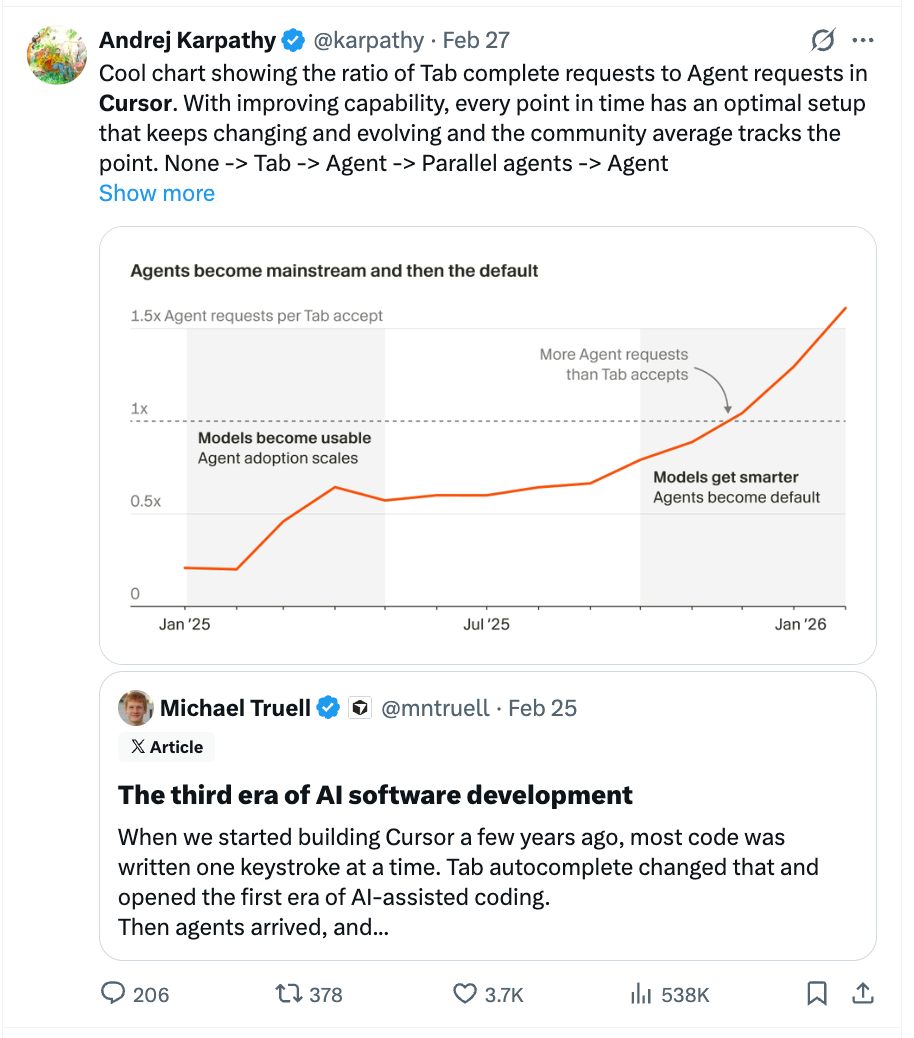
At Cursor, development is increasingly happening in Slack channels. Team members collectively kick off and redirect a cloud agent in a thread, turning development into a collaborative discussion. The IDE becomes a secondary tool, while communication platforms become the primary surface.
Most AI tools are single-player experiences. Linear is designing its agent sessions to be shared, collaborative spaces. Multiple people, like a PM and a designer, can jump into the same chat with an agent, see its work, and give it feedback together, collapsing the collaboration loop.

Using AI agents in shared Slack channels transforms coding from a solo activity into a collaborative one. Multiple team members can observe the agent's work, provide corrective feedback in the same thread, and collectively guide the task to completion, fostering shared knowledge.
By building internal AI agents directly into Slack, their usage becomes public and visible. This visibility is key for driving adoption; seeing a bot turn a message into a PR creates a "holy shit" moment that sparks curiosity and makes others want to use the tool, creating a natural viral effect.

Team members learn the capabilities and best practices for using their own AI agents by observing others' interactions in public channels. This "mid journey dynamic" creates a tacit transmission of knowledge about what's possible, accelerating the entire organization's learning curve much faster than formal training.
Individual AI use is often a siloed, one-to-one experience. To foster collective learning, create a dedicated "AI Playground" Slack channel. This gives team members a space to share successful prompts, interesting outputs, and even failures, turning individual experimentation into a shared team asset.

By launching their internal agent in a single company-wide Slack channel, Perplexity enabled employees to see each other's prompts and use cases. This created a powerful cross-pollination of ideas and accelerated learning on how to best leverage the new tool for collaborative work.

To maximize an AI agent's effectiveness, treat it like a team member, not just a tool. Integrate it directly into your company's communication and project management systems (like Slack). This ensures the agent has the full context necessary to perform its tasks.

To drive adoption of AI agents, don't force users into a new application. Instead, integrate the agent directly into their existing collaboration tools like Slack. This approach reduces friction and makes the agent feel like a natural part of the team, leading to higher engagement and user satisfaction.

Atlassian's AI onboarding agent, Nora, answers new hires' logistical questions, reducing their reluctance to bother managers. More strategically, this initial, low-stakes interaction serves as an effective on-ramp, conditioning employees from day one to view AI as a standard collaborative tool for their core work.