Get your free personalized podcast brief
We scan new podcasts and send you the top 5 insights daily.
Individual AI use is often a siloed, one-to-one experience. To foster collective learning, create a dedicated "AI Playground" Slack channel. This gives team members a space to share successful prompts, interesting outputs, and even failures, turning individual experimentation into a shared team asset.

Related Insights
To encourage AI adoption, Bitly's marketing team holds a weekly, low-preparation "How I AI" meeting. Team members share personal AI use cases, fostering a safe learning environment, spreading practical knowledge across roles, and helping overcome the common feeling of imposter syndrome around AI.

Mandating AI usage can backfire by creating a threat. A better approach is to create "safe spaces" for exploration. Atlassian runs "AI builders weeks," blocking off synchronous time for cross-functional teams to tinker together. The celebrated outcome is learning, not a finished product, which removes pressure and encourages genuine experimentation.

Finding transformative AI use cases requires more than strategic planning; it needs unstructured, creative "play." Just as a musician learns by jamming, teams build intuition and discover novel applications by experimenting with AI tools without a predefined outcome, letting their minds make new connections.
To drive AI adoption, CMO Laura Kneebush avoids appointing a single expert and instead makes experimentation "everybody's job." She encourages her team to start by simply playing with AI for personal productivity and hobbies, lowering the barrier to entry and fostering organic learning.

Beyond individual productivity, a shared AI tool fosters collaboration. Marketers can share effective prompts and custom GPTs, creating a living repository of best practices. This turns the tool into a third space for team communication, alongside Slack and email.

To overcome employee time constraints, Pendo implemented both scheduled, interactive workshops to create dedicated learning time and a Slack channel for asynchronous, "many-to-many" sharing. This dual approach ensures both focused learning and continuous, organic knowledge exchange across the organization.
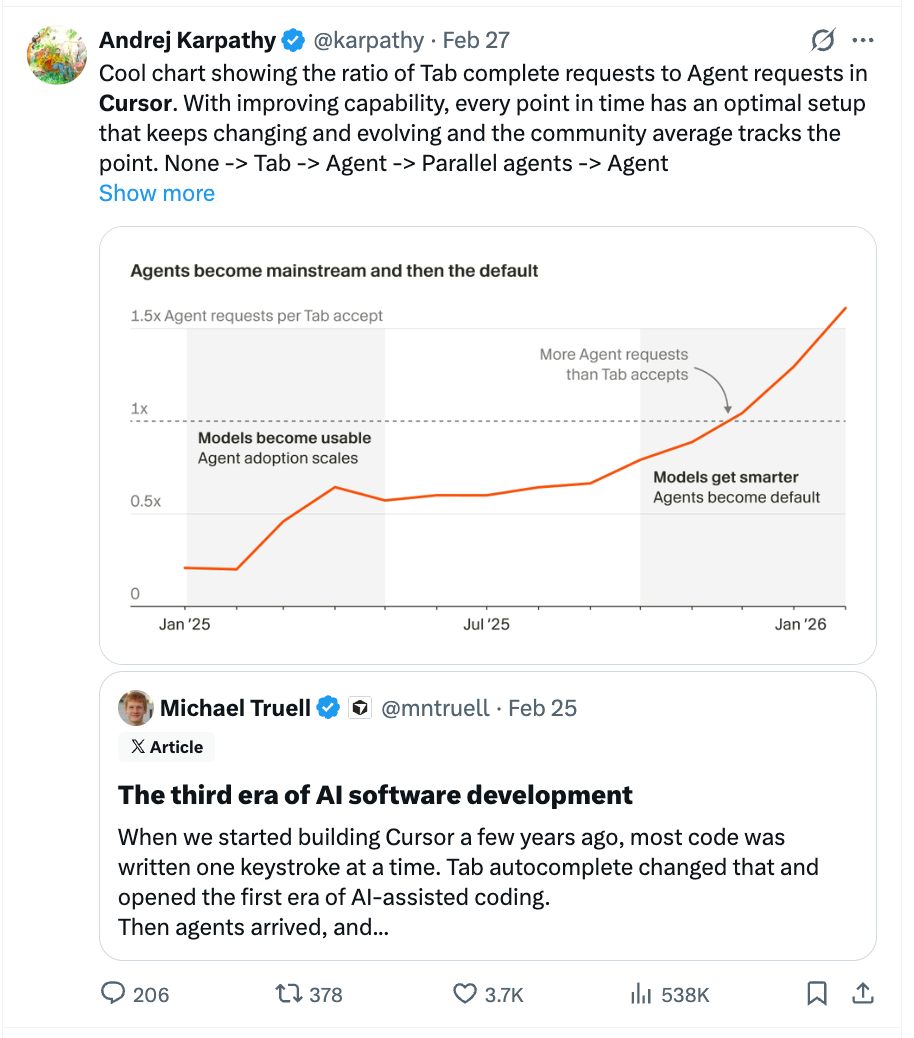
At Cursor, development is increasingly happening in Slack channels. Team members collectively kick off and redirect a cloud agent in a thread, turning development into a collaborative discussion. The IDE becomes a secondary tool, while communication platforms become the primary surface.
Using AI agents in shared Slack channels transforms coding from a solo activity into a collaborative one. Multiple team members can observe the agent's work, provide corrective feedback in the same thread, and collectively guide the task to completion, fostering shared knowledge.
By building internal AI agents directly into Slack, their usage becomes public and visible. This visibility is key for driving adoption; seeing a bot turn a message into a PR creates a "holy shit" moment that sparks curiosity and makes others want to use the tool, creating a natural viral effect.

Today, most AI use is siloed, with individuals prompting alone. The real value is unlocked when AI becomes a team sport, with specialists building systems that are shared, iterated upon, and used collaboratively across the entire organization.
