Get your free personalized podcast brief
We scan new podcasts and send you the top 5 insights daily.
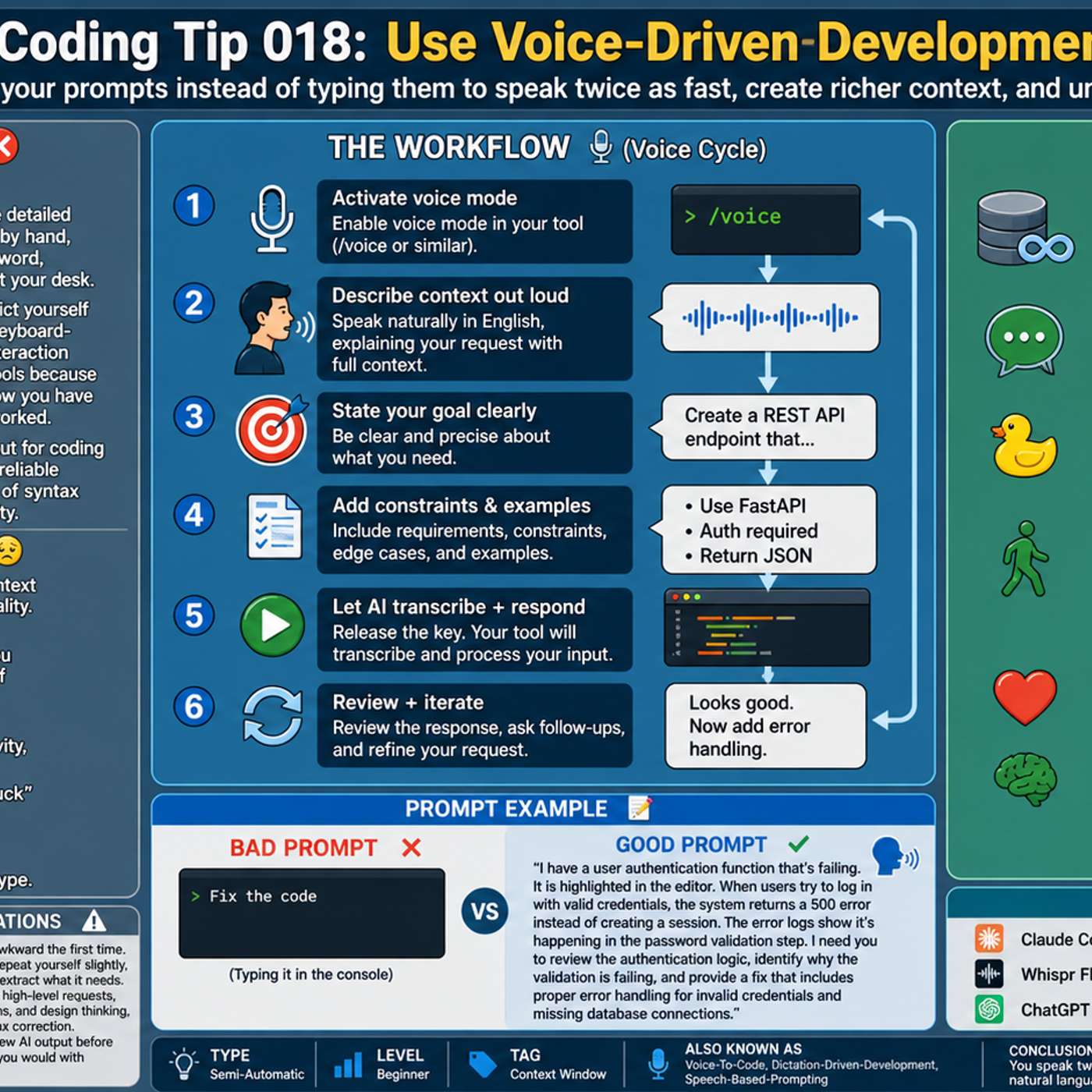
Dictating allows developers to remain in a "thinking mode" focused on the problem, rather than context-switching to the mechanical task of typing. This maintains uninterrupted mental focus on the problem, improving ideation and problem-solving.
Related Insights
Writing collaboratively with an AI can prevent the common habit of getting distracted between creative bursts. After reviewing a section, the AI's immediate prompt to start the next part acts as a psychological nudge, helping you maintain focus and momentum throughout a long project.

Instead of typing, dictating prompts for AI coding tools allows for faster and more detailed instructions. Speaking your thought process naturally includes more context and nuance, which leads to better results from the AI. Tools like Whisperflow are optimized with developer terminology for higher accuracy.

Instead of trying to code on mobile, Steve Newman uses his time away from the desk for high-level thinking. He dictates unstructured thoughts about a project into his phone, then simply pastes the entire "brain dump" into an LLM. The AI's task is to organize the ramble into a structured, actionable prompt for his coding agent.

Advanced speech-to-text apps like Whisperflow enable a new workflow: go for a walk, ramble your thoughts on a topic, and then feed the raw transcript to another AI to structure it into a polished blog post or book chapter, decoupling writing from a desk.

Dictation's primary benefit isn't just speed but enhanced ideation. Speaking is four times faster than typing, allowing thoughts to flow more freely. Use AI tools like Otter.ai or ChatGPT to capture more nuanced, deeper ideas that are often lost during the slower, more structured process of typing.

A significant, yet underestimated, productivity benefit of AI is its ability to handle logistical and administrative tasks seamlessly. This allows knowledge workers to avoid constant "context switching" and maintain a state of deep focus, or "flow." The gain comes not just from saving time on the tasks themselves, but from preserving the continuity of thought.
Gabor dictates long, detailed prompts to his AI agents. This allows him to provide significantly more context, nuance, and specific constraints than would be practical to type. The AI can parse the verbose input, leading to a much better-specified final product.

The process of verbally explaining a complex problem to an AI assistant helps developers uncover solutions on their own. This mirrors the traditional "rubber ducking" debugging technique, where vocalizing a problem clarifies one's thinking and reveals the solution.
Traditionally, engineers need long, uninterrupted blocks to achieve flow state. By managing context and generating code, AI helps engineers get into flow faster. This makes shorter, 45-minute work blocks viable and productive again, restructuring the ideal engineering workday.

Waiting for a single AI assistant to process requests creates constant start-stop interruptions. Using a tool like Conductor to run multiple AI coding agents in parallel on different tasks eliminates this downtime, helping developers and designers maintain a state of deep focus and productivity.