Get your free personalized podcast brief
We scan new podcasts and send you the top 5 insights daily.
A key operational detail of Kimi K3 is its locked "always-on" reasoning mode. The model consumes tokens for internal "thinking" processes, and these are billed at the expensive output rate of $15 per million. This makes it powerful for complex tasks but potentially wasteful and costly for simple lookups.

Related Insights
Fable 5's advanced reasoning comes at a steep cost, consuming tokens and rate limits at twice the speed of previous models. This is presented as an intentional design choice, forcing users to strategically decide if a task's complexity justifies the significant increase in operational expense.

With frontier models costing over 100x more than competent alternatives ($56 vs. 50¢ per million tokens), companies are burning cash. An estimated 98% of tasks sent to top-tier models don't require that power, an inefficiency driven by engineers who are disconnected from cost implications.

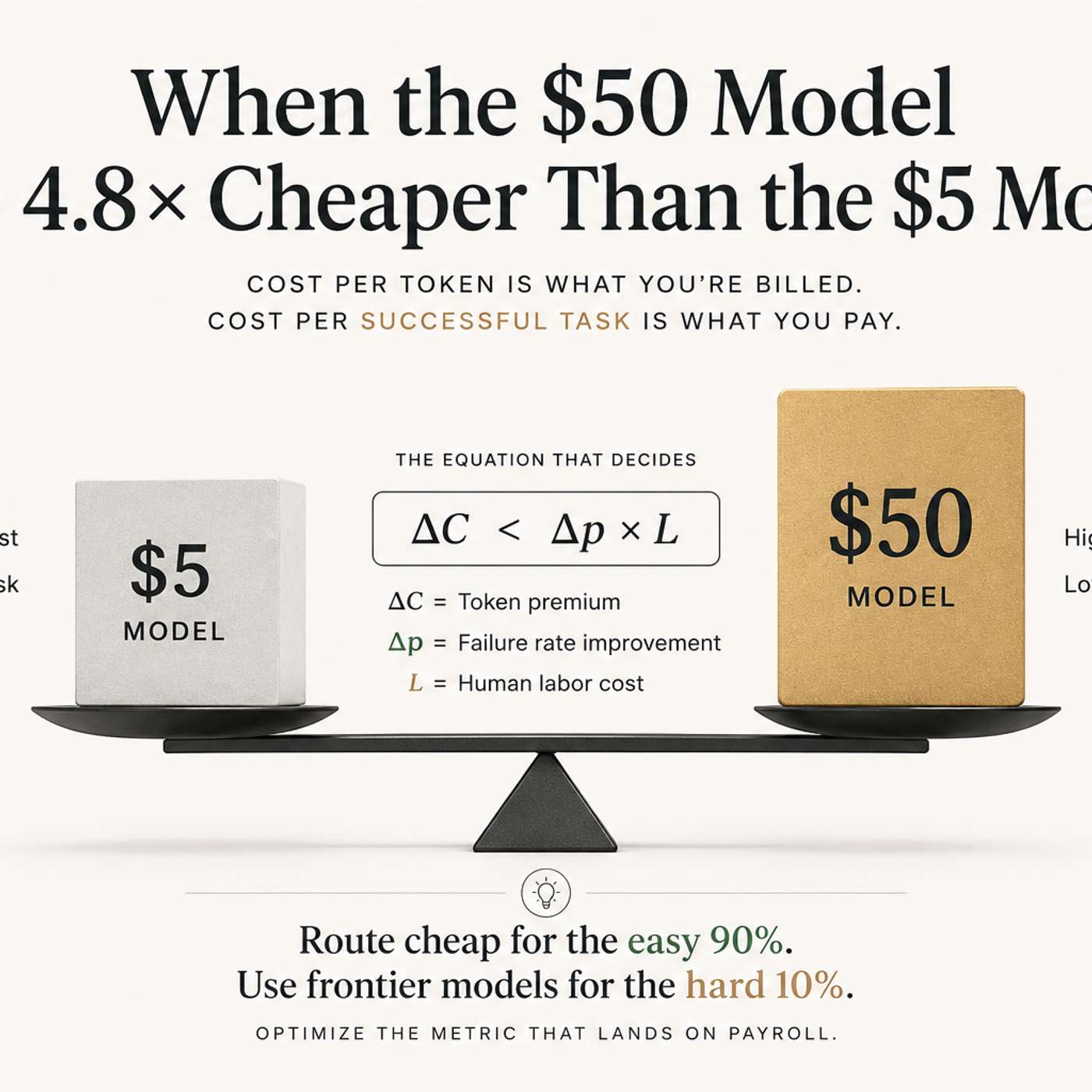
Newer AI models may have low per-token prices but are often "token hungry," requiring more tokens to complete a task. This can make them more expensive overall. The true measure of economic viability is the final cost-per-task, not the misleading per-token price.

Models that generate "chain-of-thought" text before providing an answer are powerful but slow and computationally expensive. For tuned business workflows, the latency from waiting for these extra reasoning tokens is a major, often overlooked, drawback that impacts user experience and increases costs.

Classifying a model as "reasoning" based on a chain-of-thought step is no longer useful. With massive differences in token efficiency, a so-called "reasoning" model can be faster and cheaper than a "non-reasoning" one for a given task. The focus is shifting to a continuous spectrum of capability versus overall cost.

The massive 2.8 trillion parameter count of Kimi K3 is misleading for cost analysis. Its Mixture of Experts (MOE) architecture activates only 16 of its 896 expert submodules per token. This makes the model computationally efficient and affordable for inference despite its enormous total capacity.
The binary distinction between "reasoning" and "non-reasoning" models is becoming obsolete. The more critical metric is now "token efficiency"—a model's ability to use more tokens only when a task's difficulty requires it. This dynamic token usage is a key differentiator for cost and performance.
A model with a low per-token price can be more expensive if it's inefficient, verbose, or requires multiple attempts ('overthinking'). The actual invoice depends on the total tokens needed to complete a task, making token efficiency a hidden multiplier that savvy enterprises are now tracking to determine the true cost.

To control inference costs, companies are implementing model routing systems. They differentiate between expensive tokens from frontier models for complex reasoning and cheaper tokens from fine-tuned open-source models for simpler workflow tasks. This tiered approach optimizes both performance and budget, avoiding "token maxing."

An optimal AI architecture routes tasks to different models based on complexity and risk. Simple, low-stakes work like data extraction should go to the cheapest models. Ambiguous, high-stakes work like system design warrants expensive frontier models, where preventing one engineering mistake justifies the premium token cost.