Get your free personalized podcast brief
We scan new podcasts and send you the top 5 insights daily.
Consumer AI queries filter cases before patients enter clinics, letting specialized staff focus solely on high-acuity interventions. Enhancing productivity across nursing and general care provides far more macroeconomic relief than optimizing software engineering.

Related Insights
While fears of AI-driven job loss are valid in some industries, healthcare faces a massive and growing supply-demand mismatch. With record shortages of clinicians and unlimited demand, AI is less a job destroyer and more a critical tool to augment existing workers.

The future of healthcare will see AI handling initial patient consultations, effectively becoming the primary care doctor. This will streamline the process, sending patients directly to specialized clinics for diagnostic tests, bypassing traditional, inefficient doctor visits.
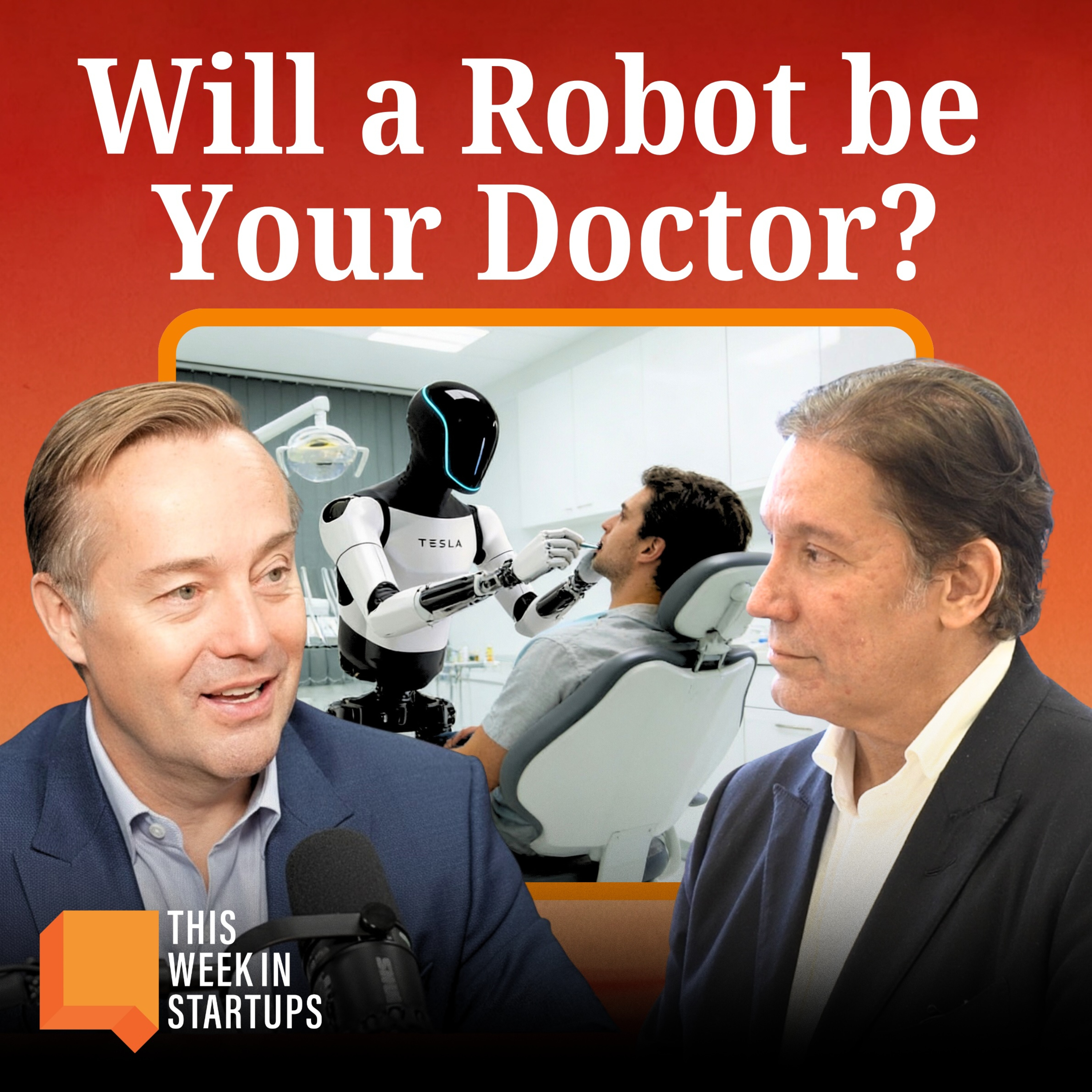
AI's most significant impact won't be on broad population health management, but as a diagnostic and decision-support assistant for physicians. By analyzing an individual patient's risks and co-morbidities, AI can empower doctors to make better, earlier diagnoses, addressing the core problem of physicians lacking time for deep patient analysis.

Doctronic's AI-native care platform dramatically increases physician productivity. By using AI to handle initial intake and summarization, doctors can see 15 or more patients an hour, compared to the traditional telehealth rate of four. This demonstrates AI's potential to address the supply-demand mismatch in healthcare.

The most effective AI strategy focuses on 'micro workflows'—small, discrete tasks like summarizing patient data. By optimizing these countless small steps, AI can make decision-makers 'a hundred-fold more productive,' delivering massive cumulative value without relying on a single, high-risk autonomous solution.

The most significant opportunity for AI in healthcare lies not in optimizing existing software, but in automating 'net new' areas that once required human judgment. Functions like patient engagement, scheduling, and symptom triage are seeing explosive growth as AI steps into roles previously held only by staff.
An effective AI strategy in healthcare is not limited to consumer-facing assistants. A critical focus is building tools to augment the clinicians themselves. An AI 'assistant' for doctors to surface information and guide decisions scales expertise and improves care quality from the inside out.

General-purpose AI like ChatGPT cannot solve complex, domain-specific healthcare problems. The key to success is specialization. Identify a single, high-friction bottleneck that wastes time and money, and focus all AI efforts on becoming the expert solution for that narrow problem.

The most tangible ROI for AI in healthcare today isn't in complex diagnostics, but in operational efficiency. AI scribes that free up doctors, intelligent call centers that triage patients correctly, and automated claim management are solving major bottlenecks and fighting burnout right now.
Instead of replacing doctors, AI will serve as a force multiplier for scarce General Practitioners. By automating paperwork and answering repetitive patient questions, AI frees doctors to focus on high-value human interaction and complex diagnosis.
