Get your free personalized podcast brief
We scan new podcasts and send you the top 5 insights daily.
The perceived intelligence of video generation models is often an illusion. The heavy lifting is done by a large language model that rewrites simple user prompts into highly detailed scenes. The video diffusion model itself is less intelligent, simply executing these detailed instructions literally.
Related Insights
Optimal results from AI vision models require model-specific prompting. Seedance V2 thrives on highly detailed prompts, especially for preserving character identity and motion. In contrast, models like Kling 3 can perform better with more straightforward, less verbose instructions, demonstrating there's no one-size-fits-all approach to prompting.

The quality and vision of an AI-generated video are determined more by the source reference images and videos than by the text prompt itself. Providing a strong visual reference gives the model a clear understanding of taste, style, and desired outcome, acting as a more powerful input than descriptive text alone.
The computational requirements for generative media scale dramatically across modalities. If a 200-token LLM prompt costs 1 unit of compute, a single image costs 100x that, and a 5-second video costs another 100x on top of that—a 10,000x total increase. 4K video adds another 10x multiplier.

Raw internet videos lack direct textual descriptions. To train a video model, teams must first create synthetic datasets by using VLMs or human labelers to generate detailed captions that precisely describe the visual content.
Traditional video models process an entire clip at once, causing delays. Descartes' Mirage model is autoregressive, predicting only the next frame based on the input stream and previously generated frames. This LLM-like approach is what enables its real-time, low-latency performance.

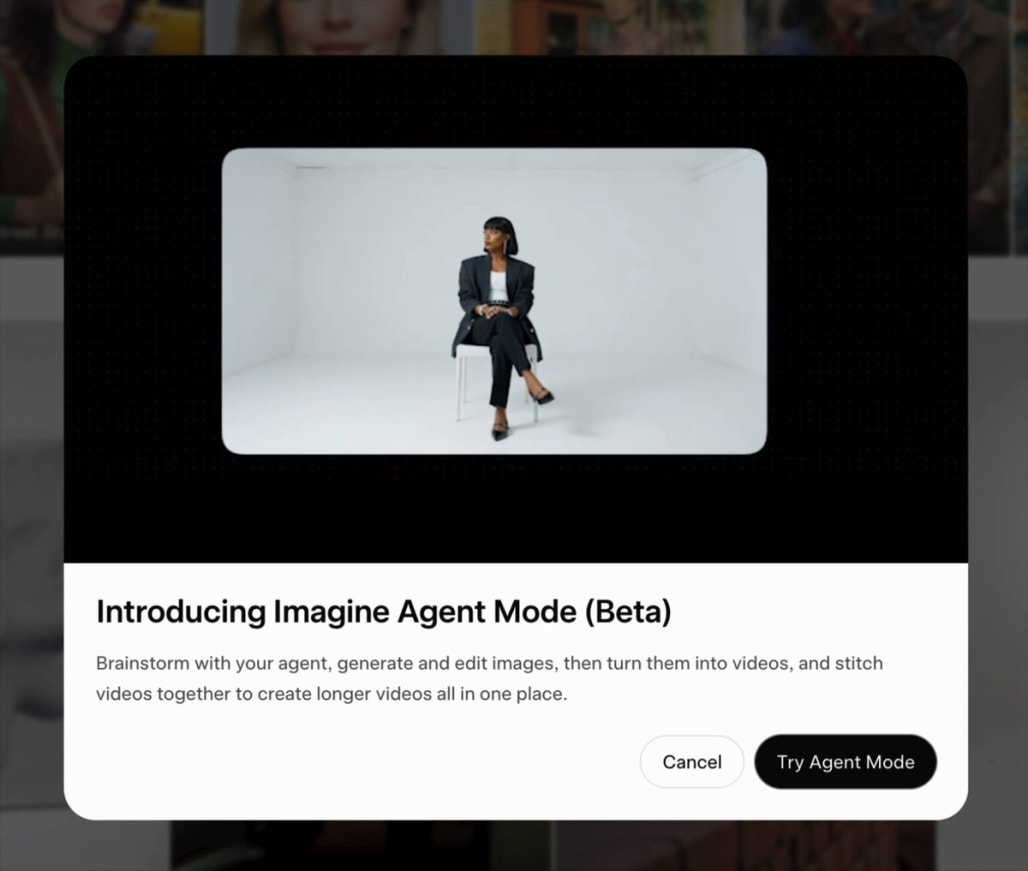
The next leap in video generation won't come from monolithic models but from AI agents. These LLM-driven agents will use a suite of tools—including diffusion models, video editors like FFmpeg, and image editors—to iteratively create and refine complex, long-form videos.
Avoid the "slot machine" approach of direct text-to-video. Instead, use image generation tools that offer multiple variations for each prompt. This allows you to conversationally refine scenes, select the best camera angles, and build out a shot sequence before moving to the animation phase.
Video models are bootstrapped from image models because the denser, cheaper language-to-image data provides a stronger foundation for understanding human intent, a prerequisite for complex video generation.
The primary challenge in creating stable, real-time autoregressive video is error accumulation. Like early LLMs getting stuck in loops, video models degrade frame-by-frame until the output is useless. Overcoming this compounding error, not just processing speed, is the core research breakthrough required for long-form generation.
The primary performance bottleneck for LLMs is memory bandwidth (moving large weights), making them memory-bound. In contrast, diffusion-based video models are compute-bound, as they saturate the GPU's processing power by simultaneously denoising tens of thousands of tokens. This represents a fundamental difference in optimization strategy.