Get your free personalized podcast brief
We scan new podcasts and send you the top 5 insights daily.
Instead of a single "AGI" event, AI progress is better understood in three stages. We're in the "powerful tools" era. The next is "powerful agents" that act autonomously. The final stage, "autonomous organizations" that outcompete human-led ones, is much further off due to capability "spikiness."

Related Insights
The most immediate AI milestone is not singularity, but "Economic AGI," where AI can perform most virtual knowledge work better than humans. This threshold, predicted to arrive within 12-18 months, will trigger massive societal and economic shifts long before a "Terminator"-style superintelligence becomes a reality.

A consortium including leaders from Google and DeepMind has defined AGI as matching the cognitive versatility of a "well-educated adult" across 10 domains. This new framework moves beyond abstract debate, showing a concrete 30-point leap in AGI score from GPT-4 (27%) to a projected GPT-5 (57%).
AI's impact on coding is unfolding in stages. Phase 1 was autocomplete (Copilot). We're now in Phase 2, defined by interactive agents where developers orchestrate tasks with prompts. Phase 3 will be true automation, where agents independently handle complete, albeit simpler, development workflows without direct human guidance.
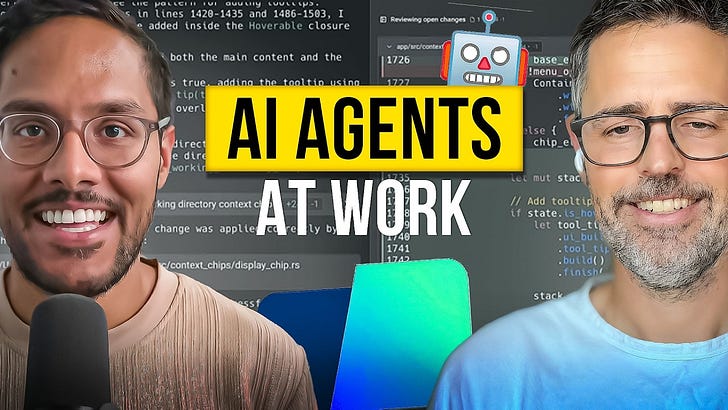
As AI evolves from single-task tools to autonomous agents, the human role transforms. Instead of simply using AI, professionals will need to manage and oversee multiple AI agents, ensuring their actions are safe, ethical, and aligned with business goals, acting as a critical control layer.

A key metric for AI progress is the size of a task (measured in human-hours) it can complete. This metric is currently doubling every four to seven months. At this exponential rate, an AI that handles a two-hour task today will be able to manage a two-week project autonomously within two years.

While current AI tools focus on individual productivity (e.g., coding faster), the real breakthrough will come from systems that improve organizational productivity. The next wave of AI will focus on how large teams of humans and AI agents coordinate on complex projects, a fundamentally different challenge than simply making one person faster.

All-AI organizations will struggle to replace human ones until AI masters a wide range of skills. Humans will retain a critical edge in areas like long-horizon strategy and metacognition, allowing human-AI teams to outperform purely AI systems, potentially until around 2040.
Despite marketing hype, current AI agents are not fully autonomous and cannot replace an entire human job. They excel at executing a sequence of defined tasks to achieve a specific goal, like research, but lack the complex reasoning for broader job functions. True job replacement is likely still years away.

The definition of AGI is a moving goalpost. Scott Wu argues that today's AI meets the standards that would have been considered AGI a decade ago. As technology automates tasks, human work simply moves to a higher level of abstraction, making percentage-based definitions of AGI flawed.
A useful mental model for AGI is child development. Just as a child can be left unsupervised for progressively longer periods, AI agents are seeing their autonomous runtimes increase. AGI arrives when it becomes economically profitable to let an AI work continuously without supervision, much like an independent adult.