Get your free personalized podcast brief
We scan new podcasts and send you the top 5 insights daily.
An ideal workflow separates probabilistic and deterministic tasks. Use an LLM agent for the creative front-end: helping users identify business constraints, research regulations, and formulate the problem. The agent then calls a dedicated mathematical optimization engine to generate a guaranteed, reliable, and explainable solution.
Related Insights
For core business automations, agentic AIs that "guess" are expensive and unreliable. A superior approach uses tools that convert natural language into deterministic, code-like workflows, which run consistently and use AI only when necessary.

LLMs can fail to follow critical instructions even when explicitly prompted, making them unsuitable for business decisions with 'hard constraints' like environmental regulations or budget limits. For high-stakes problems, mathematical optimization provides a defensible framework that guarantees constraints are never violated.
Fully autonomous agents are not yet reliable for complex production use cases because accuracy collapses when chaining multiple probabilistic steps. Zapier's CEO recommends a hybrid "agentic workflow" approach: embed a single, decisive agent within an otherwise deterministic, structured workflow to ensure reliability while still leveraging LLM intelligence.

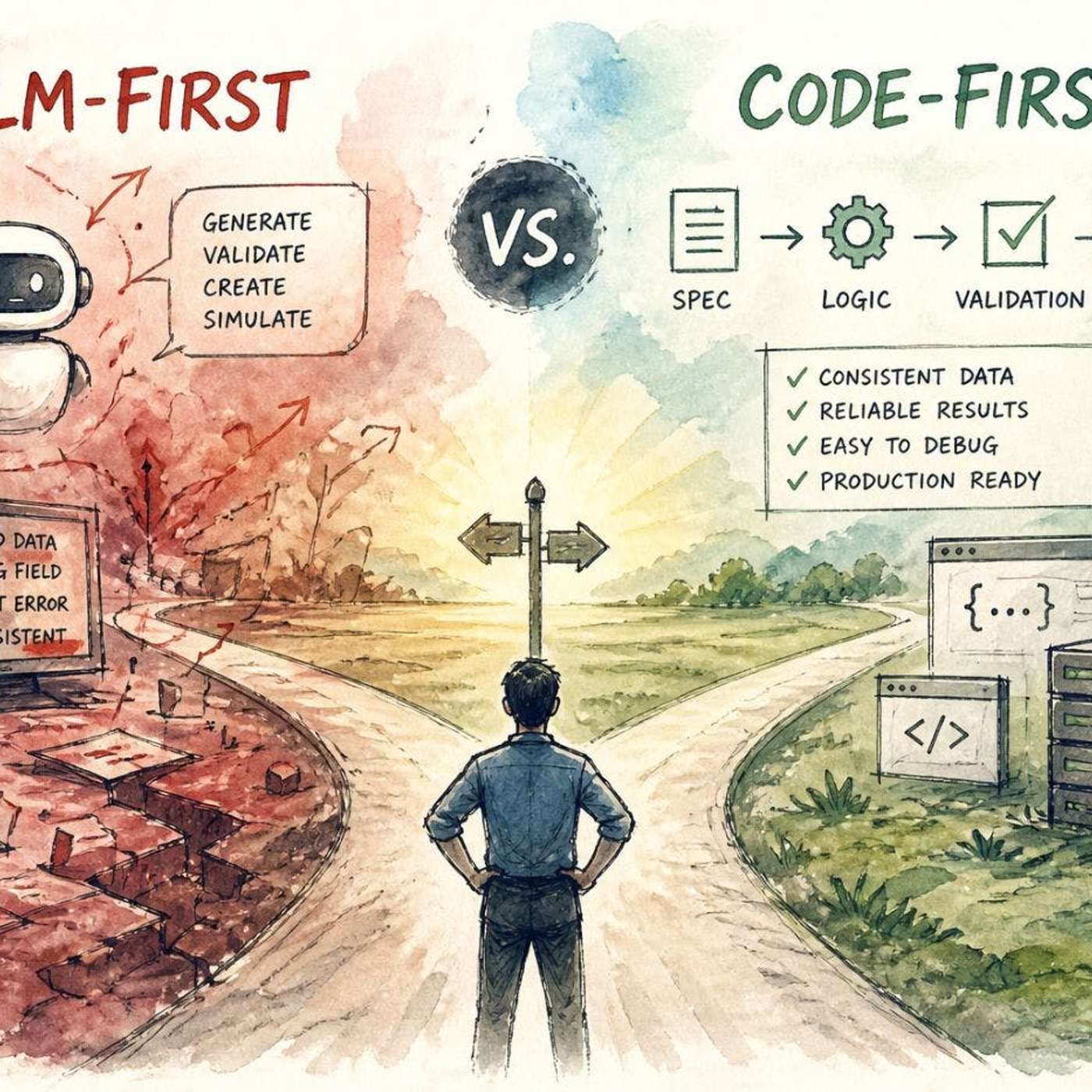
Don't give LLMs full control. Use deterministic code for core logic, validation, and enforcing rules. Delegate only tasks requiring flexibility or understanding of unstructured input to the LLM, treating it as a specialized component, not the entire system.
Rather than relying on a single LLM, LexisNexis employs a "planning agent" that decomposes a complex legal query into sub-tasks. It then assigns each task (e.g., deep research, document drafting) to the specific LLM best suited for it, demonstrating a sophisticated, model-agnostic approach for enterprise AI.
Designing a chip is not a monolithic problem that a single AI model like an LLM can solve. It requires a hybrid approach. While LLMs excel at language and code-related stages, other components like physical layout are large-scale optimization problems best solved by specialized graph-based reinforcement learning agents.

Use LLMs to help define business problems, write code, and identify potential constraints. Then, hand off to a mathematical solver like Gurobi, which provides a mathematically guaranteed optimal solution that an LLM cannot, as it will never violate a hard constraint.
Pega's CTO advises using the powerful reasoning of LLMs to design processes and marketing offers. However, at runtime, switch to faster, cheaper, and more consistent predictive models. This avoids the unpredictability, cost, and risk of calling expensive LLMs for every live customer interaction.

The most effective AI architecture for complex tasks involves a division of labor. An LLM handles high-level strategic reasoning and goal setting, providing its intent in natural language. Specialized, efficient algorithms then translate that strategic intent into concrete, tactical actions.

To deploy LLMs in high-stakes environments like finance, combine them with deterministic checks. For example, use a traditional algorithm to calculate cash flow and only surface the LLM's answer if it falls within an acceptable range. This prevents hallucinations and ensures reliability.
