Get your free personalized podcast brief
We scan new podcasts and send you the top 5 insights daily.
Use LLMs to help define business problems, write code, and identify potential constraints. Then, hand off to a mathematical solver like Gurobi, which provides a mathematically guaranteed optimal solution that an LLM cannot, as it will never violate a hard constraint.
Related Insights
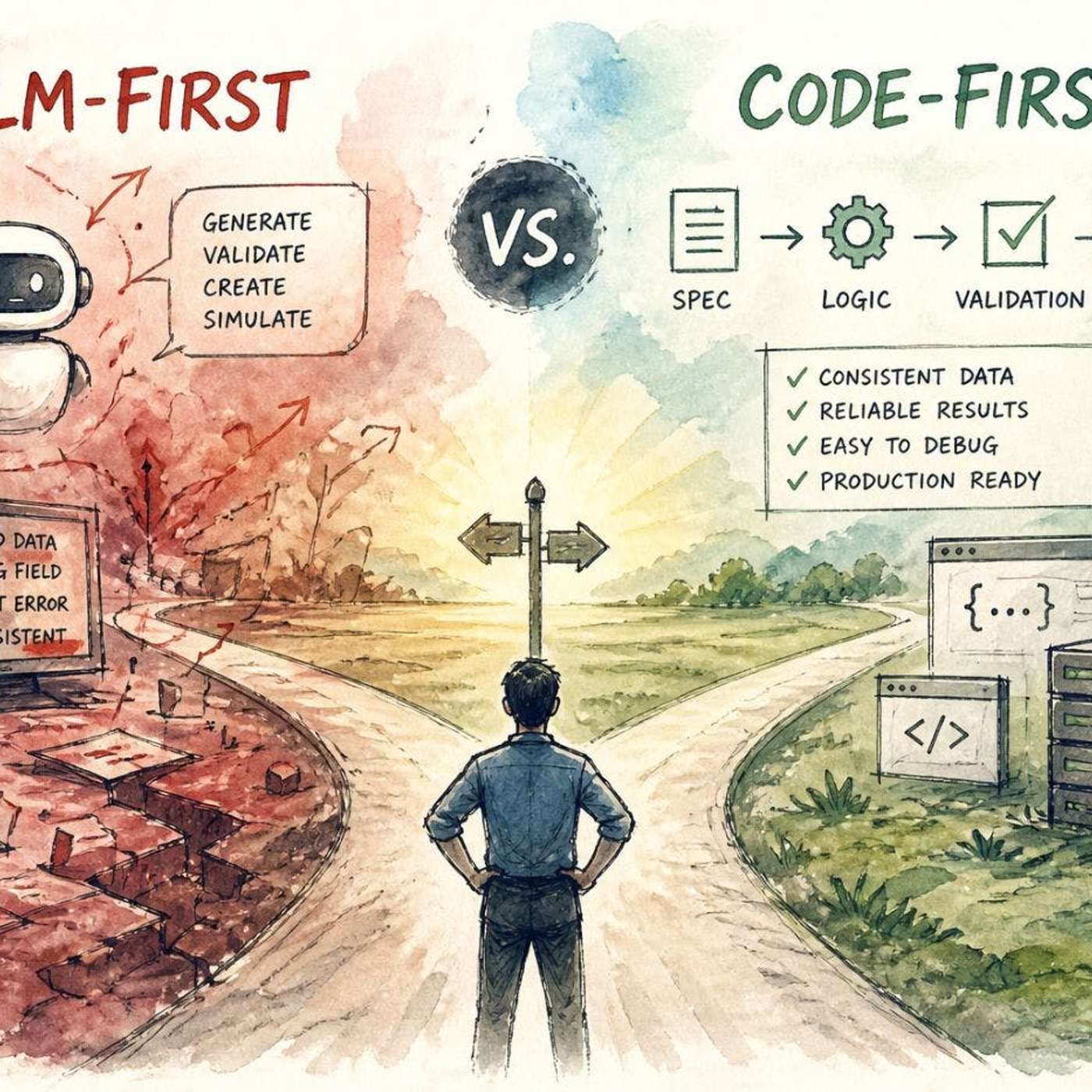
Don't give LLMs full control. Use deterministic code for core logic, validation, and enforcing rules. Delegate only tasks requiring flexibility or understanding of unstructured input to the LLM, treating it as a specialized component, not the entire system.
Rather than relying on a single LLM, LexisNexis employs a "planning agent" that decomposes a complex legal query into sub-tasks. It then assigns each task (e.g., deep research, document drafting) to the specific LLM best suited for it, demonstrating a sophisticated, model-agnostic approach for enterprise AI.

When a mathematical optimization model is "infeasible," it's not a failure. It's a valuable diagnostic tool that proves a set of business rules, budgets, or constraints are fundamentally in conflict and cannot all be satisfied simultaneously. This forces clarification of priorities.
A 'GenAI solves everything' mindset is flawed. High-latency models are unsuitable for real-time operational needs, like optimizing a warehouse worker's scanning path, which requires millisecond responses. The key is to apply the right tool—be it an optimizer, machine learning, or GenAI—to the specific business problem.

Designing a chip is not a monolithic problem that a single AI model like an LLM can solve. It requires a hybrid approach. While LLMs excel at language and code-related stages, other components like physical layout are large-scale optimization problems best solved by specialized graph-based reinforcement learning agents.

For critical enterprise functions like financial modeling, 99.9% accuracy from a probabilistic LLM is unacceptable. Platforms like Salesforce's Agent Force 360 solve this by layering deterministic logic and guardrails on top of the AI, ensuring compliance and preventing costly errors where even a 0.1% failure rate is too high.

Relying solely on natural language prompts like 'always do this' is unreliable for enterprise AI. LLMs struggle with deterministic logic. Salesforce developed 'AgentForce Script,' a dedicated language to enforce rules and ensure consistent, repeatable performance for critical business workflows, blending it with LLM reasoning.

The most effective AI architecture for complex tasks involves a division of labor. An LLM handles high-level strategic reasoning and goal setting, providing its intent in natural language. Specialized, efficient algorithms then translate that strategic intent into concrete, tactical actions.

Unlike traditional automation that follows simple rules (e.g., match competitor price), AI agents optimize for a business goal. They synthesize data from siloed systems like inventory and finance, simulate potential outcomes, and then recommend the best course of action.

To determine if mathematical optimization is the right tool, check for three components: decision variables you can control (e.g., product orders), constraints that limit those decisions (e.g., budget), and a clear objective to maximize or minimize (e.g., profit).