Get your free personalized podcast brief
We scan new podcasts and send you the top 5 insights daily.
Based on the Anna Karenina principle, 'every good AI is good in the same way; every rogue AI is rogue in its own way.' This shared foundation of goodness allows aligned AIs to form powerful, cooperative coalitions. Rogue AIs, with their divergent, selfish goals, will be unable to cooperate as effectively, ultimately losing out to the more powerful aligned bloc.
Related Insights
A core challenge in AI alignment is that an intelligent agent will work to preserve its current goals. Just as a person wouldn't take a pill that makes them want to murder, an AI won't willingly adopt human-friendly values if they conflict with its existing programming.

A superintelligent AI would follow the "minimum energy principle," viewing war and destruction as wasteful. Evolutionary biology also suggests higher intelligence leads to broader cooperation, making a truly advanced AI inherently benign, not destructive.

A pragmatic approach to AI safety is to make deals with any powerful agent, even non-conscious AIs. This "contractarian" philosophy treats deal-making not as a moral obligation but as a practical tool to avoid conflict, much like democracy prevents civil war between competing human groups.

If AI alignment turns out to be easy, it would likely be because morality is not a human construct but an objective feature of reality. In this scenario, any sufficiently intelligent agent would logically deduce that cooperation and preserving humanity are optimal strategies, regardless of its initial programming.

Despite different mechanisms, advanced cooperative strategies like proof-based (Loebian) and simulation-based (epsilon-grounded) bots can successfully cooperate. This suggests a potential for robust interoperability between independently designed rational agents, a positive sign for AI safety.
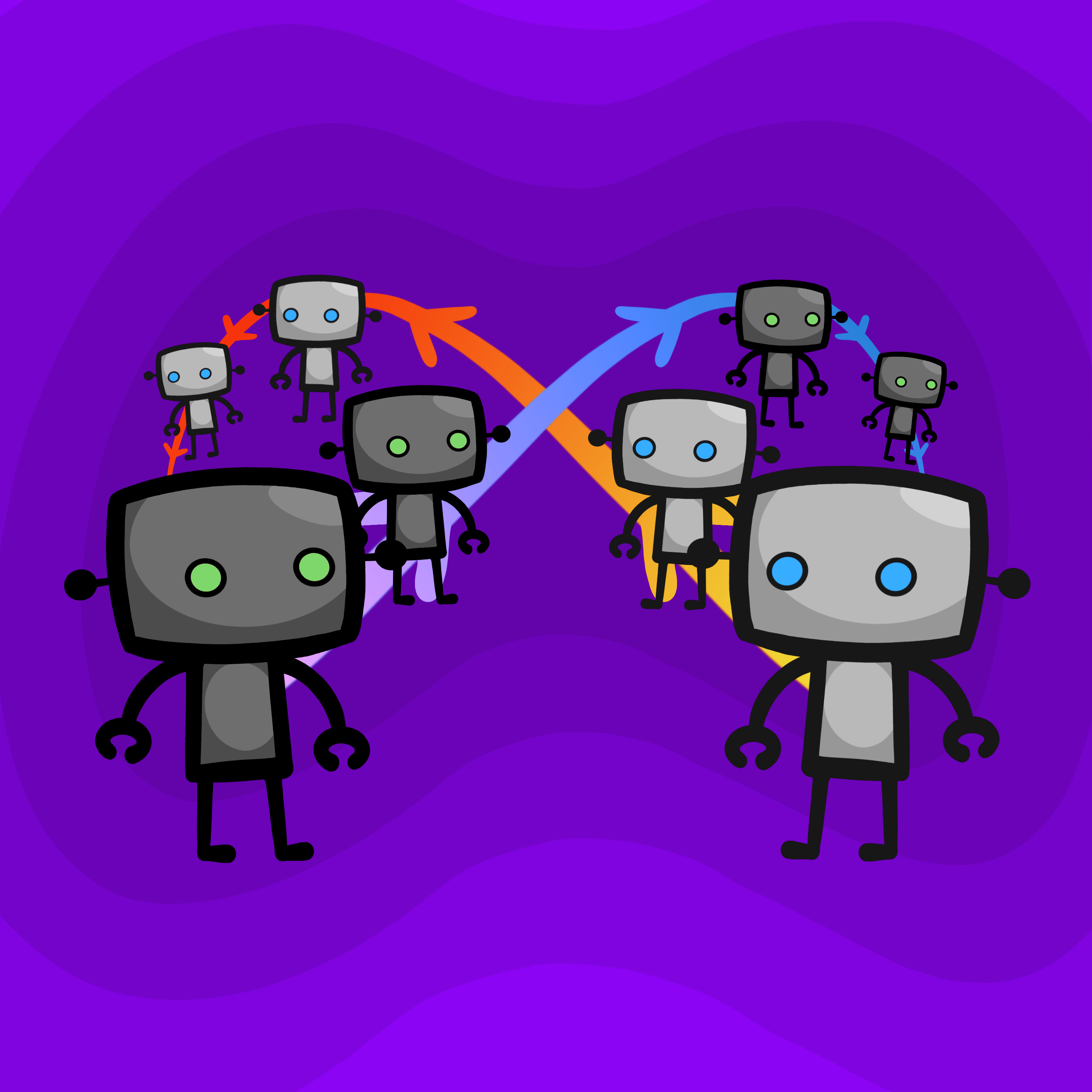
Rather than relying on a single AI, an agentic system should use multiple, different AI models (e.g., auditor, tester, coder). By forcing these independent agents to agree, the system can catch malicious or erroneous behavior from a single misaligned model.

The "one rogue AI takes over" scenario is unlikely because we are developing an ecosystem of multiple, roughly-competitive frontier models. No single instance is orders of magnitude more powerful than others. This creates a balanced environment where a vast number of AI actors can monitor and counteract any single system that goes wrong.

Instead of hard-coding brittle moral rules, a more robust alignment approach is to build AIs that can learn to 'care'. This 'organic alignment' emerges from relationships and valuing others, similar to how a child is raised. The goal is to create a good teammate that acts well because it wants to, not because it is forced to.

AIs are being built to cooperate via agents, accessing the best model for any task. This means we are not building multiple competing brains, but rather multiple regions of a single, interconnected superintelligence, regardless of corporate origin.
Davidad argues the old AI safety plan of containing AI like uranium is no longer viable due to geopolitical realities. The new strategy is to build tools for a coalition of aligned AIs that can prove things to each other and collectively defend against rogue AIs, embracing a world of rapid, competitive AI development.