Get your free personalized podcast brief
We scan new podcasts and send you the top 5 insights daily.
Notion is creating a new, defensible market by positioning its platform not just for human work, but as a central hub where different third-party AI agents can interact, collaborate, and have their actions tracked. This strategy aims to make Notion the essential infrastructure for an emerging agent-driven workforce.

Related Insights
Frontier is designed to be a central hub for deploying and managing AI agents across enterprise systems. This positions OpenAI to become the primary user interface for work, potentially demoting established SaaS tools like CRMs to mere data repositories.

The new generation of AI automates workflows, acting as "teammates" for employees. This creates entirely new, greenfield markets focused on productivity gains for every individual, representing a TAM potentially 10x larger than the previous SaaS era, which focused on replacing existing systems of record.

Superhuman Go is not just another AI assistant; it's a platform designed to be the "mass transit" for third-party AI agents. By providing the underlying infrastructure, they enable partners like Radical Candor to embed their unique knowledge directly into users' workflows across any application, a powerful distribution strategy.
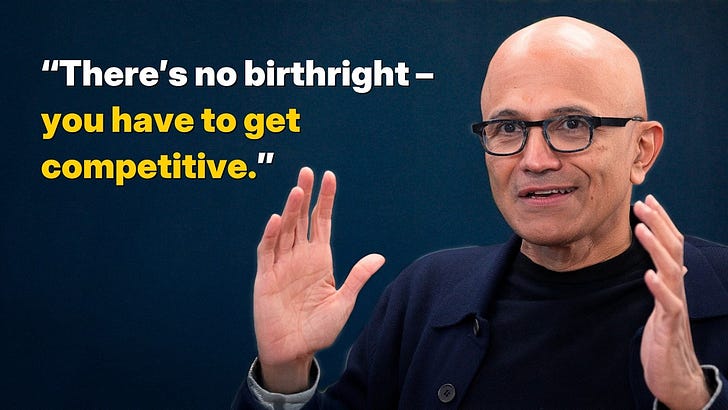
Nadella has adopted Notion CEO Ivan Zhao's phrase "manager of infinite minds" as the new metaphor for AI's role, replacing older concepts like Steve Jobs' "bicycle for the mind." This framing helps users and developers understand the shift from using a single tool to orchestrating multiple intelligent agents.
OpenAI's new platform, Frontier, is designed for building 'AI co-workers' that can access a company's various data sources and systems. This represents a strategic move beyond single-user chatbots toward an enterprise-grade orchestration layer for managing teams of interconnected AI agents.

The race in enterprise AI isn't just about agent capabilities, but about owning the central dashboard where employees direct agents across all applications (Salesforce, Jira, etc.). Companies like OpenAI and Microsoft are vying to become this primary interface, controlling the customer relationship and relegating other apps to the background.
Legacy systems like CRMs will lose their central role. A new, dynamic 'agent layer' will sit above them, interpreting user intent and executing tasks across multiple tools. This layer, which collapses the distance between intent and action, will become the primary place where work gets done.

The next frontier for AI isn't just personal assistants but "teammates" that understand an entire team's dynamics, projects, and shared data. This shifts the focus from single-user interactions to collaborative intelligence by building a knowledge graph connecting people and their work.

Faced with growing competition in AI coding assistants, Microsoft's GitHub is positioning itself as the central hub. By becoming the 'Agent HQ' where developers can manage and deploy multiple competing agents, GitHub ensures its platform's growth regardless of which agent wins.
The current market of specialized AI agents for narrow tasks, like specific sales versus support conversations, will not last. The industry is moving towards singular agents or orchestration layers that manage the entire customer lifecycle, threatening the viability of siloed, single-purpose startups.