Get your free personalized podcast brief
We scan new podcasts and send you the top 5 insights daily.
The New York Times test showing readers prefer AI writing misses the point. The critical question for professionals is determining when to use AI. A useful framework involves a spectrum from "all human" for personal, creative work where the process is the purpose, to "all machine" for repetitive, high-volume tasks.

Related Insights
While AI tools once gave creators an edge, they now risk producing democratized, undifferentiated output. IBM's AI VP, who grew to 200k followers, now uses AI less. The new edge is spending more time on unique human thinking and using AI only for initial ideation, not final writing.
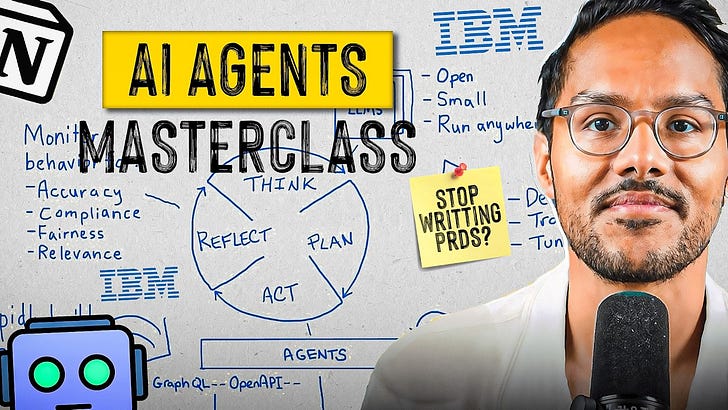
Generative AI is a powerful tool for accelerating the production and refinement of creative work, but it cannot replace human taste or generate a truly compelling core idea. The most effective use of AI is as a partner to execute a pre-existing, human-driven concept, not as the source of the idea itself.

To decide if AI is appropriate for a task, apply a simple filter. The work should involve structure, repetition, and context. Crucially, it must also be a task where human oversight is still possible and beneficial. If these conditions aren't met, using an AI tool may be inefficient or risky.

AI assistants are creating two classes of writing. The first is dense, information-transfer text (like a technical plan) best consumed and summarized by an agent. The second is storytelling with a personal "vibe" intended for human readership and emotional connection.

Medium's CEO argues that writing's future is secure because its core function is the process of structured thinking, not just content output. The act of articulating ideas reveals flaws and deepens understanding for the writer—a cognitive benefit that delegating to AI would eliminate.
Sam Altman argues the AI vs. human content debate is a false dichotomy. The dominant creative form will be a hybrid where humans use AI as a tool. Consumers will ultimately judge content on its quality and originality ('is it slop?'), not on its method of creation.

A New York Times blind taste test revealed that readers preferred AI-generated passages over human-written ones in literary fiction, fantasy, and science writing. This suggests AI has surpassed a critical quality threshold, moving beyond factual summarization to excel in nuanced, creative domains traditionally dominated by humans.

In an experiment, a professional writer's colleagues couldn't reliably distinguish his satirical column from an AI-generated one. Some even preferred the AI's version, calling it more coherent or closer to his style, revealing AI's startling ability to mimic and even improve upon creative human work.
The Atlantic's CEO Nick Thompson draws a clear line for AI in journalism. He advocates for using it extensively for reporting tasks like finding stories, analyzing data, or checking for chronological gaps. However, since a byline promises human authorship, AI should never write the final prose, even if it becomes a better writer.
The most effective way to use AI in creative fields is not as an automaton to generate final products, but as a tireless, hyper-knowledgeable writing partner. The human provides taste and direction, guiding the AI through back-and-forth exchanges to refine ideas and overcome creative blocks.
