Get your free personalized podcast brief
We scan new podcasts and send you the top 5 insights daily.
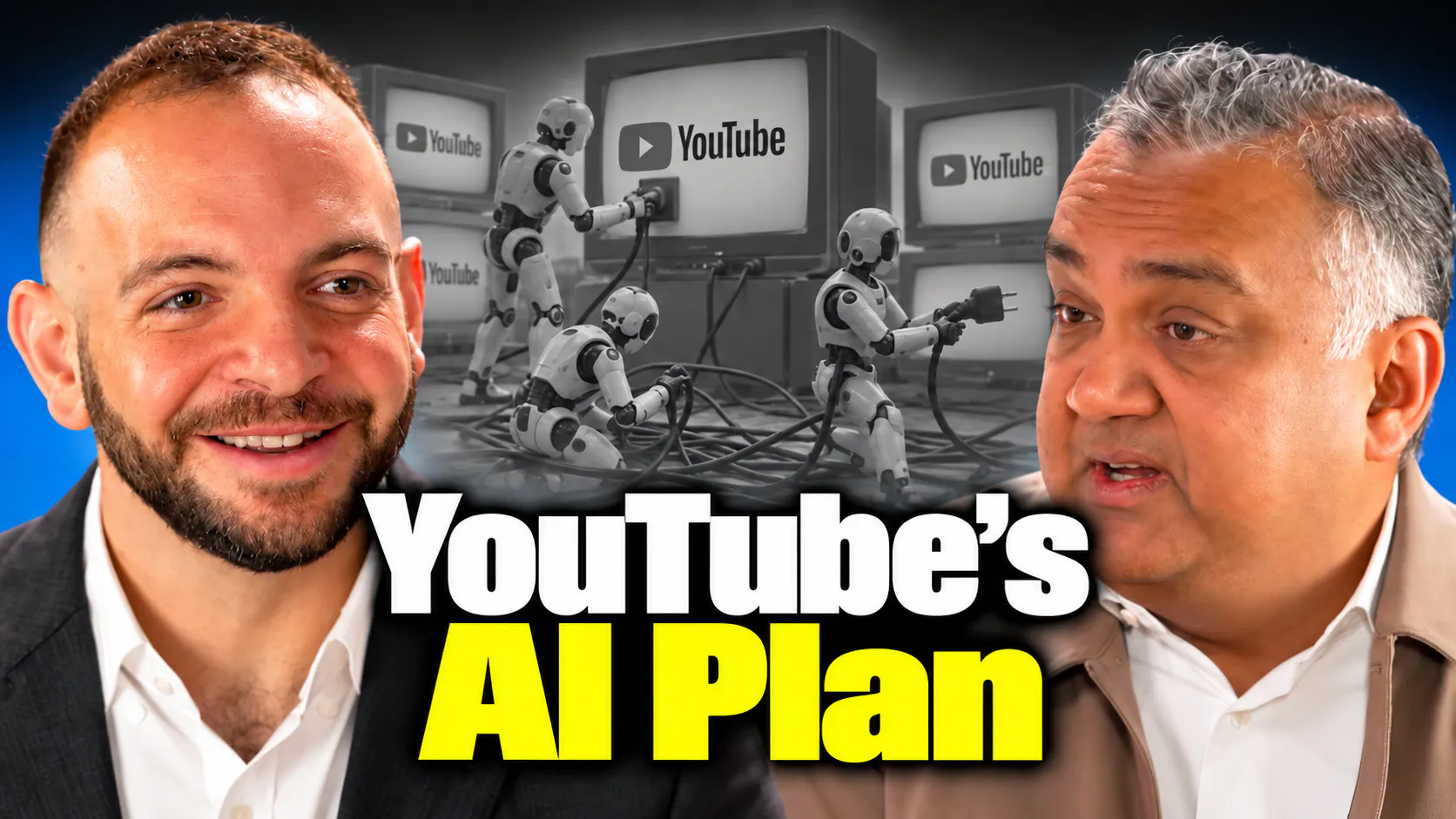
Mohan positions AI not as a tool that dictates creative choices, but as infrastructure that builds a better "stage" for creators. Its purpose is to help creators produce and distribute their work more efficiently, enhancing their capabilities rather than replacing their artistic vision.
Related Insights
AI doesn't replace creative experts; it elevates their role. Their craft shifts from manually creating individual assets to designing and building robust, reusable AI systems that empower the entire organization to generate on-brand content.

Neal Mohan reframes YouTube's recommendation engine as a direct reflection of audience choice, not an opaque AI gatekeeper. He argues that what is often called the "algorithm" is simply the collective voice of 2 billion daily viewers giving feedback and deciding what content rises to the top.
New AI tools make content creation easier than ever. However, this accessibility means the competitive advantage shifts from technical execution to the quality and originality of the core idea. Success now depends more on ideation, not just pressing a button.

The value of a creator is shifting from technical mastery of complex software to directing AI agents. The core skill is no longer tool proficiency but the ability to articulate and guide an AI towards a creative vision or story. The human becomes the director, not the technician.

As AI democratizes the technical aspects of content creation, the ability to guide it with unique perspective, craft, and taste becomes the key differentiator. AI is a powerful tool for experts to scale their vision, but it cannot replace the vision itself.
CEO Neal Mohan clarifies that YouTube will not penalize content simply for being AI-generated. The platform's policies focus on whether the content is high-quality and connects with viewers. The primary concern is preventing low-effort, mass-produced "AI slop," not discouraging the creative use of AI tools.
Instead of making artists obsolete, AI democratizes high-cost production. This empowers individual creators, making their unique taste and vision the key differentiator, rather than their ability to secure funding from traditional studios or capital aggregators.

The speaker argues against using AI for core creative tasks like scripting and idea generation, as it dilutes the human element audiences crave. Instead, AI should automate repeatable, mechanical tasks to free up time for human creativity.

Effective AI content strategy uses tools to handle first drafts and outlines, accelerating production and ensuring consistency. This frees up humans to perform the crucial roles of editing, shaping perspective, and injecting unique, lived experiences, which AI cannot replicate. The goal is amplification, not automation.

Instead of fearing replacement, view AI as a powerful creative partner. The host argues that the combination of human judgment and AI's processing power forms a dyad capable of producing completely novel work, making the human's role as a creative director more important than ever.