Get your free personalized podcast brief
We scan new podcasts and send you the top 5 insights daily.
Webflow's CPO uses a custom set of AI agents built with Claude and Cursor to analyze her calendar for delegation opportunities and triage her inbox by archiving junk, flagging important emails, and drafting replies. This offloads significant cognitive and administrative load from the executive.

Related Insights
To save time with busy clients, create a "synthetic" version in a GPT trained on their public statements and past feedback. This allows teams to get work 80-90% of the way to alignment internally, ensuring human interaction is focused on high-level strategy.
Use an AI assistant like Claude Code to create a persistent corporate memory. Instruct it to save valuable artifacts like customer quotes, analyses, and complex SQL queries into a dedicated Git repository. This makes critical, unstructured information easily searchable and reusable for future AI-driven tasks.

The problem with AI agents isn't getting them to work; it's managing their success. Once deployed, they operate 24/7, generating a high volume of responses and meetings. Your biggest challenge will shift from outreach capacity to your human team's ability to keep up with the AI's constant activity and output.
To discover high-value AI use cases, reframe the problem. Instead of thinking about features, ask, "If my user had a human assistant for this workflow, what tasks would they delegate?" This simple question uncovers powerful opportunities where agents can perform valuable jobs, shifting focus from technology to user value.
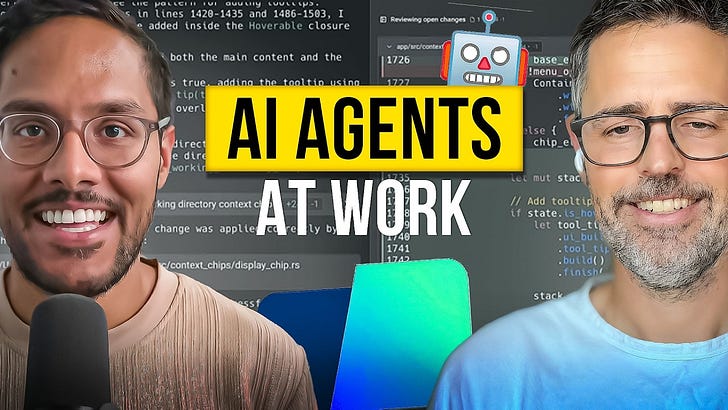
Vercel's CTO Malte Ubl suggests a simple method for finding valuable internal automation tasks: ask people, "What do you hate most about your job?" This uncovers tedious work that requires some human judgment, making it a perfect sweet spot for the capabilities of current-generation AI agents.

The term "agent" is overloaded. Claude Code agents excel at complex, immediate, human-supervised tasks (e.g., researching and writing a one-off PRD). In contrast, platforms like N8N or Lindy are better suited for building automated, recurring workflows that run on a schedule (e.g., daily competitor monitoring).

Go beyond just generating documents. PM Dennis Yang uses an AI agent in Cursor to read comments on a Confluence PRD, categorize them by priority, draft responses, and post them on his behalf. This automates the tedious but critical process of acknowledging and incorporating feedback.
To prevent constant interruptions from automated tasks, schedule recurring AI agents to align with your work week. For example, receive competitive research on Fridays before planning and support summaries on Mondays before the team meeting. This integrates agent output into your natural workflow.

Instead of holding context for multiple projects in their heads, PMs create separate, fully-loaded AI agents (in Claude or ChatGPT) for each initiative. These "brains" are fed with all relevant files and instructions, allowing the PM to instantly get up to speed and work more efficiently.
The paradigm shift with AI agents is from "tools to click buttons in" (like CRMs) to autonomous systems that work for you in the background. This is a new form of productivity, akin to delegating tasks to a team member rather than just using a better tool yourself.