Get your free personalized podcast brief
We scan new podcasts and send you the top 5 insights daily.
To prevent constant interruptions from automated tasks, schedule recurring AI agents to align with your work week. For example, receive competitive research on Fridays before planning and support summaries on Mondays before the team meeting. This integrates agent output into your natural workflow.
Related Insights
Integrate AI agents directly into core workflows like Slack and institutionalize them as the "first line of response." By tagging the agent on every new bug, crash, or request, it provides an initial analysis or pull request that humans can then review, edit, or build upon.
Treating AI coding tools like an asynchronous junior engineer, rather than a synchronous pair programmer, sets correct expectations. This allows users to delegate tasks, go to meetings, and check in later, enabling true multi-threading of work without the need to babysit the tool.
The problem with AI agents isn't getting them to work; it's managing their success. Once deployed, they operate 24/7, generating a high volume of responses and meetings. Your biggest challenge will shift from outreach capacity to your human team's ability to keep up with the AI's constant activity and output.
The most significant productivity gains come from applying AI to every stage of development, including research, planning, product marketing, and status updates. Limiting AI to just code generation misses the larger opportunity to automate the entire engineering process.

Before delegating a complex task, use a simple prompt to have a context-aware system generate a more detailed and effective prompt. This "prompt-for-a-prompt" workflow adds necessary detail and structure, significantly improving the agent's success rate and saving rework.
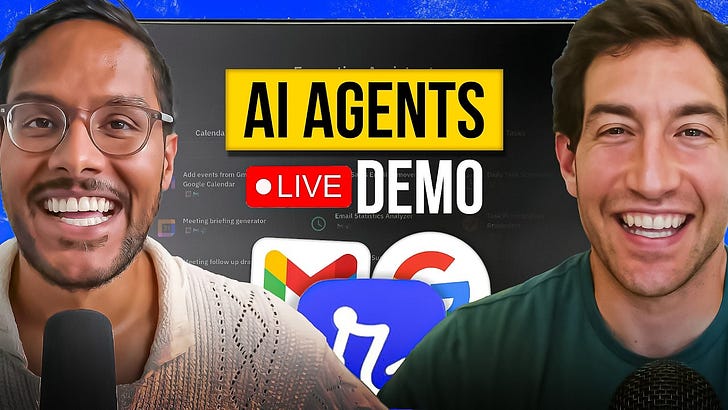
The term "agent" is overloaded. Claude Code agents excel at complex, immediate, human-supervised tasks (e.g., researching and writing a one-off PRD). In contrast, platforms like N8N or Lindy are better suited for building automated, recurring workflows that run on a schedule (e.g., daily competitor monitoring).

Instead of viewing AI collaboration as a manager delegating tasks, adopt the "surgeon" model. The human expert performs the critical, hands-on work while AI assistants handle prep (briefings, drafts) and auxiliary tasks. This keeps the expert in a state of flow and focused on their unique skills.

Instead of manually rereading notes to regain context after a break, instruct a context-aware AI to summarize your own recent progress. This acts as a personalized briefing, dramatically reducing the friction of re-engaging with complex, multi-day projects like coding or writing.
Go beyond using AI for research by codifying your North Star, OKRs, and strategic goals into a personalized AI agent. Before important meetings, use this agent as a 'thought partner' to pressure-test your ideas, check for alignment with your goals, and identify blind spots. This 10-minute exercise dramatically improves meeting focus and outcomes.
Adopt a 'more intelligent, more human' framework. For every process made more intelligent through AI automation, strategically reinvest the freed-up human capacity into higher-touch, more personalized customer activities. This creates a balanced system that enhances both efficiency and relationships.