Get your free personalized podcast brief
We scan new podcasts and send you the top 5 insights daily.
A world model has succeeded when a user in a VR headset can't distinguish between the headset's real-world "passthrough" camera feed and a fully generated, interactive environment. If you can interact with the world and are unsure if it's real or rendered, the model has passed the test.

Related Insights
Demis Hassabis notes that while generative AI can create visually realistic worlds, their underlying physics are mere approximations. They look correct casually but fail rigorous tests. This gap between plausible and accurate physics is a key challenge that must be solved before these models can be reliably used for robotics training.

Unlike video generation models that merely predict pixels, Moonlake argues a true world model must understand and predict the consequences of actions over time. This requires an abstracted, semantic understanding of the world, not just visual fidelity.
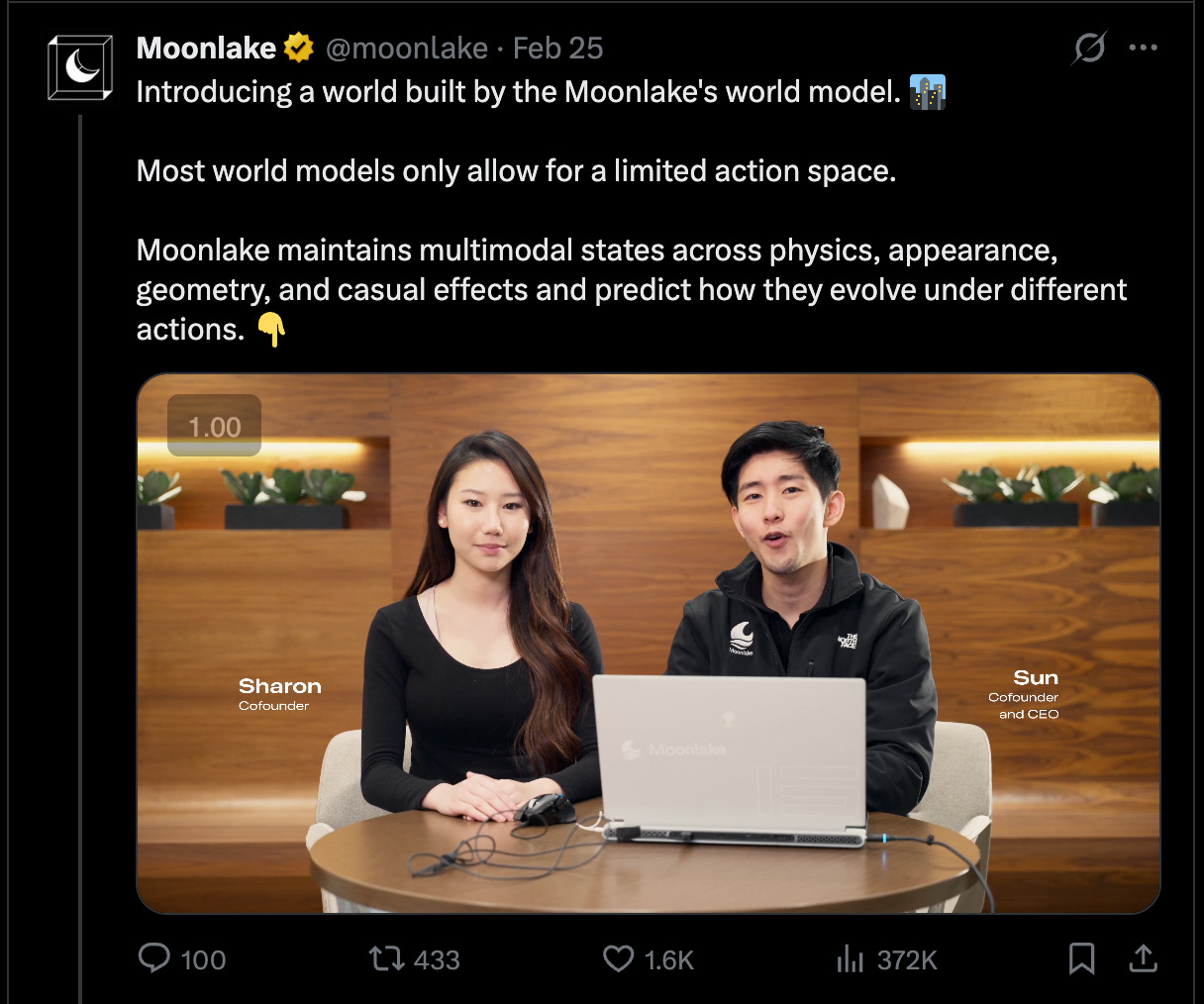
The speakers argue that complex generative systems like world models and even LLMs defy simple benchmarks. The ultimate measure of success is utility and user adoption—"people walking with their feet"—much like how consumers choose between GPT and Claude based on perceived value.
The development of camera controls for Runway's Gen 2 model sparked a key realization. Instead of just "creating" a video, users felt like they were "navigating" a 3D world. This subtle shift in user experience was the seed that grew into the company's entire research direction on world models.
Large language models are insufficient for tasks requiring real-world interaction and spatial understanding, like robotics or disaster response. World models provide this missing piece by generating interactive, reason-able 3D environments. They represent a foundational shift from language-based AI to a more holistic, spatially intelligent AI.

Moonlake uses a reasoning model for causality, physics, and game logic, while a separate diffusion model ("Reverie") renders this state into photorealistic visuals. This modularity allows for consistent interaction while offering aesthetic flexibility, described as "skins for worlds."
A "world model" transcends simple video generation. It is defined by three key capabilities: real-time responsiveness to user input (e.g., mouse clicks), long-horizon consistency over minutes or hours, and interactivity via multiple modalities like keyboard and voice.

World Labs posits that "world models"—AI focused on visual and physical understanding—represent a new general-purpose platform, similar to LLMs for text. These models can generate, simulate, and reconstruct physical worlds, with applications spanning from robotics and construction to entertainment and VR.

The "Interface World Model" treats software interfaces as real-time video. Instead of coding with HTML/CSS, developers can describe UI behavior in natural language. The model generates the interactive pixels directly, enabling rapid prototyping, exploration, and personalization.
Despite Fable 5.1's impressive capabilities, the release of WorldLab's Atlas—a model that generates video with pixel-perfect camera control and reconstructs 3D scenes—captured significantly more excitement. This suggests the next frontier capturing developers' imaginations may be in multimodal world simulation, not just better text generation.
