Get your free personalized podcast brief
We scan new podcasts and send you the top 5 insights daily.
Moonlake uses a reasoning model for causality, physics, and game logic, while a separate diffusion model ("Reverie") renders this state into photorealistic visuals. This modularity allows for consistent interaction while offering aesthetic flexibility, described as "skins for worlds."
Related Insights
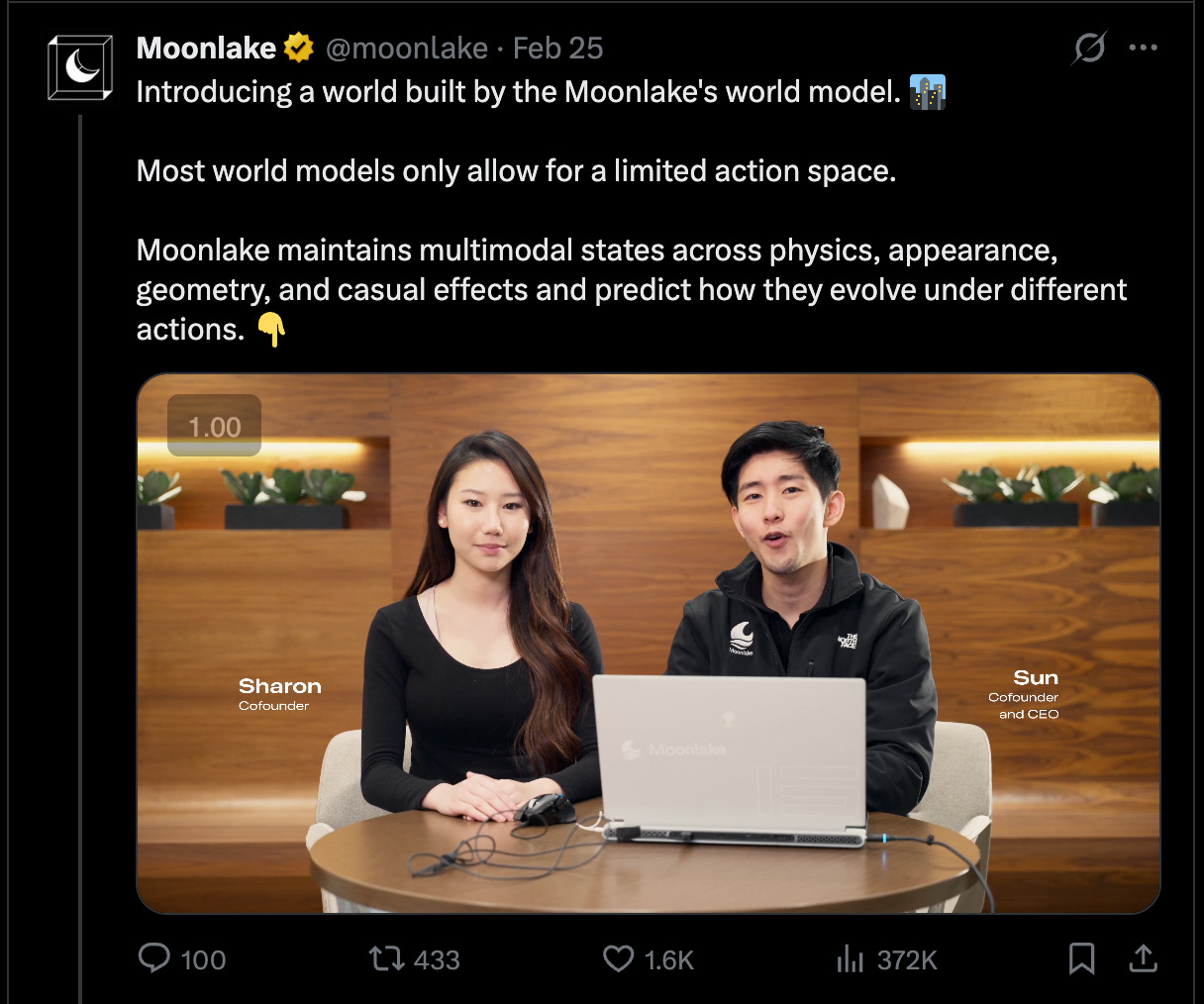
Unlike video generation models that merely predict pixels, Moonlake argues a true world model must understand and predict the consequences of actions over time. This requires an abstracted, semantic understanding of the world, not just visual fidelity.
Sora 2's most significant advancement is not its visual quality, but its ability to understand and simulate physics. The model accurately portrays how water splashes or vehicles kick up snow, demonstrating a grasp of cause and effect crucial for true world-building.

Instead of training a separate spatial audio model, Moonlake's AI leverages a game engine as a tool. The engine's built-in understanding of 3D space allows the model to generate correct spatial audio as a natural, emergent consequence of actions within the simulated world.
Startups and major labs are focusing on "world models," which simulate physical reality, cause, and effect. This is seen as the necessary step beyond text-based LLMs to create agents that can truly understand and interact with the physical world, a key step towards AGI.

Large language models are insufficient for tasks requiring real-world interaction and spatial understanding, like robotics or disaster response. World models provide this missing piece by generating interactive, reason-able 3D environments. They represent a foundational shift from language-based AI to a more holistic, spatially intelligent AI.

Their Reverie model is not just a post-processing filter; it integrates into the game loop itself. Game state changes can dynamically trigger changes in rendering, creating novel interactions where visuals become part of the game mechanics, not just static aesthetics.
To create persistent and interactive AI-generated worlds, Moon Lake uses a hybrid approach. It encodes deterministic rules and interactivity using symbolic representations like code, while leveraging pixel-based models only for the world's visual appearance. This allows for long-horizon memory and complex game mechanics that pixel-only models struggle with.

Instead of replacing entire systems with AI "world models," a superior approach is a hybrid model. Classical code should handle deterministic logic (like game physics), while AI provides a "differentiable" emergent layer for aesthetics and creativity (like real-time texturing). This leverages the unique strengths of both computational paradigms.

Instead of purely generative approaches, Moon Lake AI's strategy for creating interactive worlds involves using AI reasoning models to control and combine existing high-fidelity computer graphics tools. This is analogous to an LLM using a calculator, leveraging specialized tools for a more efficient and higher-quality outcome.

Great games are defined by their concept and gameplay, not just visual fidelity. Many successful games use primitive graphics, while visually stunning games often fail if mechanics are poor. This justifies focusing on a strong underlying world model that enables robust interaction.