Get your free personalized podcast brief
We scan new podcasts and send you the top 5 insights daily.
The often-opaque 'similarity score' in XGBoost has an intuitive explanation: it represents the difference between the variance of a dataset before a split and the sum of variances of the two resulting subsets. A high score means the split successfully created more homogeneous, lower-variance groups.

Related Insights
Analyze high-dimensional data by first using PCA to visualize it in 2-3 dimensions. Then, calculate Mahalanobis distance to quantify each condition's closeness to a target. Finally, use a decision tree to identify which factors drive that closeness, creating simple, interpretable if-then rules for stakeholders.

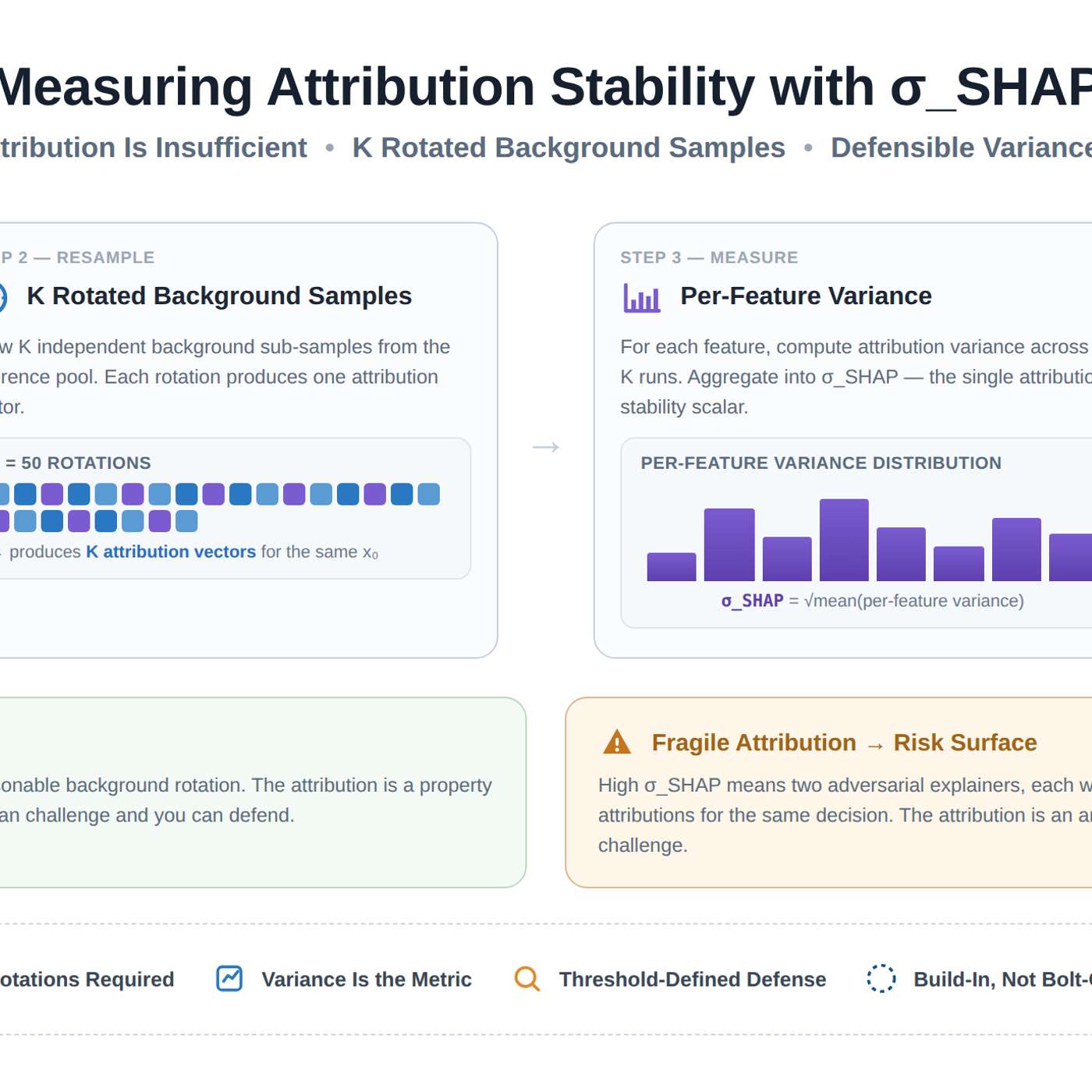
In regulated industries, the best model isn't always the most accurate. A model with slightly lower predictive performance but highly stable and defensible explanations is more valuable operationally. Attribution stability should be a key criterion in model selection, alongside traditional metrics like F1-score.
By identifying which concepts a dataset activates in a model, "predictive data debugging" anticipates which concepts the model will learn. This allows researchers to spot and filter anomalies in the data before they cause unwanted behavioral changes post-training.

Rather than building one deep, complex decision tree that would rely on increasingly smaller data subsets, MDT's model uses an ensemble method. It combines a 'forest' of many shallow trees, each with only two to five questions, to maintain statistical robustness while capturing complexity.

Instead of opaque 'black box' algorithms, MDT uses decision trees that allow their team to see and understand the logic behind every trade. This transparency is crucial for validating the model's decisions and identifying when a factor's effectiveness is decaying over time.
By analyzing a model predicting Alzheimer's, Goodfire discovered it relied on the length of cell-free DNA fragments—a previously overlooked signal. This demonstrates how interpretability can extract new, testable scientific hypotheses from high-performing "black box" models.
Data that measures success, like a grading rubric, is far more valuable for AI training than simple raw output. This 'second kind of data' enables iterative learning by allowing models to attempt a problem, receive a score, and learn from the feedback.

Contrary to the "more data is better" mantra, scaling with bad data actively degrades model performance. Undeduplicated data makes models "forgetful" and less intelligent over time. You cannot overcome poor data quality simply by adding more compute; better, cleaner data is more effective.

To overcome a small training set, researchers discretized continuous growth inhibition data into a binary (yes/no) classification. This simplified the learning task, enabling the model to achieve high predictive power where a more complex regression model would have failed due to insufficient data.

To optimize a complex biosimilar profile with many correlated attributes like glycoforms, use Mahalanobis distance. It calculates a single multivariate distance to the target profile, correctly accounting for inter-glycoform correlations, providing an objective, data-driven method for ranking experimental outcomes.