Get your free personalized podcast brief
We scan new podcasts and send you the top 5 insights daily.
By analyzing a model predicting Alzheimer's, Goodfire discovered it relied on the length of cell-free DNA fragments—a previously overlooked signal. This demonstrates how interpretability can extract new, testable scientific hypotheses from high-performing "black box" models.

Related Insights
Goodfire frames interpretability as the core of the AI-human interface. One direction is intentional design, allowing human control. The other, especially with superhuman scientific models, is extracting novel knowledge (e.g., new Alzheimer's biomarkers) that the AI discovers.
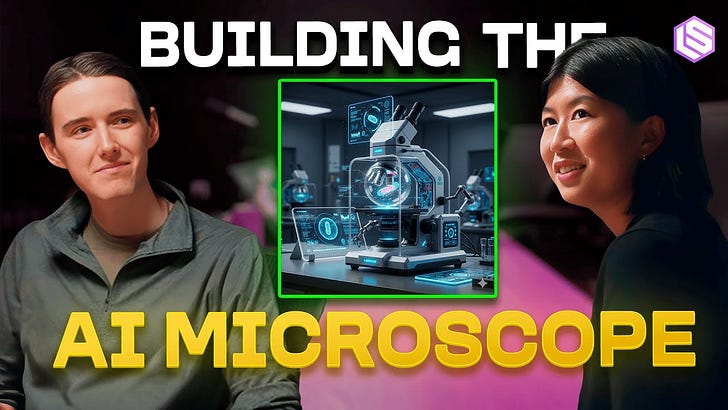
Just as biology deciphers the complex systems created by evolution, mechanistic interpretability seeks to understand the "how" inside neural networks. Instead of treating models as black boxes, it examines their internal parameters and activations to reverse-engineer how they work, moving beyond just measuring their external behavior.
As AI models are used for critical decisions in finance and law, black-box empirical testing will become insufficient. Mechanistic interpretability, which analyzes model weights to understand reasoning, is a bet that society and regulators will require explainable AI, making it a crucial future technology.

Goodfire AI found that for certain tasks, simple classifiers trained on a model's raw activations performed better than those using features from Sparse Autoencoders (SAEs). This surprising result challenges the assumption that SAEs always provide a cleaner concept space.
In partnership with institutions like Mayo Clinic, Goodfire applied interpretability tools to specialized foundation models. This process successfully identified new, previously unknown biomarkers for Alzheimer's, showcasing how understanding a model's internals can lead to tangible scientific breakthroughs.
For AI systems to be adopted in scientific labs, they must be interpretable. Researchers need to understand the 'why' behind an AI's experimental plan to validate and trust the process, making interpretability a more critical feature than raw predictive power.

Instead of pure academic exploration, Goodfire tests state-of-the-art interpretability techniques on customer problems. The shortcomings and failures they encounter directly inform their fundamental research priorities, ensuring their work remains commercially relevant.
Even when a model performs a task correctly, interpretability can reveal it learned a bizarre, "alien" heuristic that is functionally equivalent but not the generalizable, human-understood principle. This highlights the challenge of ensuring models truly "grok" concepts.
Goodfire AI defines interpretability broadly, focusing on applying research to high-stakes production scenarios like healthcare. This strategy aims to bridge the gap between theoretical understanding and the practical, real-world application of AI models.
A major frustration in genetics is finding 'variants of unknown significance' (VUS)—genetic anomalies with no known effect. AI models promise to simulate the impact of these unique variants on cellular function, moving medicine from reactive diagnostics to truly personalized, predictive health.