Get your free personalized podcast brief
We scan new podcasts and send you the top 5 insights daily.
As you manage a fleet of agents, you cannot manually review every output. Platforms like HyperAgent use "Rubrics"—an evaluation framework where one LLM judges another's work against predefined criteria. This automates quality control, which is essential for scaling an agent-first business.

Related Insights
An AI agent with access to work product can serve as an impartial manager. It can analyze performance quantitatively, like a sports coach reviewing game tape, and deliver feedback without the human biases, office politics, or emotional friction that complicates traditional performance reviews.

The key to enabling an AI agent like Ralph to work autonomously isn't just a clever prompt, but a self-contained feedback loop. By providing clear, machine-verifiable "acceptance criteria" for each task, the agent can test its own work and confirm completion without requiring human intervention or subjective feedback.
Your mental model for AI must evolve from "chatbot" to "agent manager." Systematically test specialized agents against base LLMs on standardized tasks to learn what can be reliably delegated versus what requires oversight. This is a critical skill for managing future workflows.

Treating AI evaluation like a final exam is a mistake. For critical enterprise systems, evaluations should be embedded at every step of an agent's workflow (e.g., after planning, before action). This is akin to unit testing in classic software development and is essential for building trustworthy, production-ready agents.
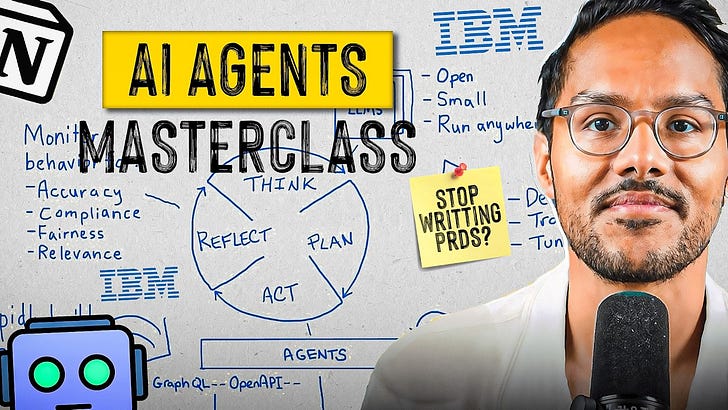
The frontier of AI training is moving beyond humans ranking model outputs (RLHF). Now, high-skilled experts create detailed success criteria (like rubrics or unit tests), which an AI then uses to provide feedback to the main model at scale, a process called RLAIF.

Notion treats its entire evaluation process as a coding agent problem. The system is designed for an agent to download a dataset, run an eval, identify a failure, debug the issue, and implement a fix, all within an automated loop. This turns quality assurance into a meta-problem for agents to solve.

A one-size-fits-all evaluation method is inefficient. Use simple code for deterministic checks like word count. Leverage an LLM-as-a-judge for subjective qualities like tone. Reserve costly human evaluation for ambiguous cases flagged by the LLM or for validating new features.

The prompts for your "LLM as a judge" evals function as a new form of PRD. They explicitly define the desired behavior, edge cases, and quality standards for your AI agent. Unlike static PRDs, these are living documents, derived from real user data and are constantly, automatically testing if the product meets its requirements.

As enterprises deploy agents for critical tasks like RFP generation or invoice processing, they will require dedicated evaluation frameworks and teams. This will create a massive new market for agent observability and eval tools, moving them beyond AI-native companies to the broader enterprise.
An agent's effectiveness is limited by its ability to validate its own output. By building in rigorous, continuous validation—using linters, tests, and even visual QA via browser dev tools—the agent follows a 'measure twice, cut once' principle, leading to much higher quality results than agents that simply generate and iterate.
