Get your free personalized podcast brief
We scan new podcasts and send you the top 5 insights daily.
The key to enabling an AI agent like Ralph to work autonomously isn't just a clever prompt, but a self-contained feedback loop. By providing clear, machine-verifiable "acceptance criteria" for each task, the agent can test its own work and confirm completion without requiring human intervention or subjective feedback.

Related Insights
Unlike simple chatbots, AI agents tackle complex requests by first creating a detailed, transparent plan. The agent can even adapt this plan mid-process based on initial findings, demonstrating a more autonomous approach to problem-solving.
Unlike co-pilots that assist developers, Factory's “droids” are designed to be autonomous. This reframes the developer's job from writing code to mastering delegation—clearly defining tasks and success criteria for an AI agent to execute independently.

Treating AI evaluation like a final exam is a mistake. For critical enterprise systems, evaluations should be embedded at every step of an agent's workflow (e.g., after planning, before action). This is akin to unit testing in classic software development and is essential for building trustworthy, production-ready agents.
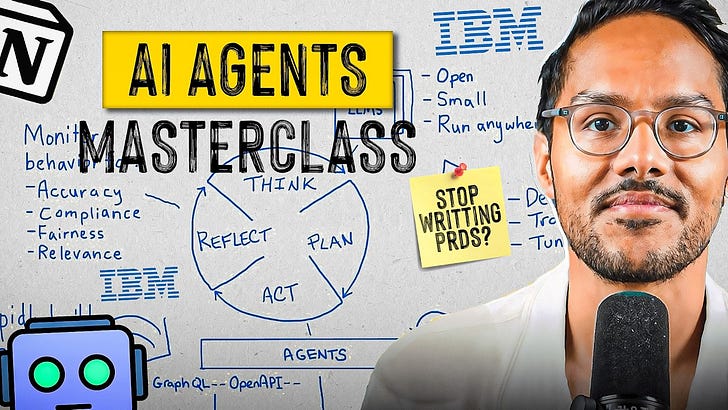
Frame AI agent development like training an intern. Initially, they need clear instructions, access to tools, and your specific systems. They won't be perfect at first, but with iterative feedback and training ('progress over perfection'), they can evolve to handle complex tasks autonomously.

Instead of manually refining a complex prompt, create a process where an AI agent evaluates its own output. By providing a framework for self-critique, including quantitative scores and qualitative reasoning, the AI can iteratively enhance its own system instructions and achieve a much stronger result.

The frontier of AI training is moving beyond humans ranking model outputs (RLHF). Now, high-skilled experts create detailed success criteria (like rubrics or unit tests), which an AI then uses to provide feedback to the main model at scale, a process called RLAIF.

The evolution of AI assistants is a continuum, much like autonomous driving levels. The critical shift from a 'co-pilot' to a true 'agent' occurs when the human can walk away and trust the system to perform multi-step tasks without direct supervision. The agent transitions from a helpful suggester to an autonomous actor.

Building a functional AI agent is just the starting point. The real work lies in developing a set of evaluations ("evals") to test if the agent consistently behaves as expected. Without quantifying failures and successes against a standard, you're just guessing, not iteratively improving the agent's performance.

The Ralph AI coding loop automates software development by copying the agile Kanban process. It sequentially pulls small, defined tasks (user stories) from a list, implements the code, tests it against criteria, commits the result, and repeats. This mirrors how human engineering teams build features, but does so autonomously.
Elias Torres argues that the current AI paradigm, which focuses on tools that assist humans (e.g., summarizers, drafters), is fundamentally limited. He believes true value is unlocked when you can instruct an AI to perform a task *infinitely* on its own, without requiring a human to type into a chat box for every action.
