Get your free personalized podcast brief
We scan new podcasts and send you the top 5 insights daily.
Your mental model for AI must evolve from "chatbot" to "agent manager." Systematically test specialized agents against base LLMs on standardized tasks to learn what can be reliably delegated versus what requires oversight. This is a critical skill for managing future workflows.

Related Insights
Instead of one monolithic agent, build a multi-agent system. Start with a simple classifier agent to determine user intent (e.g., sales vs. support). Then, route the request to a different, specialized agent trained for that specific task. This architecture improves accuracy, efficiency, and simplifies development.

As AI evolves from single-task tools to autonomous agents, the human role transforms. Instead of simply using AI, professionals will need to manage and oversee multiple AI agents, ensuring their actions are safe, ethical, and aligned with business goals, acting as a critical control layer.

True Agentic AI isn't a single, all-powerful bot. It's an orchestrated system of multiple, specialized agents, each performing a single task (e.g., qualifying, booking, analyzing). This 'division of labor,' mirroring software engineering principles, creates a more robust, scalable, and manageable automation pipeline.

Treating AI evaluation like a final exam is a mistake. For critical enterprise systems, evaluations should be embedded at every step of an agent's workflow (e.g., after planning, before action). This is akin to unit testing in classic software development and is essential for building trustworthy, production-ready agents.
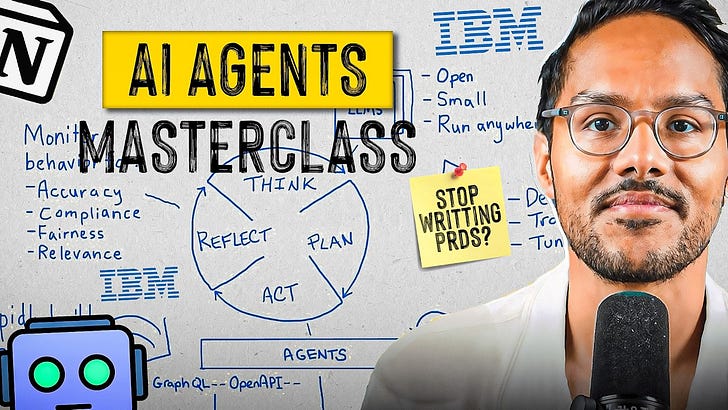
Building a functional AI agent is just the starting point. The real work lies in developing a set of evaluations ("evals") to test if the agent consistently behaves as expected. Without quantifying failures and successes against a standard, you're just guessing, not iteratively improving the agent's performance.

As businesses deploy multiple AI agents across various platforms, a new operations role will become necessary. This "Agent Manager" will be responsible for ensuring the AI workforce functions correctly—preventing hallucinations, validating data sources, and maintaining agent performance and integration.

Don't view AI tools as just software; treat them like junior team members. Apply management principles: 'hire' the right model for the job (People), define how it should work through structured prompts (Process), and give it a clear, narrow goal (Purpose). This mental model maximizes their effectiveness.
Instead of relying on a single, all-purpose coding agent, the most effective workflow involves using different agents for their specific strengths. For example, using the 'Friday' agent for UI tasks, 'Charlie' for code reviews, and 'Claude Code' for research and backend logic.

The next evolution of enterprise AI isn't conversational chatbots but "agentic" systems that act as augmented digital labor. These agents perform complex, multi-step tasks from natural language commands, such as creating a training quiz from a 700-page technical document.

Anthropic's upcoming 'Agent Mode' for Claude moves beyond simple text prompts to a structured interface for delegating and monitoring tasks like research, analysis, and coding. This productizes common workflows, representing a major evolution from conversational AI to autonomous, goal-oriented agents, simplifying complex user needs.