Get your free personalized podcast brief
We scan new podcasts and send you the top 5 insights daily.
The frontier of AI training is moving beyond humans ranking model outputs (RLHF). Now, high-skilled experts create detailed success criteria (like rubrics or unit tests), which an AI then uses to provide feedback to the main model at scale, a process called RLAIF.

Related Insights
A fascinating meta-learning loop emerged where an LLM provides real-time 'quality checks' to human subject-matter experts. This helps them learn the novel skill of how to effectively teach and 'stump' another AI, bridging the gap between their domain expertise and the mechanics of model training.

Effective enterprise AI deployment involves running human and AI workflows in parallel. When the AI fails, it generates a data point for fine-tuning. When the human fails, it becomes a training moment for the employee. This "tandem system" creates a continuous feedback loop for both the model and the workforce.

Treating AI evaluation like a final exam is a mistake. For critical enterprise systems, evaluations should be embedded at every step of an agent's workflow (e.g., after planning, before action). This is akin to unit testing in classic software development and is essential for building trustworthy, production-ready agents.
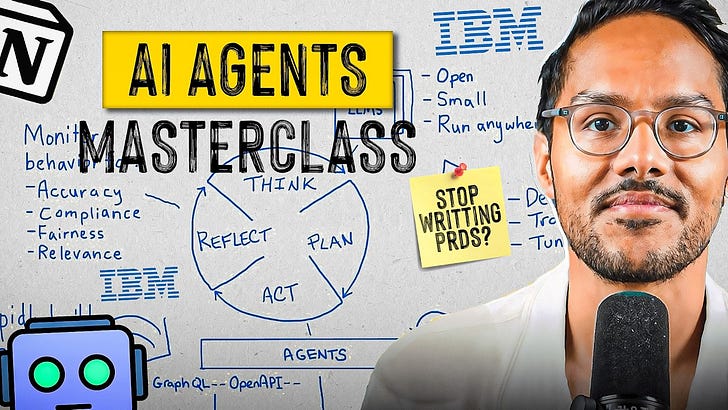
Instead of manually refining a complex prompt, create a process where an AI agent evaluates its own output. By providing a framework for self-critique, including quantitative scores and qualitative reasoning, the AI can iteratively enhance its own system instructions and achieve a much stronger result.

Beyond supervised fine-tuning (SFT) and human feedback (RLHF), reinforcement learning (RL) in simulated environments is the next evolution. These "playgrounds" teach models to handle messy, multi-step, real-world tasks where current models often fail catastrophically.

Reinforcement Learning with Human Feedback (RLHF) is a popular term, but it's just one method. The core concept is reinforcing desired model behavior using various signals. These can include AI feedback (RLAIF), where another AI judges the output, or verifiable rewards, like checking if a model's answer to a math problem is correct.

Companies like OpenAI and Anthropic are spending billions creating simulated enterprise apps (RL gyms) where human experts train AI models on complex tasks. This has created a new, rapidly growing "AI trainer" job category, but its ultimate purpose is to automate those same expert roles.
The primary bottleneck in improving AI is no longer data or compute, but the creation of 'evals'—tests that measure a model's capabilities. These evals act as product requirement documents (PRDs) for researchers, defining what success looks like and guiding the training process.
The prompts for your "LLM as a judge" evals function as a new form of PRD. They explicitly define the desired behavior, edge cases, and quality standards for your AI agent. Unlike static PRDs, these are living documents, derived from real user data and are constantly, automatically testing if the product meets its requirements.

As reinforcement learning (RL) techniques mature, the core challenge shifts from the algorithm to the problem definition. The competitive moat for AI companies will be their ability to create high-fidelity environments and benchmarks that accurately represent complex, real-world tasks, effectively teaching the AI what matters.
