Get your free personalized podcast brief
We scan new podcasts and send you the top 5 insights daily.
AI's impact on healthcare will be a bifurcation. One end will be hyper-efficient, low-cost, AI-driven telehealth. The other will be high-touch, relationship-based advanced primary care. The traditional, inefficient fee-for-service model in the middle will become obsolete, much like Amazon and luxury retail hollowed out department stores.

Related Insights
As AI automates administrative and clinical tasks, the U.S. economy may shift from services to a model based on community and connection. Healthcare could lead this by creating roles like paid caregivers and companions, funded through programs like Medicare Advantage.

The future of healthcare will see AI handling initial patient consultations, effectively becoming the primary care doctor. This will streamline the process, sending patients directly to specialized clinics for diagnostic tests, bypassing traditional, inefficient doctor visits.
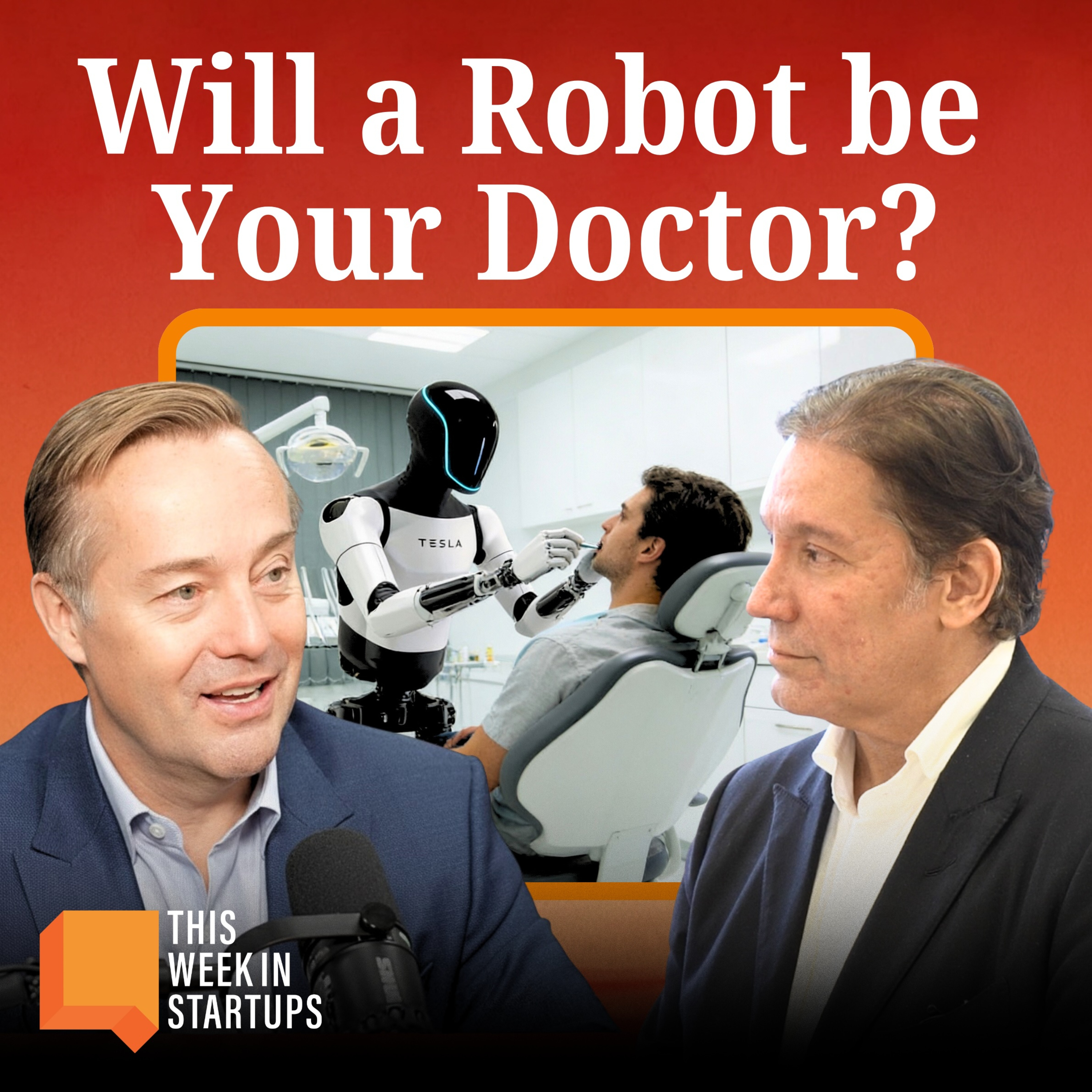
Healthcare has historically been a service, with costs tied to licensed professionals. AI models like Gemini and ChatGPT are changing this by providing medical advice, effectively turning healthcare into a product. This shift, currently tolerated by regulators, could dramatically lower costs and increase access, just like software products.

AI's most significant impact won't be on broad population health management, but as a diagnostic and decision-support assistant for physicians. By analyzing an individual patient's risks and co-morbidities, AI can empower doctors to make better, earlier diagnoses, addressing the core problem of physicians lacking time for deep patient analysis.

The next evolution in personalized medicine will be interoperability between personal and clinical AIs. A patient's AI, rich with daily context, will interface with their doctor's AI, trained on clinical data, to create a shared understanding before the human consultation begins.
Doctronic's AI-native care platform dramatically increases physician productivity. By using AI to handle initial intake and summarization, doctors can see 15 or more patients an hour, compared to the traditional telehealth rate of four. This demonstrates AI's potential to address the supply-demand mismatch in healthcare.

The most significant opportunity for AI in healthcare lies not in optimizing existing software, but in automating 'net new' areas that once required human judgment. Functions like patient engagement, scheduling, and symptom triage are seeing explosive growth as AI steps into roles previously held only by staff.
While clinical AI is promising, the most immediate ROI is in tackling the $1 trillion in administrative waste (20-25% of total costs). AI can automate friction points like scheduling and prior authorizations, directly improving the patient experience and bending the cost curve.

The widespread use of AI for health queries is set to change doctor visits. Patients will increasingly arrive with AI-generated analyses of their lab results and symptoms, turning appointments into a three-way consultation between the patient, the doctor, and the AI's findings, potentially improving diagnostic efficiency.

Instead of replacing doctors, AI will serve as a force multiplier for scarce General Practitioners. By automating paperwork and answering repetitive patient questions, AI frees doctors to focus on high-value human interaction and complex diagnosis.
